


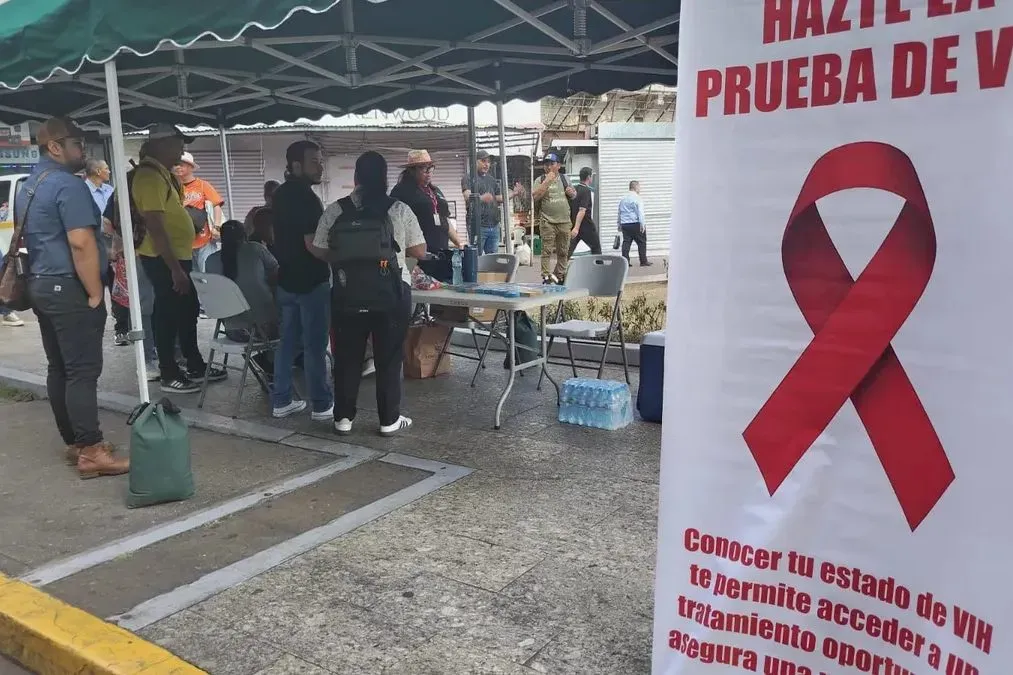
Health workers in Panama City administered more than 100 free rapid tests for HIV, syphilis, and hepatitis C in a public square this week. The Metropolitan Health Region organized the preventive campaign ahead of the capital’s Carnival festivities to curb potential increases in sexually transmitted infections. Officials focused on public education and reducing barriers to diagnostic services during a period of heightened social activity.
The testing drive took place at the historic Plaza 5 de Mayo, a central location chosen for its high public visibility. Teams from the Regional Laboratory and the ITS/HIV/AIDS Program led the effort, offering confidential counseling alongside the screenings. This proactive outreach forms part of a broader strategy to integrate preventive healthcare into community spaces, especially before major public holidays.
“A key protection mechanism is using a condom. People should also avoid risky sexual relations. If someone plans to be intimate with a person they do not know well or whose health status is unknown, it is better to protect themselves with a condom,” said Dr. Jonathan Guerra, head of Regional Public Health. [Translated from Spanish]
The immediate goal is to empower residents with knowledge and tools before the Carnival celebrations begin. Health authorities plan to maintain similar vigilance at health centers throughout the holiday period. They aim to prevent the seasonal spike in infections that often follows large-scale festivals where alcohol consumption and spontaneous encounters may increase.
Combating Stigma Through Accessible Testing
Beyond testing, campaign leaders emphasized the importance of responsible behavior and fighting the social shame associated with screening. Yuriseth Nelson, coordinator of the ITS/HIV/AIDS Program, stressed that protection is a continuous responsibility. She argued that fear should be directed at unknown health status, not at the test itself.
“It is important that during the Carnival parties people protect themselves from all sexually transmitted infections through the use of condoms,” Nelson stated. [Translated from Spanish] She added, “With these activities we seek to give the population greater access to tests and eliminate the stigma of getting an HIV test. People should fear not knowing their serological status more than the test.” [Translated from Spanish]
Her comments highlight a dual approach combining practical prevention with psychological support. Making testing routine and publicly available helps normalize it as a standard part of healthcare. This is critical for early detection and treatment, which improves individual outcomes and reduces community transmission rates.
Metropolitan Region Data Informs Public Health Strategy
The campaign unfolds against a backdrop of concrete local health data. The Metropolitan Health Region recorded 497 new cases of HIV in 2025. That figure included 27 cases diagnosed in pregnant women. These statistics drive the urgency behind preventive outreach, particularly in dense urban areas.
Authorities confirmed that testing for a range of sexually transmitted infections (STIs) remains freely available at metropolitan health centers year-round. Available screenings cover HIV, syphilis, hepatitis B, and hepatitis C. The recent public event was designed to complement those fixed services by meeting people where they gather.
Public health experts note that early diagnosis of these infections is crucial. Effective treatments exist that can manage HIV as a chronic condition and cure infections like syphilis and hepatitis C. Undetected, these diseases can lead to severe long-term health complications and increase the risk of unknowingly infecting others. The Ministry of Health’s strategy relies on constant public messaging paired with accessible, de-stigmatized testing opportunities.
As Carnival approaches, the message from Panama City’s health network is clear. Protection and awareness are the foundation of a safe celebration. Officials hope the visibility of testing in Plaza 5 de Mayo reminds citizens that health services are available and that prevention is a shared community responsibility.