


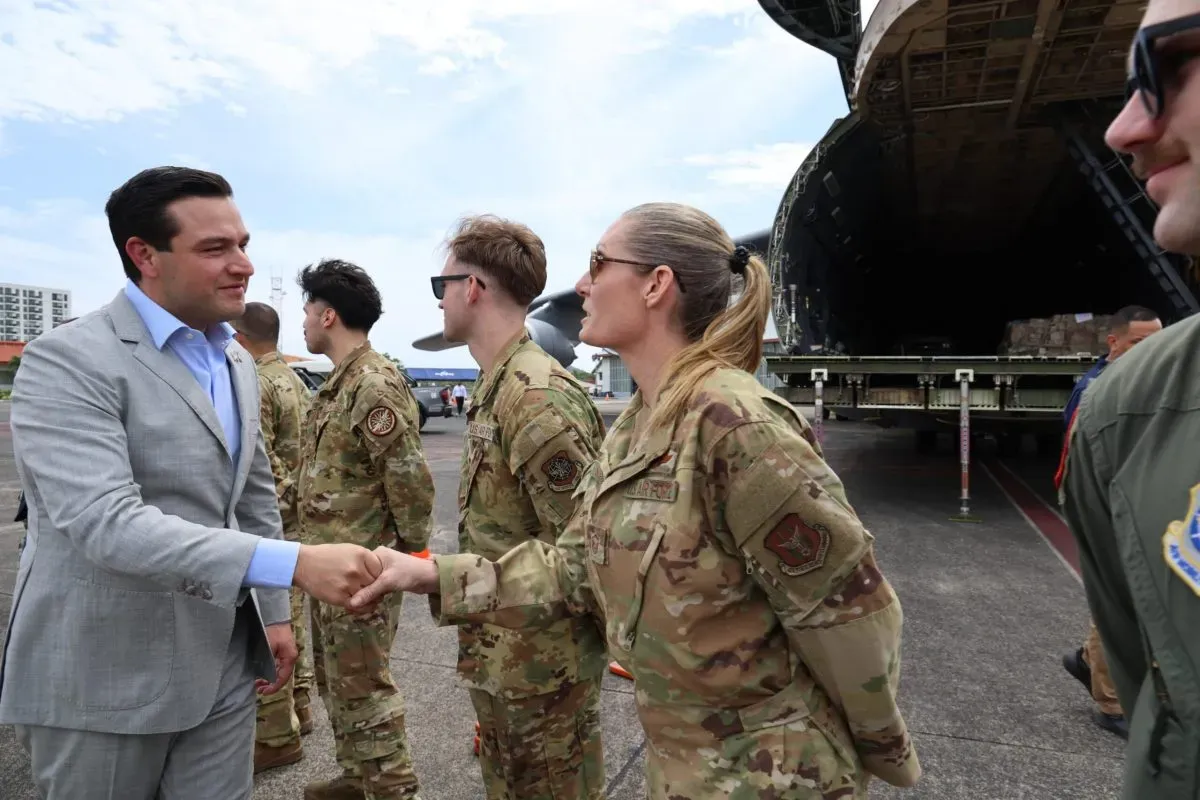
U.S. Ambassador Kevin Marino Cabrera delivered a major shipment of medical aid to Panama’s Ministry of Health on December 12. The donation, valued at 75,000 dollars, included 4,000 pounds of medications and supplies transported directly by a U.S. Air Force C-5 aircraft to Panama Pacifico Airport.
This direct aid forms a key part of the bilateral Juntos por la Salud medical initiative. Officials said the shipment exemplifies a strategy focused on delivering tangible results through efficient, government-to-government cooperation.
Ambassador Cabrera emphasized the direct nature of the support during the handover ceremony. He was joined by Panama’s Minister of Health, Dr. Fernando Boyd Galindo, and representatives from U.S. Southern Command.
“Today’s direct delivery from SOUTHCOM to Panama’s Ministry of Health is exactly what Secretary Rubio’s America First Global Health Strategy is all about,” said Ambassador Cabrera. [Translated from Spanish] “Under President Trump, we are cutting out bloated NGOs and bureaucratic middlemen and putting resources directly into the hands of Panamanian doctors and patients.”
The ambassador outlined the immediate impact of the donation. He noted the supplies will treat conditions like hypertension and diabetes for thousands of Panamanian patients starting immediately.
Contents and Direct Impact of the Medical Donation
Specific medications in the shipment target high blood pressure, infections, diabetes, and pain management. The donation also contains specialized dental and veterinary supplies for upcoming missions scheduled through mid-2026.
A dental care mission in Colón province will utilize the new materials. Veterinary supplies are destined for a readiness exercise in the remote Darién Gap region between February and May next year.
Panamanian Health Minister Dr. Fernando Boyd Galindo accepted the supplies on behalf of the government. He stressed the importance of the ongoing partnership in strengthening Panama’s public health system.
“This efficient, results-driven cooperation through the Juntos por la Salud initiative reflects the strength of the U.S.–Panama partnership,” Ambassador Cabrera added. [Translated from Spanish] “These medications will treat high blood pressure, diabetes, infections, and pain for thousands of Panamanians while our rotating medical teams continue expanding care.”
The direct delivery method bypassed traditional distribution channels. U.S. officials stated this approach ensures supplies reach medical professionals faster and with greater accountability.
Expanding Medical Care Through Bilateral Partnership
The donation supports the broader Juntos por la Salud program, which plans a significant expansion in 2026. U.S. medical teams are scheduled to deploy to 27 locations across Panama throughout the coming year.
These mobile teams will provide primary care, specialized treatments, and preventive services. The program also includes dental and veterinary support components, aiming to serve more than 10,000 patients nationwide.
Officials from both nations framed the health initiative as a cornerstone of bilateral relations. They said it advances shared security interests by promoting stability and addressing humanitarian needs.
The United States positions itself as Panama’s strongest partner through such direct aid. This recent donation follows other collaborative projects, including infrastructure support and community initiatives. Readers with feedback about similar bilateral efforts can find related coverage on regional developments.
Ambassador Cabrera and Panamanian officials toured the massive transport aircraft after the formal handover. U.S. military personnel stationed in Panama facilitated the logistics for the entire operation.
This health partnership continues to evolve based on identified needs within Panama’s public health network. The direct government-to-government model, as demonstrated by this 75,000-dollar donation, is now a stated priority for future cooperation. Individuals with sharing your feedback on security and aid partnerships may find context in reports on other U.S. support programs in Panama.