


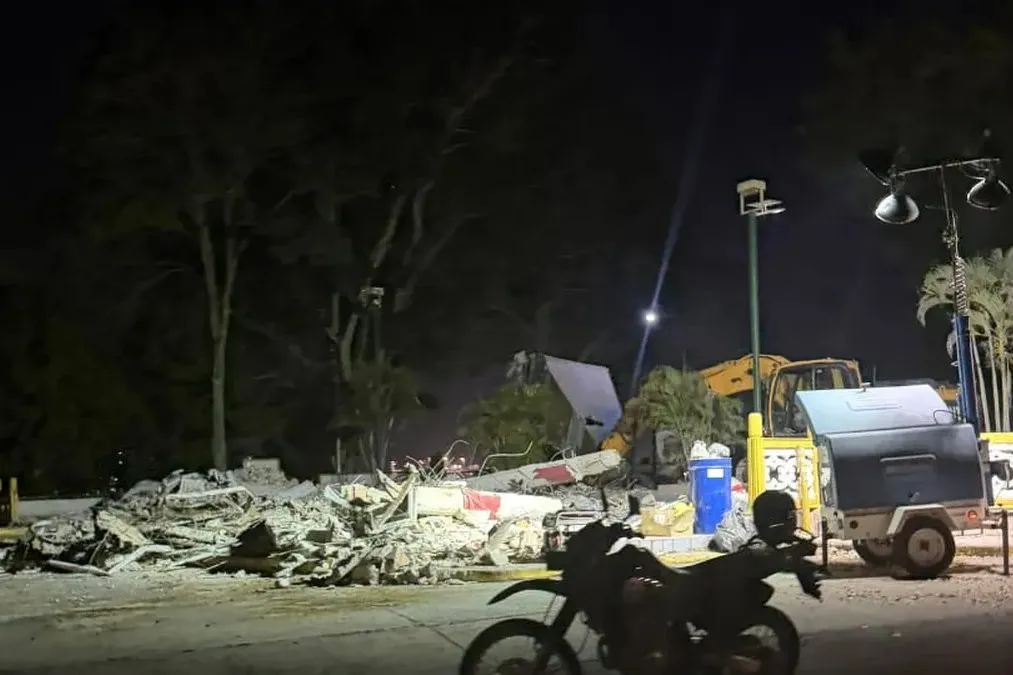
The national government of Panama has ordered the immediate restoration of a monument honoring the Chinese community after its controversial demolition. Officials issued the directive late Tuesday, rejecting both the destruction of the cultural landmark and the clandestine manner of its removal from a popular viewpoint near the Bridge of the Americas.
Authorities clarified they do not support destroying an ancestral cultural element representing a community with 171 years of historical presence. They also condemned the procedure, which occurred at night without prior dialogue, warning, or communication with involved sectors. No coordination or notification was given to the central government, officials stated.
“We do not share the destruction of an ancestral cultural element, which represents a community with 171 years of historical presence in the country, nor the procedure in which the action was executed,” the official government statement read. [Translated from Spanish]
The executive branch reiterated its commitment to preserving cultural rights, recognized as human rights. It announced immediate steps to restore and reconstruct the monument in coordination with the Chinese Community of Panama and the Ministry of Culture. The Government of Panama further urged the Arraiján Mayor’s Office to listen to all communities and preserve cultural heritage, noting such symbols represent the diversity that strengthens the nation.
Controversy Erupts Over Demolition Justification
Public controversy ignited after videos circulated on social media showing heavy machinery toppling the structure. The footage prompted swift criticism and questions from citizens and various social sectors. Facing growing backlash, Arraiján Mayor Stefany Dayan Peñalba issued a statement with photographs to justify the removal.
She cited alleged structural risks as the reason. The decision was described as preventive and based on technical and safety criteria. According to the Directorate of Works and Construction (DOYC), the structure had corroded bases, visible cracks, and unstable zones. Their report claimed it posed a risk to visitors and tourists frequenting the scenic overlook.
National authorities countered that protecting Cultural heritage requires dialogue, institutional coordination, and respect for involved communities. This fundamental disagreement on process led directly to the restoration order. The government’s stance emphasizes procedural legitimacy alongside physical preservation.
Reconstruction efforts are expected to begin swiftly. The focus now shifts to how the restoration will be managed and funded. The incident has sparked a broader conversation about how Panama manages its diverse historical landmarks. It underscores the tension between local administrative actions and national cultural policy.
Community representatives have expressed relief at the government’s intervention. They await details on the timeline and design for the monument’s return. This process will test the promised coordination between the national government, cultural ministries, and the Chinese community itself.