


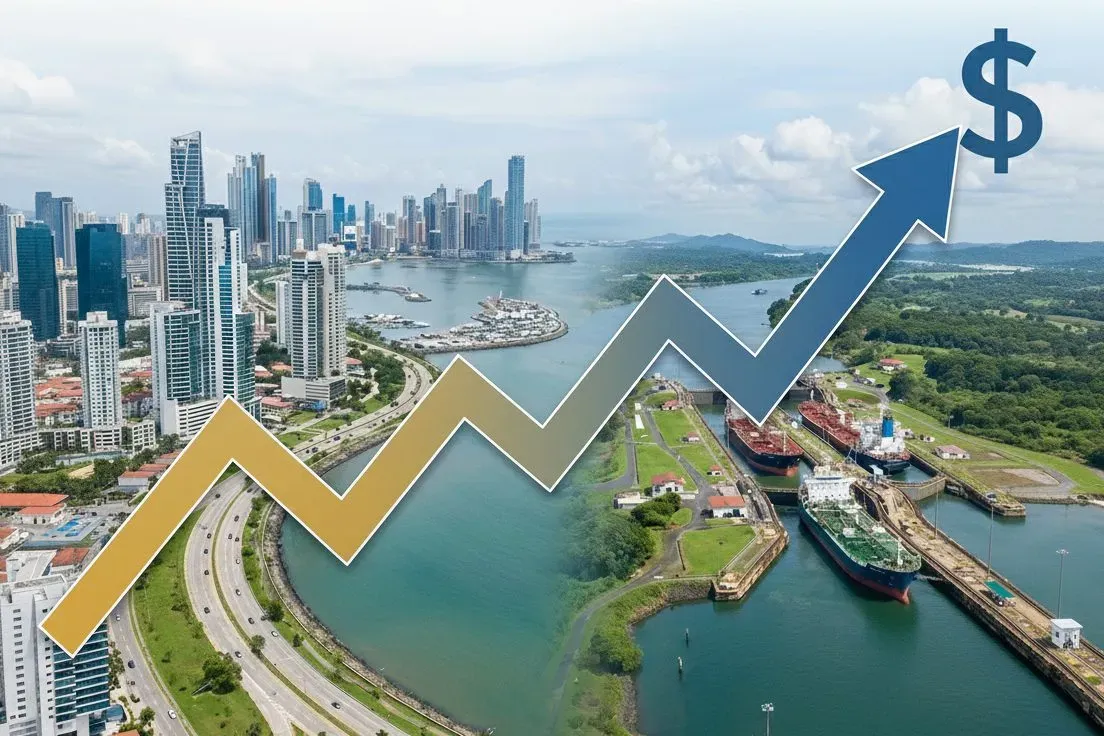
Panama enters 2026 with its economy growing faster than most of its neighbors, but economists warn the nation must urgently tackle deep structural challenges. The coming year’s success hinges on translating that growth into formal jobs, higher tax revenue, and sustainable public finances, all while navigating a complex global landscape. Execution of major projects, institutional transparency, and maintaining investor confidence will be decisive factors, according to multiple financial analysts.
Official data from the Panama Ministry of Economy and Finance shows the nation’s total public debt stock reached $58.9046 billion as of recent reports. This figure represents a slight increase of $71.9 million from the previous month, maintaining persistent pressure on the country’s fiscal health. Government revenues are growing yet continue to fall short of budget targets, complicating efforts to manage the nation’s substantial public debt.
“The challenge for 2026 is not just to grow, but to generate dignified and formal employment in a labor market with high informality,” said Iracema Fuentes, an economist representing the College of Economists of Panama. [Translated from Spanish]
The National Institute of Statistics and Census reported Panama’s real accumulated economic growth reached 4.2 percent for the first nine months of 2025. Third-quarter growth specifically came in at 3.9 percent, positioning the country’s expansion well above the average projected for Latin America and the Caribbean. This performance, however, has not fully bridged the gap in the labor market or public coffers.
Revenue Rises But Fiscal Gap Persists
Tax collection presents another mixed signal. Preliminary results from the General Directorate of Revenue indicate accumulated tax revenues hit $5.2139 billion by the end of October 2025. That number marks a 15.2 percent increase compared to the same period in 2024. Despite this rise, collection still lagged $1.1566 billion behind the budget target, an 18.2 percent shortfall for the ten-month period.
This persistent gap confirms that even with economic recovery, fiscal performance remains insufficient to meet deficit and debt reduction goals. Several economists identify this as the most critical point for the 2026 agenda. Closing it requires not just economic activity but more effective tax administration and perhaps politically difficult reforms.
Carlos Arauz, another prominent economist, argues the principal challenge will be fiscal discipline and the government’s ability to fulfill its promise of austerity. He contends sustainable growth depends entirely on responsible management of public spending and a substantial improvement in the tax agency’s collection capacity. “Without austerity, the long-term path is compromised,” Arauz stated, emphasizing that the quality of government expenditure will be a key signal of fiscal sustainability. [Translated from Spanish]
An Open Economy in a Uncertain World
Analysts stress that Panama’s small, open economy cannot be viewed in isolation. Its fortunes are deeply tied to global trade flows, international finance, and a logistics sector hypersensitive to external shocks. Iracema Fuentes notes that in an international scenario marked by growth deceleration and heightened uncertainty, Panama must consolidate internal strengths to mitigate outside risks.
Projections from the United Nations Economic Commission for Latin America and the Caribbean estimate regional growth around 2.3 percent for 2026. Panama could achieve approximately 3.7 percent growth, provided it maintains momentum in its logistics and financial services sectors. This external dependency makes domestic stability and competitiveness non-negotiable priorities.
The Panama Canal and the broader logistics sector stand as undeniable pillars for sustaining economic growth next year. Fuentes highlights the critical need for the Canal to continue implementing measures that mitigate the effects of the El Niño phenomenon forecast for the coming year. Effective water resource management is paramount. These actions reduce the risk of operational disruptions, guaranteeing continuity for ports, transportation, storage, and connected services. They also provide a direct social impact by sustaining indirect jobs throughout the logistics chain and related commerce sectors.
The Labor Market Challenge and Infrastructure’s Role
Perhaps the most daunting internal hurdle is the labor market. Official statistics placed unemployment at 9.5 percent in 2024, while informality reached a staggering 49.3 percent. Unofficial projections suggest unemployment could end 2025 near 9.9 percent, with a potential improvement to 7.7 percent in 2026. The translation of macroeconomic growth into quality jobs remains inconsistent.
To confront this, economists point to stimulating internal activities like construction. This sector is linked to large infrastructure projects such as Metro Line 3 and the fourth bridge over the Canal, alongside commerce, local services, and internal tourism. “Construction and infrastructure projects will be key to reactivating internal consumption and formalizing employment,” Fuentes added. [Translated from Spanish] She also acknowledged that an adjustment to the minimum wage could lead to a slower start to the year, particularly for small and medium-sized enterprises navigating higher costs.
The government’s ability to efficiently execute these flagship projects is now directly linked to its economic and social goals. Delays or cost overruns would not only represent a fiscal deficit concern but also a missed opportunity for job creation and economic stimulation. Each project is viewed as a potential catalyst for formal employment in a market desperate for it.
Economist Carlos Arauz concludes that Panama’s macroeconomic challenges are inextricably linked to the efficient execution of public works and the creation of widespread prosperity. The technical milestones of completing a bridge or a metro line matter less, in the public view, than their tangible impact on everyday life and opportunity. The Panama Ministry of Economy and Finance therefore faces a dual mandate: maintaining strict budgetary discipline while ensuring strategic investments reach completion and deliver their promised benefits. The credibility of the state’s planning and implementation machinery is on the line for 2026.