


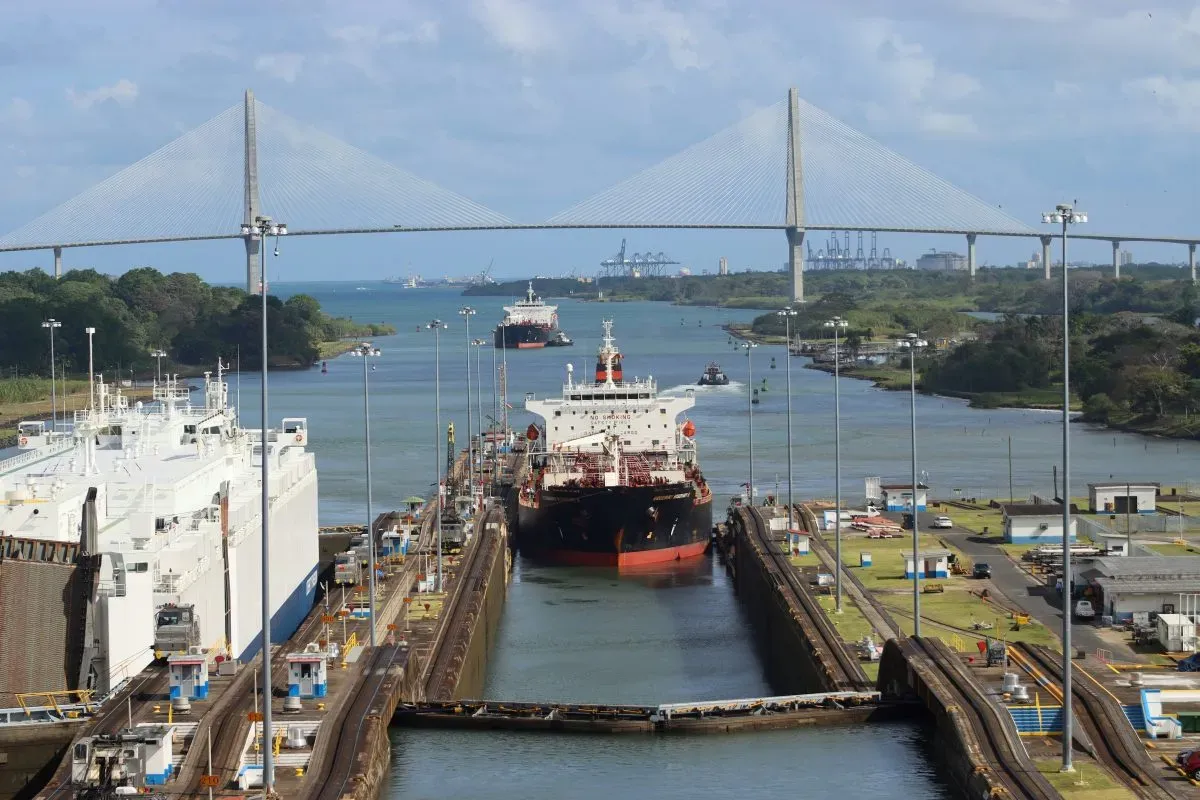
The Panama Canal Authority is advancing major new port and energy infrastructure projects, officials confirmed last week. This expansion comes as competing interoceanic corridor projects across Latin America face significant delays, accidents, or financial paralysis. The developments reinforce Panama’s entrenched position in global maritime logistics.
📑 Table of Contents
A recent review by Nikkei Asia highlighted the stalled status of mega-projects in Mexico, Nicaragua, and Honduras. These initiatives, once touted as potential competitors, are grappling with structural, financial, and geopolitical hurdles. Meanwhile, the Panama Canal is not just maintaining its operations but actively investing to widen its competitive moat.
The Canal’s administrator, Ricaurte Vásquez, outlined the new strategic direction.
“Our focus is on integrated logistics solutions that complement the waterway. We are building resilience and adding value for the global shipping community.” [Translated from Spanish]
These statements follow the January 30 publication of pre-qualification documents for two key initiatives. The moves signal a proactive effort to capitalize on the region’s infrastructure gaps.
Failed Alternatives Across the Region
Other nations have struggled to turn ambitious blueprints into reality. Mexico’s Interoceanic Corridor of the Isthmus of Tehuantepec (CIIT) represents the most advanced effort. It was partially inaugurated in December 2023 and even conducted a test run transporting Hyundai vehicles in March 2025.
A severe derailment in December 2025, however, resulted in 14 fatalities and forced a full suspension of rail service. Mexican President Claudia Sheinbaum stated on February 2 that operations would not resume until authorities confirm total compliance with safety norms. The incident cast a long shadow over the corridor’s immediate viability.
Nicaragua’s grand canal dream, backed by Chinese investment, remains practically paralyzed. The 2013 concession to a Hong Kong company led to little more than a symbolic groundbreaking. The project confronted a daunting geographical reality. A Nicaraguan canal would need to span up to 450 kilometers, compared to the Panama Canal’s approximate 80-kilometer route.
Estimated costs between $50 billion and $100 billion, coupled with persistent financing challenges, ultimately stalled the venture. It stands as the region’s most emblematic failed bet.
In Honduras, plans for a large-scale canal seco, or dry canal, have failed to gain momentum. The proposed $18 billion multimodal network combining roads, rail, and logistics centers presents a fiscal challenge for one of Central America’s most fiscally constrained nations.
Professor Mario Sosa of the Metropolitan University of Honduras told Nikkei Asia that realizing such a project would leave the country with little choice but to depend on China for funding. The current political climate appears to be moving in the opposite direction. New President Nasry Asfura, who took office in late January, has announced a pivot toward a more pro-United States stance, distancing his administration from the previous government’s outreach to Beijing.
Panama’s Dual Strategy for Expansion
While others falter, Panama is executing a two-pronged strategy to solidify its dominance. The first pillar involves significant port expansion. The Canal Authority is preparing to tender contracts for two new terminal facilities. The Telfers terminal on the Atlantic side and the Corozal terminal on the Pacific side aim to absorb an additional 5 to 6 million containers per year.
This expansion targets a specific market segment. The Canal’s ecosystem currently moves about 21 million containers annually in various forms. Roughly 11 million of those containers transit the waterway without being unloaded at local ports. The new terminals are designed to capture more of this through traffic, converting simple transits into value-added port calls.
The second strategic pillar is the development of an energy corridor. Plans call for a 76-kilometer pipeline across the isthmus to connect Atlantic and Pacific terminals. This system would transport propane, butane, and ethane with a capacity of up to 2.5 million barrels per day.
A key advantage of this pipeline is its operational independence from the Canal’s locks. It would not consume the freshwater resources critical for lock operations, a major concern following the 2023-2024 drought that caused transit restrictions. This project directly addresses past vulnerabilities while creating a new revenue stream.
These investments demonstrate a clear calculation. The water crisis temporarily revived discourse about regional alternatives. The Canal Authority’s response is to make its own infrastructure more indispensable. It is leveraging its existing integration into global trade networks, a deep-water port ecosystem, and over a century of operational experience. Competitors find these assets nearly impossible to replicate quickly.
The Authority’s latest moves also reflect a broader regional context where Panama continues to assert its logistical leadership, including through initiatives like its recent rica latina partnership for hurricane reconstruction. The message to global shippers and investors is one of confidence and long-term planning. Other projects remain concepts hampered by terrain, tragedy, or treasury shortfalls. Panama is building.