


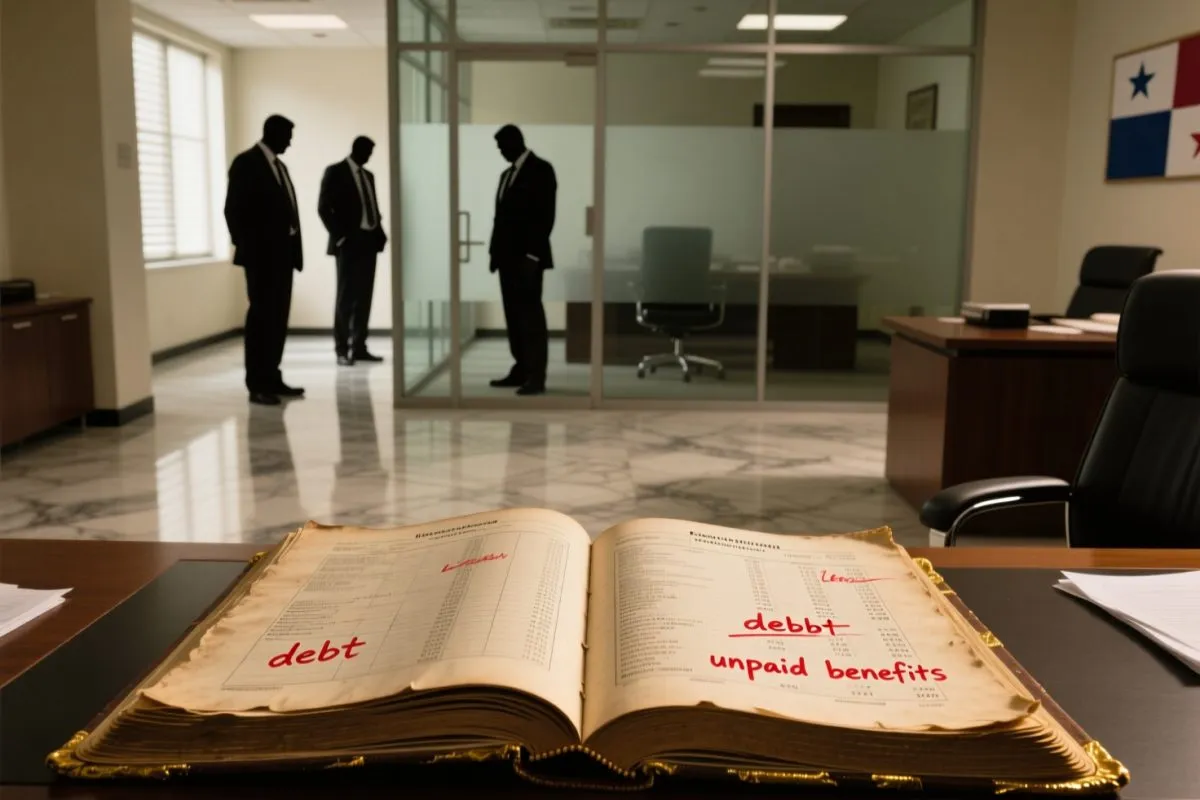
Panama’s national government has accumulated a massive financial liability stemming from unpaid employee benefits that have gone unresolved for over a decade. The debt for seniority premiums, a legally mandated payment for public sector workers, has been growing silently since 2014. Multiple government ministries now acknowledge obligations totaling tens of millions of dollars owed to thousands of former civil servants.
This systemic problem originated from an Executive Decree signed in the final days of the Ricardo Martinelli administration. Executive Decree 52, signed by Martinelli and then-Minister of Labor Alma Cortes just three days before leaving power, regulated laws that established a new stability regime for the public sector. The legislation extended a system of indemnities similar to the Labor Code to government functionaries. What began as a mechanism to protect political appointees has since evolved into a structural debt crisis affecting nearly every branch of government.
An Uncalculated Burden
No single government entity currently tracks the total amount owed nationwide. The Ministry of Economy and Finance (Panama) confirmed that amounts are not centralized, with each institution managing its figure independently. This decentralized approach makes calculating the full scope of the liability nearly impossible. Budget Deputy Janine Prado of the Vamos party has emerged as a vocal critic of the government’s handling of the situation.
Millions are owed to thousands of former officials for a seniority premium that is an acquired labor right. Not even the Ministry of Economy and Finance has that figure, which shows negligence and irresponsibility from past administrations. [Translated from Spanish]
Prado emphasized that debts have been accumulating since 2014. She explained that successive governments left the matter to the discretion of each institution without implementing proper controls or budget planning. The new administration is now scrutinizing the issue to ensure compliance with these former public servants, many of whom face illnesses or have died without receiving their entitled benefits.
Institutional Debts Revealed
The scale of the problem becomes clear when examining individual ministry disclosures. During a September appearance before the Budget Commission, Health Minister fernando boyd galindo revealed that his ministry carries a debt approaching 40 million dollars in accumulated seniority premiums since 2014. He detailed that the institution is working on compiling an official list of former employees to establish a gradual payment plan. This effort aims to bring order to a commitment that remained for years without administrative control or budget projection.
That same month, the Ministry of Security disclosed it had disbursed 2 million dollars in seniority premium payments to 305 former officials. Another 294 checks totaling 572,800 dollars remain unclaimed. The entity acknowledged maintaining 2,167 additional processes underway, whose sum exceeds 8.3 million dollars. These figures from just two ministries alone surpass 50 million dollars in outstanding obligations.
The Social Security Fund reported last year that it was analyzing payments for approximately 6,000 former employees who had submitted requests since 2014. The Assembly’s Budget Commission approved a transfer of 24.6 million dollars to complement payment of this labor right accumulated over more than a decade. Other entities including the Ministry of Social Development and the Institute for Training and Human Resources Development communicated payments exceeding 200,000 dollars and 300,000 dollars respectively this year.
Budgetary Responses and Systemic Challenges
Some institutions have begun incorporating these obligations into their annual financial planning. The Ministry of Commerce and Industries included a 2.1 million dollar allocation for this right in its 2026 budget. The National Land Authority similarly budgeted 650,000 dollars for the same purpose. The University of Panama allocated 5 million dollars to pay premiums, bonuses, and other programs.
Alejandro Haynes, general secretary of the National Federation of Public Servants, warns that the debt continues growing uncontrollably. He states the number of affected functionaries remains very high and the government is not complying with the law.
Some institutions have begun including payment of this right in their budgets. We have fought for payment to happen, and the first should be the most senior and those no longer working. The Ministry of Economy and Finance is one of the few entities that has set an example with disbursements. [Translated from Spanish]
Haynes believes the backlog has become so profound that the debt now carries painful human stories. He confirms that some individuals have died waiting for payments they were legally owed. The federation continues advocating for prioritizing those who left state service after January 1, 2014, as the regulations stipulate.
Government ministries now face the dual challenge of managing current operations while addressing these accumulated historical debts. The absence of a centralized tracking system complicates resolution efforts. Each institution must independently verify claims, establish payment priorities, and secure budget allocations for obligations that sometimes span more than eleven years. This fragmented approach ensures the total national liability remains unknown even as individual ministries disclose significant portions of their debt.