


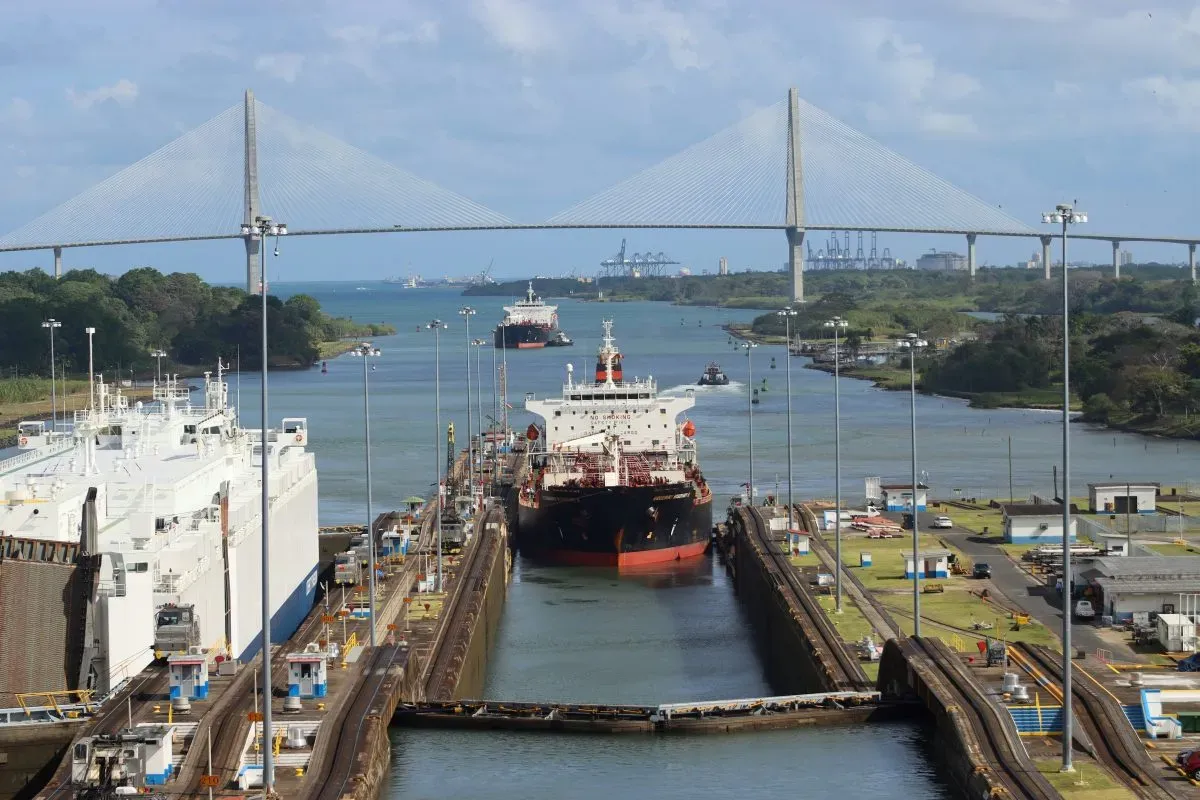
The Panama Canal recorded a 5.6 percent increase in total ship transits for October, the first month of its 2026 fiscal year. Canal Administrator Ricaurte Vásquez confirmed the growth, attributing it to seasonal holiday trade and commercial efforts to beat potential future tariffs.
📑 Table of Contents
Official data from the Panama Canal Authority (ACP) shows 1,029 transits occurred in October. That figure represents 55 more transits than the 974 recorded during the same month in the previous fiscal year. The daily transit average for the month reached 33.2 vessels.
Vásquez pointed to a specific day in early December as a sign of current operational strength. He noted the waterway handled 38 transits on Tuesday, December 2, hitting its maximum daily capacity for large vessels.
“Without water restrictions, the Canal’s maximum daily capacity is 38 deep-draft vessels, not counting yachts and small boats,” Vásquez stated. [Translated from Spanish]
This performance aligns with post-expansion levels seen after the Canal’s major widening project was inaugurated on June 26, 2016. The highest single-day volume in October reached that full capacity of 38 crossings, while the lowest day saw 28 transits. The average transit time per ship was 10.5 hours.
Container Ships Lead Canal Traffic Mix
A detailed breakdown of October traffic reveals which shipping sectors are driving the increase. Container ships remained the most frequent users with 242 transits, solidifying their position as the Canal’s primary customer segment. Bulk carriers followed with 205 transits, while chemical tankers and gas carriers recorded 196 and 149 transits respectively.
Vehicle carriers, known as RoRo ships, completed 73 crossings. Other segments included refrigerated cargo ships (43), tankers (41), general cargo vessels (39), and passenger ships (15). The transit count for Liquefied Natural Gas (LNG) carriers stood at just six for the month, continuing a notable decline linked to shifted trade routes and lower Asian demand.
By lock system, the original Panamax (ship size classification) locks handled 722 transits. The newer, larger Neopanamax locks, built during the expansion, accommodated 307 transits.
Vásquez called the results for October and November very positive, exceeding initial estimates. He issued a note of caution about the sustainability of this specific surge. The administrator explained that a significant portion of the current container traffic aims to stock inventories for the Christmas and New Year holidays while also preempting potential U.S. tariff implementations.
“Once the holidays pass, that volume of cargo will not be maintained,” Vásquez anticipated. [Translated from Spanish]
He made these comments during a conversation with editors from European and Latin American media, organized by EditoRed with support from La Prensa newspaper.
Canal’s Role in Global Commerce
During the forum, Vásquez contextualized the waterway’s broader economic impact. He stated the Panama Canal facilitates roughly 6 percent of total global trade by value. The economic activity surrounding the corridor, however, is far more extensive.
“Around 50 percent of trade operates near the Panama Canal, so all port activities and operations complementary to the Canal do not respond solely to its existence, but also to the country’s geographic position and its openness to the world,” Vásquez said. [Translated from Spanish]
He emphasized Panama’s historical role as a strategic transit and connection point, a tradition continuing with the modern Canal. The nation has consistently been a focal point for transformation and the application of new technologies to maintain the flow of commerce. From pre-Columbian paths to the colonial Camino Real and the Chagres River, the isthmus has always functioned as a crucial link for global movement.
The Canal Authority continues to monitor water levels and seasonal demand patterns closely. The strong start to fiscal year 2026 provides a buffer, but officials remain aware that the factors boosting October numbers may be temporary. The coming months will test the resilience of this growth trend beyond the peak holiday shipping season.