


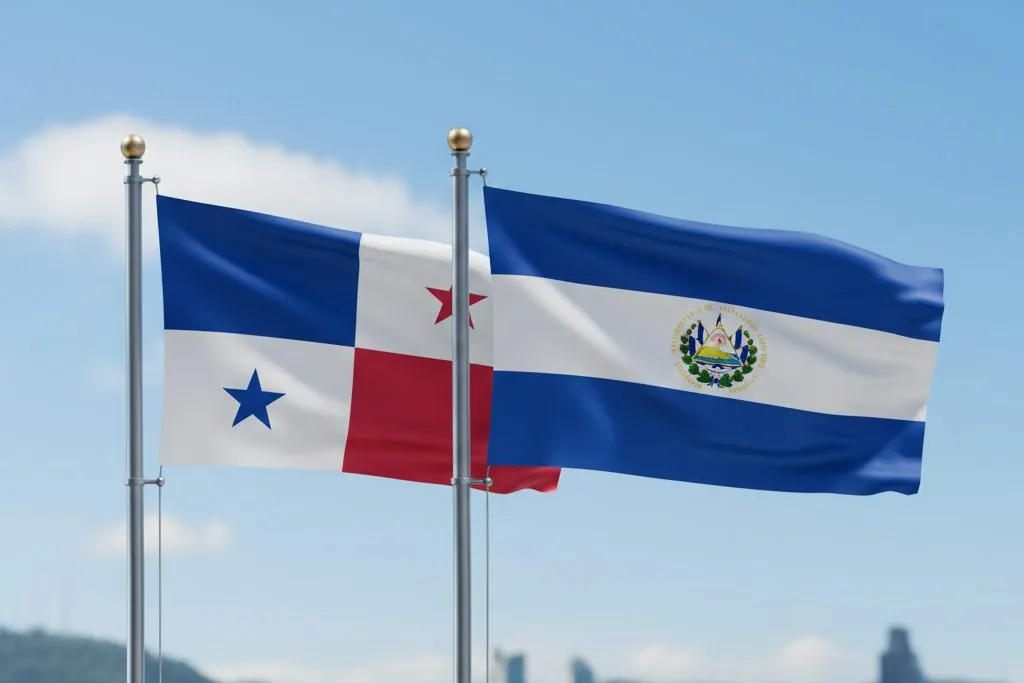
El Salvador and Panama fell in the ranking of top exporters to the United States last year, new federal data shows. They were the only Central American nations to lose ground despite most regional partners improving their positions. The shift comes amid changing U.S. tariff policies affecting the region.
The latest monthly trade bulletin from the U.S. Bureau of Economic Analysis (BEA), published in collaboration with the U.S. Census Bureau, details the change. The report covers trade through October 2025. El Salvador dropped from 67th to 68th place among America’s top supplier partners. Panama also slid one spot, moving from 96th to 97th.
Central American Export Performance Diverges
Other Central American nations generally advanced in the rankings. Costa Rica now sits in 34th place, a two-spot improvement. Nicaragua moved from 59th to 57th. Guatemala climbed three positions to 53rd, and Honduras advanced four spots to reach 51st. The data underscores a fragmented regional trade performance with the world’s largest economy.
This movement occurred within a massive import market. The United States imported nearly $2.95 trillion in goods during the first ten months of 2025. Mexico remained the dominant partner, supplying over $451 billion. Central America as a whole remains outside the top 20 supplier groups, however.
“The United States confirmed that, between January and October 2025, it imported $2.948 trillion, of which $451,421.3 million came from Mexico, its main trading partner.” [Translated from Spanish]
The tariff landscape for the region became more complex in April 2025. The U.S. increased its base tariff rate to 10% for most Central American countries under the Central American Free Trade Agreement (CAFTA-DR). Nicaragua faced a steeper 18% rate. Despite these cost increases, export values grew for most nations.
El Salvador’s Export Growth Lags Region
El Salvador’s minimal growth became a key concern. Its exports to the U.S. grew just 1% year-over-year, reaching $2.04 billion through October 2025. That is the slowest growth rate in Central America. Official Salvadoran data from the Central Reserve Bank (BCR) paints an even starker picture. It shows a 2.4% contraction in exports to the U.S. for the period, falling to $1.78 billion.
Contrast that with regional leaders. Costa Rica saw a remarkable 22.7% surge, with exports jumping from $9.65 billion to $11.85 billion. Nicaragua’s exports grew 6.8% to $4.31 billion. Panama, despite its lower ranking, posted a 12% increase to $542 million. Guatemala’s exports rose 3.8% to $4.8 billion.
Honduras proved the exception to the growth trend. Its exports to the U.S. actually fell by $45.3 million, finishing at $4.89 billion for the ten-month period. This decline happened even as its ranking improved, highlighting how global competition affects all these positions.
Analysts are now watching how these trends will influence economic planning. Nations like Panama are investing heavily in infrastructure, with projects like major bridge works demanding significant funding. Local governments there continue to seek resources, as seen in recent disputes over municipal budgets. Upcoming projects, including scheduled Otober road repairs on existing bridges, aim to bolster logistics and trade capacity.
The diverging fortunes of close neighbors like El Salvador and Costa Rica raise questions about competitiveness. Product mix, foreign investment, and domestic stability likely play roles. For Salvadoran and Panamanian officials, reversing this slide in the rankings will require a focused strategy. They must address the specific barriers making their exports less attractive than those from regional peers.
U.S. trade data for the full 2025 year will provide a clearer picture. It will show whether these ten-month trends solidified or shifted in the final quarter. For now, the message for two of Central America’s economies is clear. They are losing ground in their most critical single market.