


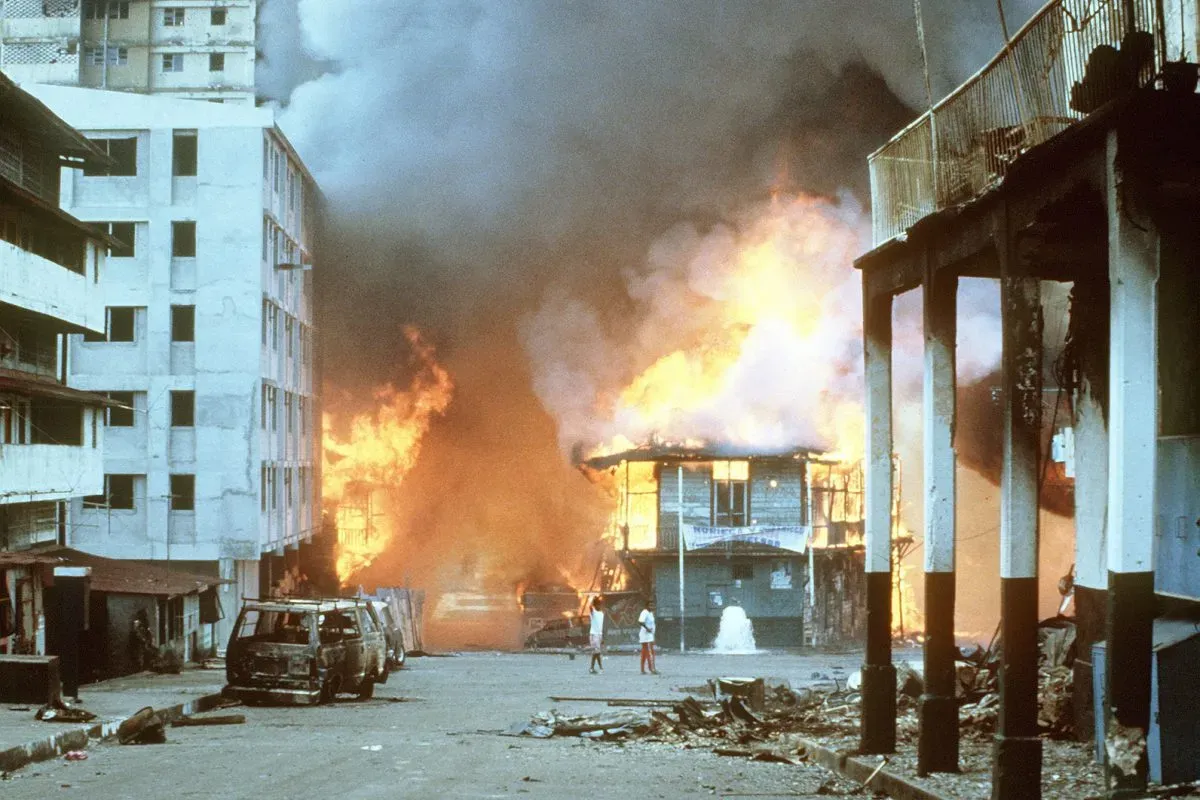
Thirty-six years after the United States military intervention in Panama, the families of 236 people reported missing continue their search for answers. On December 20, 1989, a night of bombing and ground assaults left a wound that has yet to heal for hundreds of Panamanians. A special commission and the nation’s Public Ministry are now engaged in a painstaking forensic effort to locate and identify the remains of those lost during the United States invasion of Panama.
The work focuses on the chaotic hours between the night of December 19 and the early morning of December 20. Combat erupted at multiple locations across Panama City and in Coclé province. These sites included the Central Barracks in El Chorrillo, the Panama Viejo barracks, and the Tinajitas barracks in San Miguelito. Fighting also occurred at Fort Amador, the 2000 Battalion in Tocumen, the Naval Barracks in Coco Solo, and the Río Hato base. United States forces secured access to the Bridge of the Americas during the operation.
A Search Built on Fragmented Memories
For relatives like Elías Núñez, the past is a story assembled from other people’s memories. He was just three months old when his father vanished. “I never had the chance to know my father,” Núñez said, explaining that his father was a second corporal with the National Police of Panama. He spent his childhood without an explanation for the absence, later learning his father disappeared during the invasion. His understanding of the tragedy comes entirely from the testimonies of family and friends who lived through it.
Brenda Bethancourt faces a similar struggle for clarity regarding her father, police officer Braulio Bethancourt. Her family’s grief remains unresolved without a definitive answer. “We have not been able to close this mourning,” Bethancourt stated. “We do not have a grave to bring flowers to or to say a prayer for his rest.” Early reports suggested her father was buried in the Amador cemetery, then later in Corozal. No certainty exists. She was told his body had a gunshot wound to the head, but even that detail remains unverified.
“It has been very hard not being able to explain to my children where their father was,” said Trinidad Ayola, widow of Captain Octavio Rodríguez. She described her sons constantly asking where their father was, what happened to him, and why he did not come home. [Translated from Spanish]
Ayola acknowledged that the work of the December 20 Commission and the Public Ministry has provided answers for some families. Several have now located remains and held proper burials. This offers a fragile template for hope.
Forensic Science and Frustrating Delays
The path to identification is complex and slow. Geomara Guerra, the prosecutor leading the investigation into the invasion-era disappearances, confirmed the work is long-term. Her office currently has 33 active cases. For 24 of those, prosecutors have requested courts reopen investigations because new leads point toward possible positive identification.
Progress is measured in single digits, but it is progress. To date, forensic teams have identified 11 individuals. The remains of ten have been returned to their families. The list includes Alejandro Antonio Hubbard Torrero, Dídimo Miranda, and Ricardo Aurelio Arana Riquelme. Others identified are Ramón Alberto Vásquez Núñez, Yervin José Peruta Ávila, and Daniel Alex Martínez Valdéz. Héctor Porfirio Murillo, Juan Gutiérrez, Erick Abdiel Bonilla Terrero, and Luis Carlos Méndez Hernández have also been named.
“This is work that will not conclude in the short term,” Prosecutor Geomara Guerra stated, emphasizing the investigative challenges. She noted that many people come forward with information, but all tips must be rigorously validated with evidence before a criminal investigation can be formally opened. [Translated from Spanish]
A major hurdle involves the Jardín de Paz cemetery. Exhumations there began in 2020 but faced immediate delays due to the COVID-19 pandemic. A significant number of unidentified human remains are still believed to be located at the site. New exhumations will be necessary despite the recent identifications made through DNA matching.
Forensic anthropologist Adán Hernández of the Institute of Legal Medicine and Forensic Sciences (IMELCF) detailed the laborious identification process. It requires a team of specialists. The condition of the remains often complicates the work. Some are severely degraded by humidity. Others were burned, making traditional identification methods nearly impossible. DNA analysis has become the critical tool, the only key for many of these cases.
Uncertain Numbers and a Push for State Accountability
The official number of Panamanian casualties from the invasion remains disputed. United States military reports from the time estimated around 500 deaths on the Panamanian side, including both civilians and military personnel. The chaos of the conflict, however, led to haphazard burials. With hospitals overwhelmed by the wounded and the dead, many bodies were placed in bags and interred in mass graves.
Investigations by the Public Ministry (Panama) reveal a grim pattern. Numerous bodies were found in the streets without any identification. They were taken to morgues and given summary burials. This practice created the current crisis of the missing.
Rolando Murgas Torraza, president of the December 20 Commission, argues the state has a fundamental responsibility to clarify these cases. He is calling for authorities to play a greater role in building a collective memory of what happened on December 20, 1989. For the families, this means more than just statistics. It means names, stories, and proper graves.
Each identification represents a small step toward national reconciliation. It also represents a family finally gaining the right to mourn at a specific place. The process is slow, hindered by degraded evidence and the passage of time. Yet the work continues. Thirty-six years later, the demand for answers about the disappeared remains a powerful force, a testament to loss that refuses to be forgotten.