


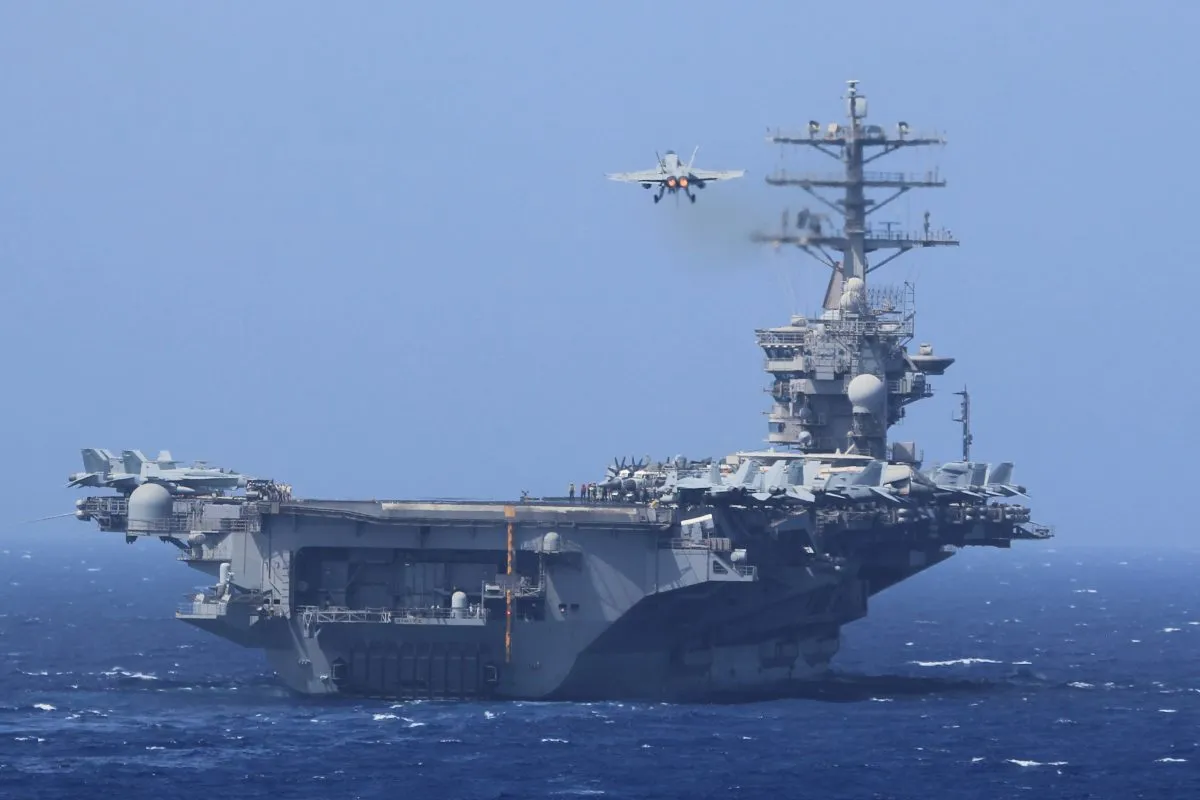
A United States Navy carrier strike group led by the USS Nimitz (CVN-68) is conducting a months-long operational transit around South America. Panama’s National Aeronaval Service (Panama) confirmed the vessels will operate in Panamanian waters from March 29 to April 2.
The deployment supports the “Southern Seas 2026” initiative, a recurring U.S. Southern Command operation focused on multinational maritime cooperation. The servicio nacional aeronaval stated the visit aims to strengthen knowledge exchange and interoperability with regional partners.
“This deployment underscores our commitment to regional partnerships and maritime security,” a U.S. Navy spokesperson said. [Translated from Spanish]
The nuclear-powered aircraft carrier and its accompanying guided-missile destroyer, the USS Gridley, departed the U.S. West Coast on March 12. Their scheduled route includes a planned transit through the Strait of Magellan before repositioning to the U.S. East Coast by June 20.
Port Calls and Operational Schedule
Alongside Panama, the ships are scheduled for port visits and engagements with naval forces in Peru, Chile, and Brazil. Each stop involves planned professional exchanges and cooperative maritime exercises. These engagements are standard for Southern Seas deployments, which happen every few years.
In Panama, the two vessels will have separate arrangements. The USS Nimitz, due to its massive size, will remain anchored in open waters off the coast. The destroyer USS Gridley is scheduled to dock at the Amador Cruise Port, allowing for more direct logistical and diplomatic interactions.
Panama’s nacional aeronaval will coordinate with U.S. personnel during the four-day presence. The agency emphasized the routine nature of the visit within the framework of existing bilateral agreements.
Capabilities of the Deployed Vessels
As one of the world’s largest warships, the USS Nimitz acts as a floating airbase. It measures approximately 333 meters long and displaces nearly 100,000 tons. The carrier can accommodate about 90 fixed-wing aircraft and helicopters, projecting significant air power across vast distances. Its top speed exceeds 30 knots.
The USS Gridley provides crucial escort and defensive capabilities for the carrier group. This Arleigh Burke-class destroyer is equipped with the Aegis Combat System, advanced radar, and both anti-air and land-attack missile systems. It is designed for multi-mission warfare and tactical support.
Combined, the two ships carry a complement of roughly 6,000 sailors and aviators. Their transit represents a substantial demonstration of U.S. naval mobility and sustained forward operations.
“These operations enhance our collective ability to ensure a secure and prosperous hemisphere,” an official from Panama’s servicio nacional noted. [Translated from Spanish]
The current deployment follows a period of heightened regional naval activity. It allows participating nations to practice communication protocols and joint maneuvering. Such exercises build familiarity that can prove critical during real-world humanitarian or security crises.
Following its time in Central America, the strike group will continue south along the Pacific coast of South America. The entire voyage underscores the strategic importance of key maritime chokepoints and partnerships throughout the Americas. Final repatriation to the U.S. Atlantic Fleet is set for late June.