


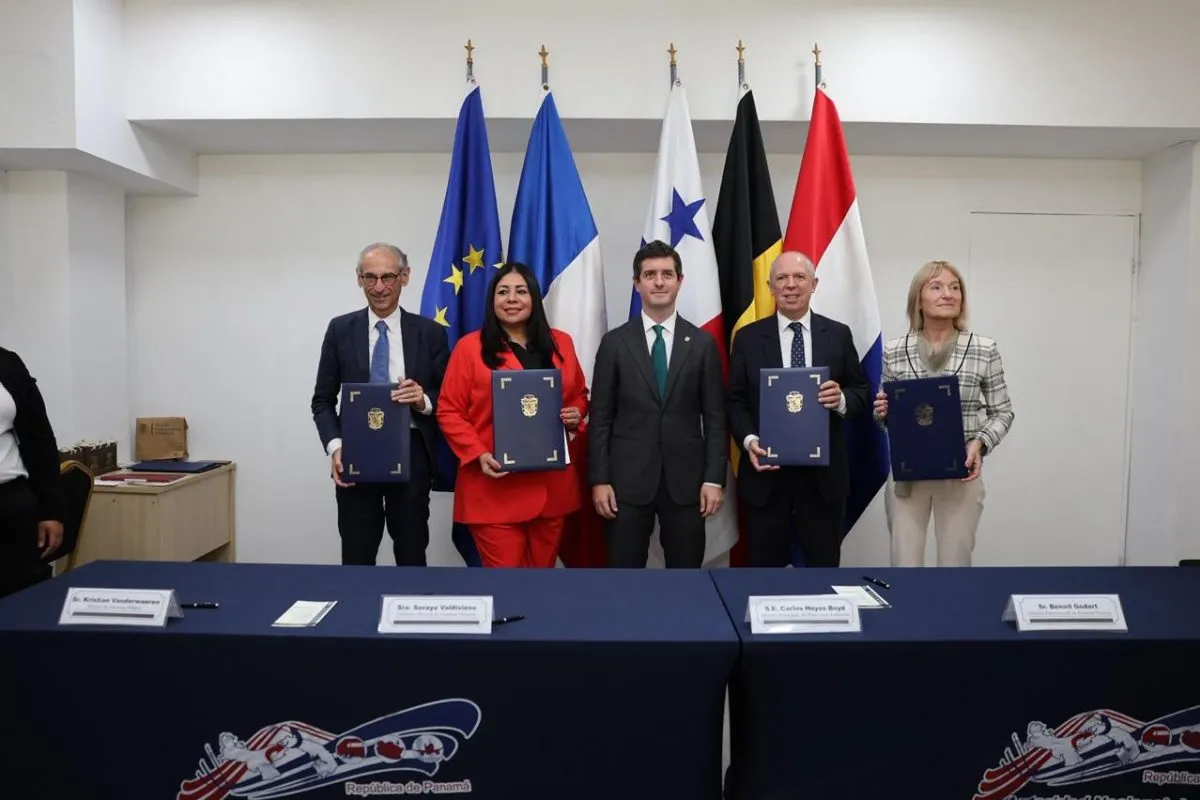
Panama’s Customs Authority formalized a major international cooperation pact with three European Union member states on Tuesday, December 9. The agreement with Belgium, France, and the Netherlands aims to intensify the fight against global drug trafficking networks by enhancing intelligence sharing and operational coordination.
This joint declaration represents a significant diplomatic achievement for the administration of President Jose Raul Mulino. It signals growing international confidence in Panama’s strategic role in securing global maritime trade routes against illicit commerce.
Customs directors from all three European nations traveled to Panama City for the historic signing. The delegation included Nanette van Schelven from the Netherlands, Belgium’s Kristian Vanderwaeren, and Benoit Godart, Director of International Affairs for French Customs.
“Today we commemorate a transcendental event in international cooperation,” said Soraya Valdivieso, Director General of Panama’s Customs Authority. “These documents respond to the shared will to work as a team against illegal trade. This is a strategic tool that positions Panama as a link for safe and transparent commerce.” [Translated from Spanish]
Operational Focus on Intelligence and Security
The new partnership framework will strengthen real-time intelligence exchange, joint risk analysis, and direct coordination between the Panama Customs Authority and its key European counterparts. Panama serves as a critical maritime crossroads, making this collaboration vital for intercepting narcotics shipments destined for European markets.
Planned activities under the agreement include joint training programs, enhanced port security protocols, and developing new methods to detect increasingly sophisticated smuggling techniques. Officials from all four administrations stressed that a unified international response is the only effective way to dismantle transnational criminal organizations.
The pact is expected to support more effective cargo inspections, faster information flows, and tighter collaboration on cross-border investigations. This move aligns with Panama’s broader efforts to bolster its legal trade framework while aggressively targeting illegal activities that threaten its economy and security.
Several high-ranking Panamanian officials attended the signing ceremony as honorary witnesses. The group included Acting Foreign Minister Carlos Arturo Hoyos, Minister of the Presidency Juan Carlos Orillac, and Attorney General Luis Carlos Gomez. The director of the National Security Council, Manuel Moreno, and the Administrator of the Panama Maritime Authority, Luis Roquebert, were also present alongside members of the Port Task Force.
Strategic Context and Regional Leadership
This agreement arrives as Panama seeks to deepen its international trade and security partnerships on multiple fronts. The administration of presidente mulino has actively engaged with regional blocs, recently evaluating integration progress with the MERCOSUR trade alliance alongside the President of Paraguay.
Forging stronger ties with the European Union and its member states provides a counterbalance to other geopolitical relationships. It reinforces Panama’s commitment to transparent governance and international legal standards, a message frequently emphasized in its foreign policy.
The direct involvement of European customs directors underscores the pact’s operational seriousness. It is not merely a symbolic gesture but a working-level commitment to share expertise and resources. For Panama, hosting this signing elevates its status from a transit zone to an active, leading partner in global enforcement.
Next steps will involve establishing technical working groups to implement the agreement’s provisions. The focus will remain on creating actionable systems for data sharing and coordinated operations, with the immediate goal of disrupting narcotics shipments before they leave Panamanian waters.
Panamanian authorities anticipate this model of cooperation could expand to include other nations committed to securing the Western Hemisphere’s shipping lanes. The country’s unique geographic position makes such partnerships essential for both national security and the integrity of global commerce.