


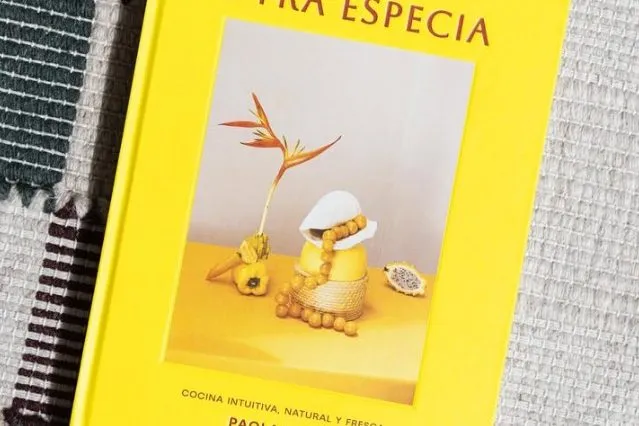
Paola Reyes Corró, a Panamanian chef and entrepreneur, has published the country’s first major cookbook dedicated to underutilized native ingredients. The book, titled “Otra Especia” features 103 original recipes developed from her years of research into Panama’s rich biodiversity. Reyes Corró launched the project from her Instagram account during the Covid 19 pandemic, transforming a personal passion into a full-fledged brand that includes a restaurant and now a national culinary guide.
The 215-page volume is the culmination of a journey that began with informal cooking tips shared online. It represents a formal effort to document and promote Panama’s diverse, often overlooked edible plants, grains, and seafood. Reyes Corró photographed by Vivian de Castro, combines minimalist design with nutritional science, offering a new perspective on local food culture.
“When I was building my restaurant Salva to serve natural food, the pandemic hit and I went to live in the interior,” Reyes Corró said. [Translated from Spanish] “I cooked every day and some friends, having only the three hours allowed per week to go to the supermarket during the Covid 19 quarantine, began asking me about preserving vegetables. So one day in April 2020 I posted a couple of useful tips on my personal Instagram and suddenly I started receiving many questions. I then decided to open another account with the name ‘Otra Especia,’ a name that refers to that personal touch that each person imparts to their recipe in addition to the ingredients.”
Her academic background proved unexpectedly vital to this culinary mission. Reyes Corró holds a master’s degree in Sociology, a field she says taught her rigorous research and analytical skills. Her studies took her to universities in Germany, Thailand, India, and South Africa, where she consistently supplemented her coursework with local cooking classes.
From Global Research to Local Kitchen
This international exposure deeply influenced her philosophy on food systems. An internship in India with the advocacy group Fairfood International gave her direct insight into global supply chain ethics. She studied how large supermarket chains source ingredients and learned about the composition of highly processed foods. That experience, she explains, directly steered her toward a commitment to natural, whole ingredients.
“When you study sociology you learn to do research first, then you learn to summarize that research, analyze it, and draw theories or hypotheses,” Reyes Corró stated. [Translated from Spanish] “Everything I learned clearly led me to where I am now. My cooking, which many categorize as healthy cooking, I simply categorize as natural cooking.”
Her definition of natural cooking rejects processed condiments in favor of fresh spices, herbs, vegetables, and grains. This approach forms the core of her cookbook, which she describes as a guide to “intuitive, natural, and fresh” cuisine. The project took two years to complete, a process she admits was challenged by her own self-doubt and the quest for a perfect aesthetic.
Editorial designer Alex Vallarino, who had taken a cooking class with Reyes Corró, provided the crucial push. Vallarino, known for working with renowned chefs like Cuquita Calvo, insisted she had to create a book. The resulting collection aims to change how Panamanians view their own pantry.
Celebrating Panama’s Edible Biodiversity
A central thesis of “Otra Especia” is that Panamanians use only a fraction of the edible resources available in their own environment. The country’s remarkable Biodiversity offers a vast, under-explored culinary palette. Reyes Corró’s recipes intentionally highlight ingredients like white cacao, red rice, breadfruit patacones, cherimoya, and tamarind.
She points out that Panama exports nutrient-dense foods like red pitahaya, a superfood packed with antioxidants, while domestic consumption remains low. Her mission is to reintroduce these native powerhouses into the everyday Panamanian kitchen. She argues that food is medicine, and exploring local variety is the best starting point for healthier living.
“In Panamanian food we use very few vegetables in particular out of so much diversity that we have,” she observed. [Translated from Spanish] “We don’t usually eat so many plants given the amount we have at our disposal. I can say that every day you can eat a different Panamanian legume dish.”
The book is structured to be both inspirational and educational. Each recipe includes a nutritional guide noting high contents of carotenoids, polyphenols, fiber, or antioxidants. Reyes Corró provides functional pairing options and notes, aiming to help readers with specific dietary needs, such as increasing fiber or finding plant-based proteins beyond meat.
Signature Recipes and Lasting Impact
When asked about her favorite recipes, Reyes Corró highlights two. The first is a gluten-free breaded fish, a dish that required extensive experimentation. She finally achieved the desired crispiness using a blend of cassava and coconut flour. She tops it with a green mango ceviche, calling the combination delicious and distinctly Panamanian.
The second is a Chayote Carpaccio, a reinterpretation of a vegetable ever-present in her childhood home. She prepares the raw chayote with lemon, vinegar, olive oil, arugula, and pumpkin seeds toasted until they puff up in the oven. These recipes embody her approach, transforming familiar foundations into novel, nutrient-focused meals.
Her work challenges the notion that flavorful food must be indulgent. Reyes Corró’s cuisine consciously avoids white flours and processed sugars, relying instead on the inherent flavors and textures of whole foods. This focus makes her cookbook a potential resource for people seeking to explore healthier eating without sacrificing cultural identity or taste.
The publication of “Otra Especia” marks a significant moment for Panama’s culinary scene. It moves beyond traditional recipe collections to act as a documented research project, a celebration of national biodiversity, and a call to culinary adventure. From an Instagram account born of pandemic isolation, Paola Reyes Corró has built a brand that now offers a permanent, edible map of Panama’s forgotten flavors.