


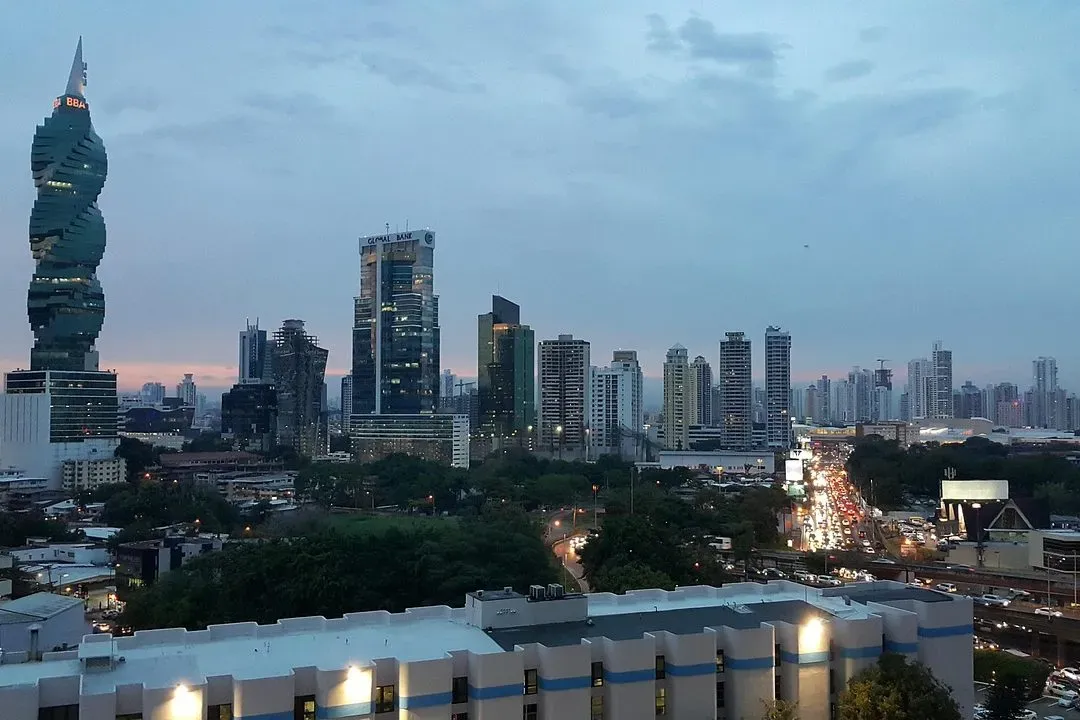
Panama’s national banking system continues to grow by attracting foreign funds and issuing international credit, but its domestic loan portfolio shows significant weakness. A new sector analysis from Moody’s Local Panama, dated February 9, 2026, reveals this growing dependency on external markets for the fifth consecutive year.
The total credit portfolio of the National Banking System (SBN) grew by 4.2% through November 2025, a slower pace than in 2024. The data reveals a stark divergence between external and internal credit performance. While the external loan book advanced by 11%, domestic credit increased by just 1.2%, one of the lowest rates recorded since the pandemic.
International Credit Dominates Bank Balances
The weight of international financing on bank balance sheets has grown significantly. According to the Moody’s report, external credit now represents 43% of the total portfolio, up from just 26% in 2020. This trend solidifies Panama‘s position as a regional platform for originating loans to other countries.
The weak performance of internal credit was influenced by a 12.2% contraction in financing for the construction sector and a 21.8% drop in credit to the public sector. The public sector had shown a strong rebound just a year earlier in 2024.
“Except for 2024, the growth of internal credit has remained below the growth of real Gross Domestic Product (GDP) in the last four years,” the Moody’s analysis states. [Translated from Spanish]
A high level of banking penetration in Panama compared to other regional countries further limits the potential for domestic expansion. The nation’s role as a financial hub is now its primary engine for growth.
Asset Quality and Profitability Trends
Asset quality metrics remain stable on the surface. The past-due loan ratio stood at 2.4% at the close of November 2025, maintaining levels considered healthy for the sector.
Provisions for non-performing loans, however, fell to 92.9%. This figure sits below levels observed in previous years, suggesting banks face greater pressure to preserve profitability. The increased share of external credit has positively contributed to overall quality indicators. These are primarily corporate and business loans with better risk profiles and greater geographic diversification.
On the funding front, foreign deposits grew 8% year-over-year through November 2025. That outpaced the 3.6% growth recorded for local deposits. External funds now represent 31.1% of total deposits, up from 27.1% in 2020.
The system’s liquidity coverage ratio reached 46.1%. The average legal liquidity index hit 54.1%, reflecting a comfortable overall position. Profitability metrics also appear strong at first glance. The system sustained a return on assets (ROA) of approximately 1.8% and a return on equity (ROE) of 15.9%.
Excluding the three entities with the greatest weight in profits and loans, however, those indicators tell a different story. Without Banco General, BAC International Bank, and Banco Nacional de Panamá, the ROA falls to about 1.0% and the ROE drops to 10.4%. This gap highlights a significant concentration of market power within a few key institutions.
Outlook for 2026 Hinges on External Factors
Moody’s Investors Service forecasts a stable banking system for 2026. Its analysts also warn of increased exposure to the evolution of international markets. The behavior of global interest rates will be a determining factor for the year ahead.
“An eventual reduction in rates could alleviate pressure on financial margins, although the effect will depend on the pace of transmission to the local economy,” the report concludes. [Translated from Spanish]
In summary, Panamanian banking maintains solid metrics and robust liquidity. Its growth is increasingly tied to the pulse of the external environment. The domestic credit market now faces a scenario of limited expansion, relying on its international hub status to drive the numbers forward.