


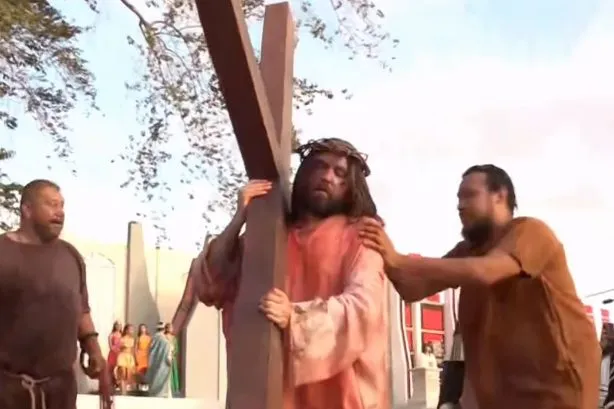
Communities across Panama are transforming public spaces into biblical stages this week. Young actors in towns like Pesé and Río de Jesús are leading elaborate live reenactments of the Passion of Christ, a central tradition for the country’s Holy Week. These events blend deep religious devotion with cultural performance, drawing both local faithful and national visitors.
Authorities expect over 120,000 pilgrims to converge on two major religious sites simultaneously. The scale of participation highlights how these observances remain a powerful force in Panamanian community life, particularly in the country’s interior regions.
Decades of Tradition in Azuero Peninsula Dramas
On the Azuero Peninsula, the “Living Holy Week” in Pesé stands as one of Panama’s most emblematic traditions. Its streets have served as an open-air stage since 1954. Organizers describe it as a unifying act of collective memory that merges faith, culture, and community.
The program meticulously recreates key scenes from the final days of Jesus Christ. It includes the Last Supper and Washing of the Feet on Holy Thursday, followed by the Via Crucis and Crucifixion on Good Friday. For the actors, the commitment extends far beyond simple performance.
“Portraying Jesus gives you the chance to feel, live, and represent exactly the suffering of a person who gave his life for us,” said Carlos Javier Ocaña, who has played the role of Jesus for seven years. [Translated from Spanish]
Ocaña emphasized the role’s profound responsibility. It demands months of emotional, spiritual, and physical preparation from those involved. His dedication reflects the serious weight participants place on their annual contributions to local semana santa customs.
Innovation Meets Evangelism in Veraguas
Other towns have built their own long-standing Passion play traditions. In Montijo, the “Living Passion of Christ” drama marks 52 years. Neighboring Río de Jesús celebrates 56 years with a production that now incorporates professional-grade scenery, lighting, and sound design.
Coordinators there actively innovate to engage modern audiences. Alypio Puga, the event’s coordinator, outlined significant changes for this year’s performance. For the first time, they constructed three separate stages to create an amphitheater-style experience.
“The idea is to do something in the style of an amphitheater,” Puga explained. “Scenes with Pilate and Caiaphas will alternate simultaneously.” [Translated from Spanish]
Puga also revealed narrative adjustments, including a new appearance by Mary at the Last Supper and the inclusion of Peter’s denial, a scene previously omitted. Actor Jerónimo Name confirmed the fresh approach aims to offer something new while preserving the event’s core purpose. Judith de González framed the production’s goal in clear terms. She called it a catechism for the entire town and a form of nationwide evangelization.
Pilgrimages Converge on Major Sanctuaries
While actors prepare, thousands of Panamanians embark on physical journeys of faith. The Sanctuary of the Christ of Alanje anticipates one of the country’s largest single gatherings. More than 120,000 pilgrims are expected to visit the site, home to a wooden statue believed to date from the 18th century.
Local legend says a mysterious old man carved the Christ figure before vanishing without a trace. This story bolsters its reputation as a miraculous icon. Security forces have mobilized to manage the massive influx of devotees traveling for lica menor observances and other events.
Simultaneously, the viernes santo pilgrimage culminates at the Minor Basilica of Atalaya. Thousands will fulfill vows and offer prayers to Jesús Nazareno there. This tradition intertwines personal sacrifice with communal hope, creating another powerful focal point for Holy Week devotion.
Together, these dynamic expressions of faith illustrate a living tradition. Panama’s Holy Week unfolds not only inside churches but along highways, in town squares, and on makeshift stages. It is a faith performed, taught, and transmitted through each generation’s commitment. The collective effort to remember and reenact these stories continues to shape national and local identity across the country.