


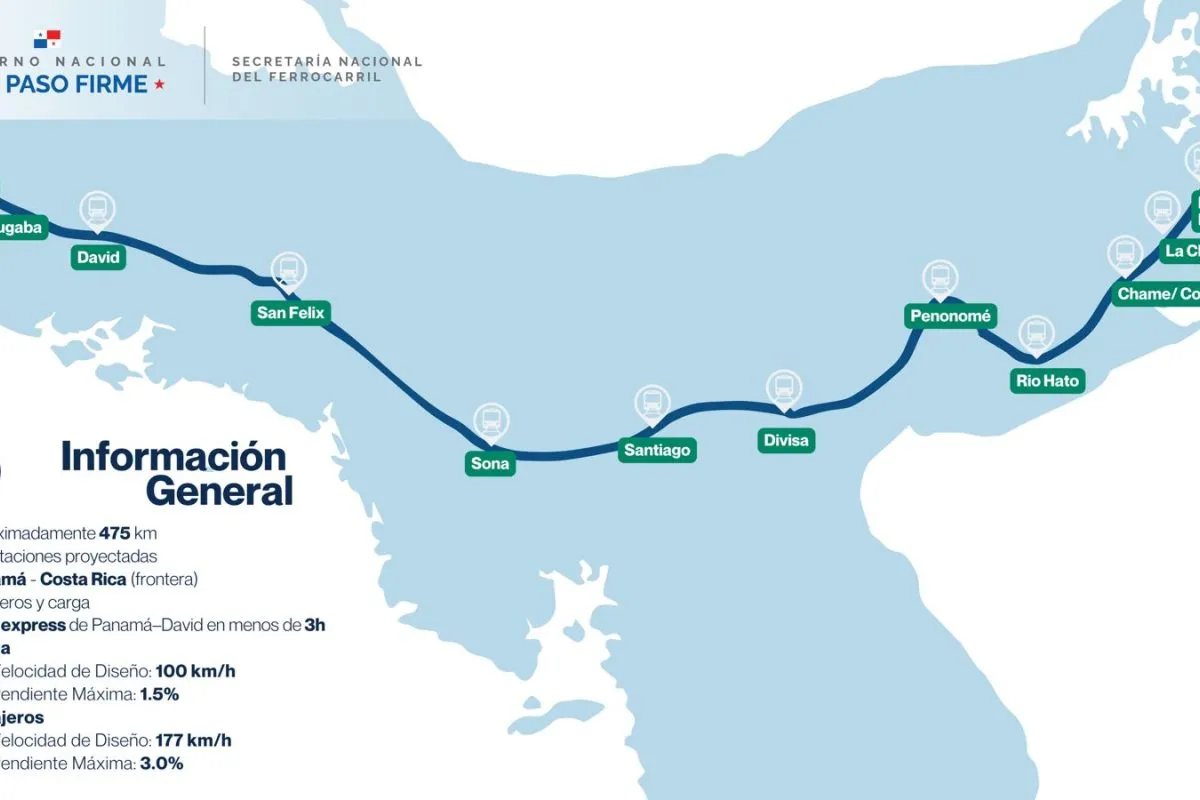
The Panamanian Cabinet Council has authorized a $4.17 million contract with the U.S. firm AECOM for technical advisory work on the proposed Panama-David-Frontier railway. This decision, made through Resolution No. 145-25, marks a concrete step forward for the massive infrastructure project intended to connect Panama City with the western province of Chiriquí and the border with Costa Rica.
The National Railway Secretariat will use the exceptional procedure contract to secure strategic engineering development and feasibility study consolidation. Officials stated that preparatory work, including the project’s master plan and initial environmental studies, is already underway.
“The Railway Secretariat has advanced in the master plan of the project, as well as in the scope of the 20 percent engineering development for a section of Phase 1,” the government resolution stated. [Translated from Spanish]
The immediate focus involves finalizing a comprehensive feasibility document. This work must align with the methodological guidelines set by Panama’s Ministry of Economy and Finance. The contract also covers technical oversight of ongoing geotechnical campaigns and the critical Environmental Impact Assessment (EIA) for Phase 1.

Fifth Canal Bridge Design Included in New Scope
A significant new element has been added to the project’s requirements. The consultancy must now include the conceptual design for a fifth bridge over the Panama Canal. This infrastructure is deemed essential for linking the railway corridor across the isthmus.
Authorities have requested the 20 percent engineering development for additional sections between Albrook Station and El Espino. Integrating this canal crossing represents one of the project’s most complex engineering challenges. Its design and cost estimation, referred to as CAPEX, form a core part of AECOM’s new assignment.
The broader train panama initiative aims to revitalize rail transport across the country. It promises to reduce road congestion and boost economic connectivity with western regions.
“The new consultancy must include the production and coordination of feasibility studies leading to the feasibility document,” the Cabinet resolution detailed. It also mandates “the design of the fifth bridge over the Panama Canal and the CAPEX estimate.” [Translated from Spanish]
Project planners are simultaneously developing a business plan. They are analyzing market demand and potential private investment mechanisms allowed under Panamanian law. A dedicated market study will identify key suppliers for railway services and related development opportunities.
Feasibility and Financial Modeling Under Review
Beyond pure engineering, the contract encompasses extensive financial and legal analysis. Consultants will work on integrating demand and supply studies to feed accurate financial models. A preliminary assessment of transit-oriented development potential at six key points is also required.
This phase includes a necessary review of the legal and regulatory framework related to project feasibility. The goal is to structure a project that is both technically sound and financially viable, potentially leveraging private investment.
The Railway Secretariat’s push indicates the government’s commitment to advancing this long-discussed corridor. Moving from preliminary studies to defined engineering on specific segments like the Albrook-Sajalices stretch shows tangible progress. All developments remain contingent on the outcomes of the ongoing environmental and feasibility reviews.
Panama continues to invest in major transportation upgrades. This railway project, alongside other infrastructure works, seeks to modernize national logistics and foster regional economic integration. The coming months will focus on completing the foundational studies that will determine the project’s final design and financial path forward.