


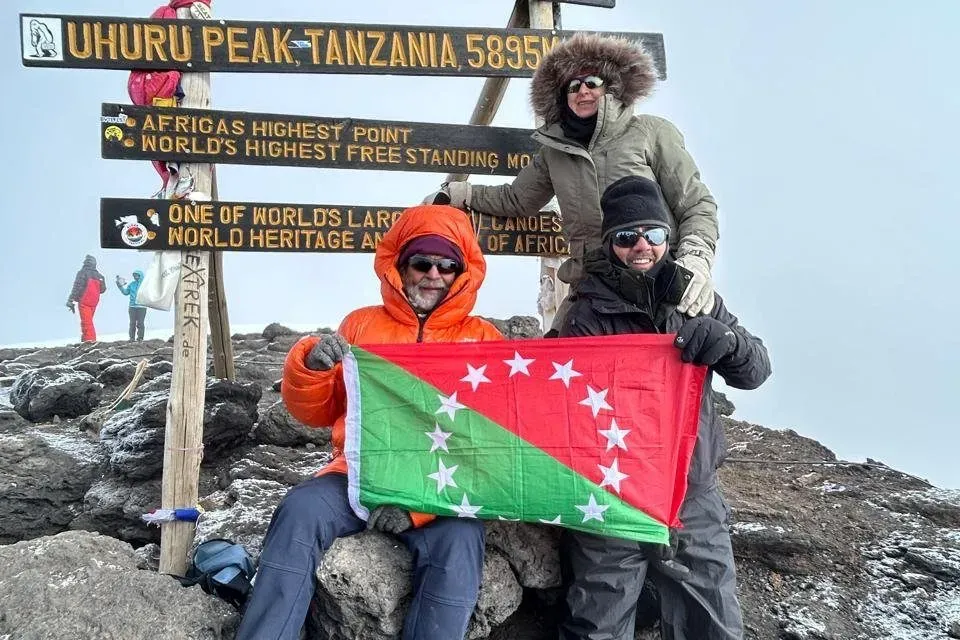
Roberto Brenes, a prominent 80-year-old Panamanian businessman and former president of the Panama Stock Exchange, has successfully summited Mount Kilimanjaro. Brenes reached the peak of Africa’s highest mountain in late 2024, planting the Panamanian flag at 5,895 meters after a grueling six-day ascent via the Machame route. This extraordinary feat caps a lifetime of athletic pursuits for the Geisha coffee producer and current board chairman of Singular.
The expedition required meticulous physical and mental preparation, which Brenes described as a return to his adventurous roots in Chiriquí province. His journey to the roof of Africa was supported by a team of porters and cooks, with the group facing significant altitude challenges that forced two members to turn back before reaching the summit.
First you see the clouds below you, which means it rarely rains up there but the wind is very strong. You reach that level with limited oxygen and experience a period where you release enormous amounts of endorphins, as if you had smoked a baseball bat. All of that is a product of the altitude. [Translated from Spanish]
Brenes explained the surreal experience of standing at the summit, where visitors typically remain for only fifteen minutes before beginning their descent. He noted that the descent proved particularly challenging, stating that after a certain age, going down stairs costs much more effort than going up, simply due to the physical toll.
Lifetime of Preparation for Ultimate Challenge
Brenes credits his successful summit to a lifetime of outdoor activities and specific altitude training. Born and raised in Chiriquí, he spent his youth hiking hills, swimming in rivers, free diving, and visiting islands. After moving to Panama City, he transitioned to organized sports including running, swimming, and cycling.
At age 55, Brenes committed to triathlon training, a discipline that pushed him to compete seriously. He completed his final Ironman Triathlon in Panama in 2022. In recent years, he returned to climbing Volcán Barú, Panama’s highest peak, and purchased a coffee farm in Piedra Candela, Chiriquí, at 1,600 meters elevation, which he regularly walks.
For Kilimanjaro you need to know how to adapt to the altitude, because Volcán Barú is at 3,400 meters and Kili reaches almost 6,000 meters. I highly recommend Cerro Fábrega in Bocas del Toro, which I climbed for the first time in my seventies. [Translated from Spanish]
His preparation included climbing Cerro Fábrega, Panama’s second-highest elevation, and completing multiple hikes from Boquete to Bocas del Toro. Brenes also undertook several expeditions in the Darién region, building the endurance necessary for high-altitude trekking.
The Call of Africa’s Solitary Giant
Brenes developed his fascination with Kilimanjaro during previous visits to Kenya and Tanzania, where he toured national parks. The mountain’s majestic, solitary presence captured his imagination, particularly during a hot air balloon ride in Kenya where he saw the peak rising above the clouds.
The opportunity to climb materialized when Panamanian guide Oliver López established connections with African outfitters. Brenes seized the chance to attempt the summit, recognizing it as the ultimate test of his lifelong fitness philosophy.
I have been to Kenya and Tanzania twice visiting parks, and Kilimanjaro always caught my attention. It is a majestic mountain, and also solitary, not connected to any mountain range. While in Kenya, from a balloon above the clouds, I had Kilimanjaro in front of me. I felt admiration. [Translated from Spanish]
Living at sea level presented a significant training challenge. To prepare for the altitude, Brenes underwent fourteen sessions at a hypoxic laboratory, training with a mask under simulated low-oxygen conditions while exercising on machines. This specialized preparation proved crucial for his successful acclimatization.
Seven Days on the Machame Route
The expedition began in Arusha, Tanzania, near Kilimanjaro International Airport. Brenes and his team selected the seven-day Machame route, known for its scenic beauty and better acclimatization profile. The journey took them through increasingly dramatic landscapes where they could appreciate the mountain’s majesty before ascending above the cloud line.
On the fifth night, the team camped, slept briefly, and began their final summit push at midnight. They reached the summit at dawn on the sixth day, with Brenes becoming the first in his group to plant the Panamanian flag.
We carried a group of porters and cooks, and every time we made camp they set up the tents. Usually you don’t eat lunch, there’s no lunch camp, you just stop, eat some snacks and continue. When you arrive at the sleeping place they set up the tents and you have dinner in a large tent with the group. [Translated from Spanish]
Logistics proved critical at higher elevations. The team conducted daily oxygen level and blood pressure checks above 4,000 meters, where altitude sickness typically begins affecting climbers. Headaches started around 3,000 meters for most participants. The expedition carried a satellite phone for emergency communications throughout the seven-day journey.
Sustenance and Survival in Extreme Conditions
Nutrition played a vital role in the team’s success. Meals provided adequate protein and substantial carbohydrates to fuel the demanding physical exertion. Brenes, drawing from his triathlon experience, brought energy gels and endurance supplements to maintain his performance.
He carried a 20-pound backpack containing 3 liters of water weighing 7 pounds, plus additional food. Porters handled the tents, sleeping bags, and clothing changes needed for the week-long expedition through dramatically changing temperatures.
The food was good, there was protein and lots of carbohydrates. As I have been a triathlete I brought energy gels, endurance gels, and a 20-pound backpack with 3 liters of water that weighs 7 pounds, and some food. The porters brought the tents, the sleeping bags and some clothing that you change during the 7 days, besides which it is freezing cold. I was the one who made coffee every day for the group. We drank high-altitude Tanzanian coffee. [Translated from Spanish]
Brenes took on the role of group barista, preparing coffee daily using high-altitude Tanzanian beans. This small ritual provided comfort and normalcy in the challenging environment, where temperatures dropped to extreme lows, particularly during the nighttime summit push.
The successful Kilimanjaro ascent represents another milestone for Brenes, who continues to demonstrate that age need not limit extraordinary physical achievement. His methodical preparation and lifelong commitment to fitness offer a blueprint for approaching major challenges, whether on African mountains or in business ventures.