


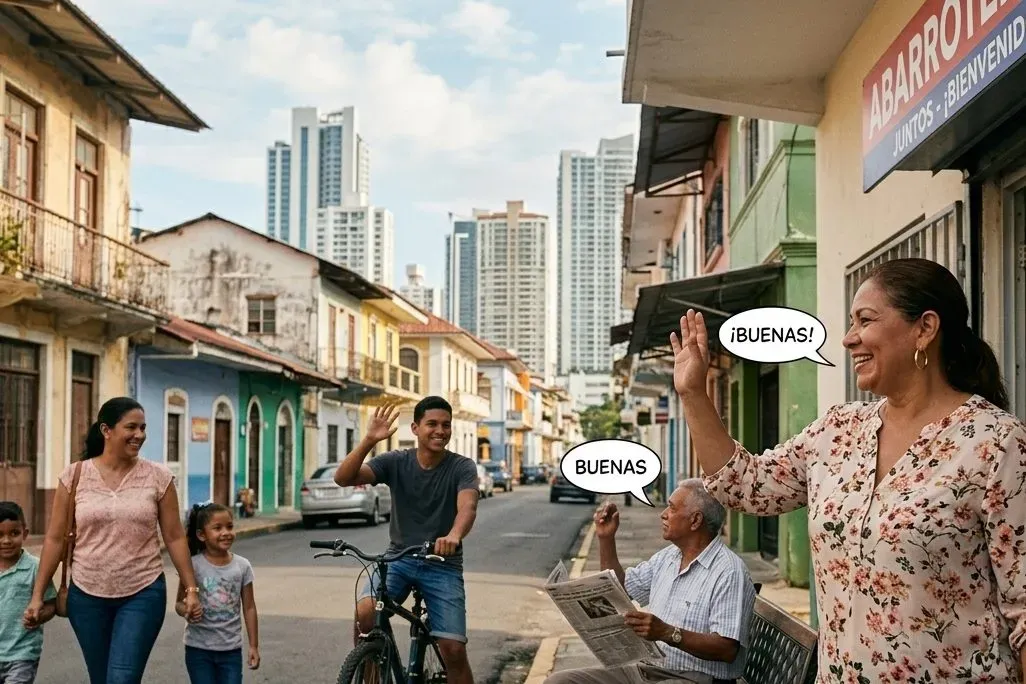
For newcomers to Panama, the most essential cultural lesson is not found in a guidebook. It is a single word heard countless times each day. The national custom of saying “Buenas” operates as the fundamental social glue for Panamanian society. This simple greeting shapes daily interactions from urban elevators to rural trails, creating a framework of respect that foreigners must learn to navigate successfully.
The practice is far more than a linguistic shortcut. It represents a core social contract. Cultural experts describe it as the invisible thread maintaining community cohesion in a nation balancing rapid modernization with deep tradition. Mastering its use is often the key for expats transitioning from being perceived as outsiders to being accepted as residents.
The Linguistic Simplicity and Social Complexity of ‘Buenas’
Linguistically, “Buenas” solves a practical problem. Formal Spanish language greetings require time sensitivity. Panamanians streamlined this with an all-purpose salutation. It works from dawn until midnight, eliminating the anxiety for newcomers about precisely when “buenos días” becomes “buenas tardes.”
“It is the first rule of engagement here,” said Maria Fernandez, a cultural liaison with the Tourism Authority. “When you say ‘Buenas,’ you are not just saying hello. You are acknowledging a person’s dignity and showing you were raised with manners, what we call ‘educación.'” [Translated from Spanish]
Ignoring this custom can have immediate social consequences. It may be interpreted as coldness or even a slight. In offices, shops, and public transport, the greeting is considered mandatory. This contrasts sharply with norms in North America or Europe where avoiding interaction with strangers in confined spaces is often standard practice.
The Mandatory Room Greeting and Its Cultural Weight
One of the most striking differences expats encounter is the “room greeting.” Entering a small store, a doctor’s waiting room, or a modest elevator requires addressing everyone present. A clear, audible “Buenas” broadcast to the room signals good upbringing. Failure to do so marks a person as rude or strangely aloof.
This practice dismantles what some sociologists call the “invisible social armor” common in larger Western cities. Panama’s culture intentionally rejects anonymous public spaces. The greeting humanizes strangers, transforming them from background figures into acknowledged individuals. This foundational act makes daily transactions smoother and fosters a baseline of community awareness.
In neighborhoods, this constant acknowledgment functions as a soft security check. Residents who greet each other regularly are more likely to notice unusual activity. It builds a network of casual recognition that enhances local safety.
Regional Variations and the Art of Delivery
The pronunciation and delivery of “Buenas” shift across the country, offering audible clues about regional identity. In Panama City, it is often quick and efficient, a brief urban nod to social protocol. The tone changes dramatically in the interior provinces.
On the Azuero Peninsula, widely considered the nation’s cultural heart, the word stretches into a melodic announcement. “Buueeeennnnaaaaassssss” is sung rather than spoken, reflecting a more tranquil pace of life. In rural areas without doorbells, a loud, calling “¡Buenas!” serves as the standard method for announcing one’s arrival at a gate or front door.
“The difference between the city ‘Buenas’ and the interior ‘Buenas’ is the difference between a handshake and a hug,” explained one Panamanian anthropologist . “Both accomplish the same goal of connection, but the energy and time invested reflect the local social rhythm.” [Translated from Spanish]
This variation demonstrates the greeting’s deep integration. It is not a monolithic rule but a flexible custom adapted to local contexts. For expats, listening to these nuances provides valuable insight into the unspoken rules of their specific community.
The Practical Impact on Daily Expat Life
Adopting this habit often marks the turning point in an expat’s cultural integration. The moment a person automatically says “Buenas” when entering a bus or a shop is the moment they stop feeling like an observer. They become a participant. This simple shift in behavior can dramatically alter how locals respond, often leading to more patient assistance and warmer interactions.
The order of operations is non-negotiable. A request must always be preceded by the greeting. Approaching a store clerk requires a “Buenas,” a pause for the returned greeting, and only then the question. Jumping directly to a demand for information or service is considered profoundly rude and will likely slow down the response. Pairing the word with brief, friendly eye contact communicates sincerity.
This emphasis on relational courtesy underpins Panama’s business and social environment. The country operates as a relationship-based society. Major transactions and minor repairs often depend on cultivated rapport as much as formal agreements. “Buenas” lays the first brick in that foundation of trust. It is an investment in social capital that pays dividends in smoother daily life.
The custom also lowers barriers in a nation of nearly four million people. It transforms a metropolis of strangers into a city of potential acquaintances. While Panama contends with modern stresses like traffic and bureaucracy, this ritual offers a constant, humanizing counterbalance. It reminds everyone they share the same physical and social space.
For those seeking to understand panamanian culture, mastering “Buenas” is the first and most critical step. It is more than vocabulary. It is the key that unlocks a more respectful, connected, and ultimately successful experience living in a country where Social etiquette is woven into the fabric of everyday language. The word itself may be simple, but its consistent use demonstrates a profound respect for the Panamanian way of life.