


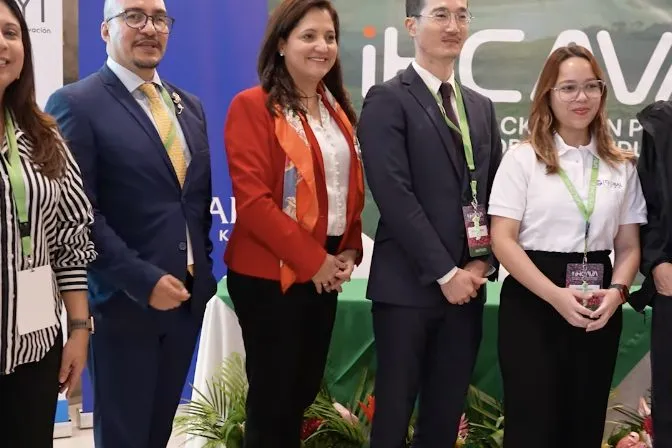
The Japan International Cooperation Agency (JICA) and Panama’s National Secretariat for Science, Technology, and Innovation (Senacyt) have launched a new pilot program. This initiative, called the IHCAVA Ideathon and Hackathon, aims to generate technological solutions for the agricultural sector in Chiriquí province. The program officially began its first phase in late January 2026.
Designed to strengthen the local agro-industrial value chain, the project connects farmers, agricultural businesses, and tech talent. Its core objective is to transform persistent field challenges into scalable, practical innovations. The Organization for Innovation and Business Culture (INNOBUC) is providing advisory support alongside specialized mentors.
“This project allows us to articulate the public, academic, and private sectors to generate applied solutions for agriculture,” said Fumiya Naito, head of the JICA Cooperation Team in Panama. [Translated from Spanish] He added that it promotes local capacity development and the participation of young talent.
Officials view the program as a direct investment in Panama’s innovation ecosystem. It creates a structured pipeline for problem-solving where the private sector’s needs meet academic and entrepreneurial energy.
Bridging Technology and Farming Challenges
Gladys Bernett, Senacyt’s Director of Business Innovation, explained the program’s broader significance. She stated it strengthens the national innovation framework by integrating productive sectors, academia, and technology.
“The initiative strengthens the national innovation ecosystem by integrating the productive sector, academia, entrepreneurship, and technological talent to address real country challenges,” Bernett said. [Translated from Spanish]
The methodology explicitly focuses on applied technology. Proposed solutions will incorporate artificial intelligence, Agrotech, and digital traceability tools. These technologies target tangible improvements in production processes across Chiriquí’s agricultural landscape.
This collaboration with the Japan International Cooperation Agency (JICA) underscores a shared commitment to sustainable development. JICA brings extensive experience in international technical cooperation to the table.
A Two-Phase Approach to Solution Development
The IHCAVA program unfolds across two intensive phases. Each stage has a distinct goal, moving from conceptual ideas to working prototypes.
The Ideathon phase occurred on January 27 and 28, 2026. Multidisciplinary teams first identified critical agricultural challenges. Their task involved constructing viable proposals adapted to real conditions in production, storage, transport, and commercialization. The focus remained on scalability and practicality from the very start.
Next comes the Hackathon scheduled for February 25 and 26, 2026. The best ideas from the Ideathon will advance to this technical development stage. Participants will build functional prototypes and Minimum Viable Products (MVPs). This involves hands-on work in software development, hardware programming, interface design, and technical validation.
Organizers anticipate the program will yield concrete technological tools. These solutions should directly address the needs of Chiriquí’s producers. The ultimate goal is a measurable contribution to modernizing Panama’s agricultural sector through homegrown innovation.