


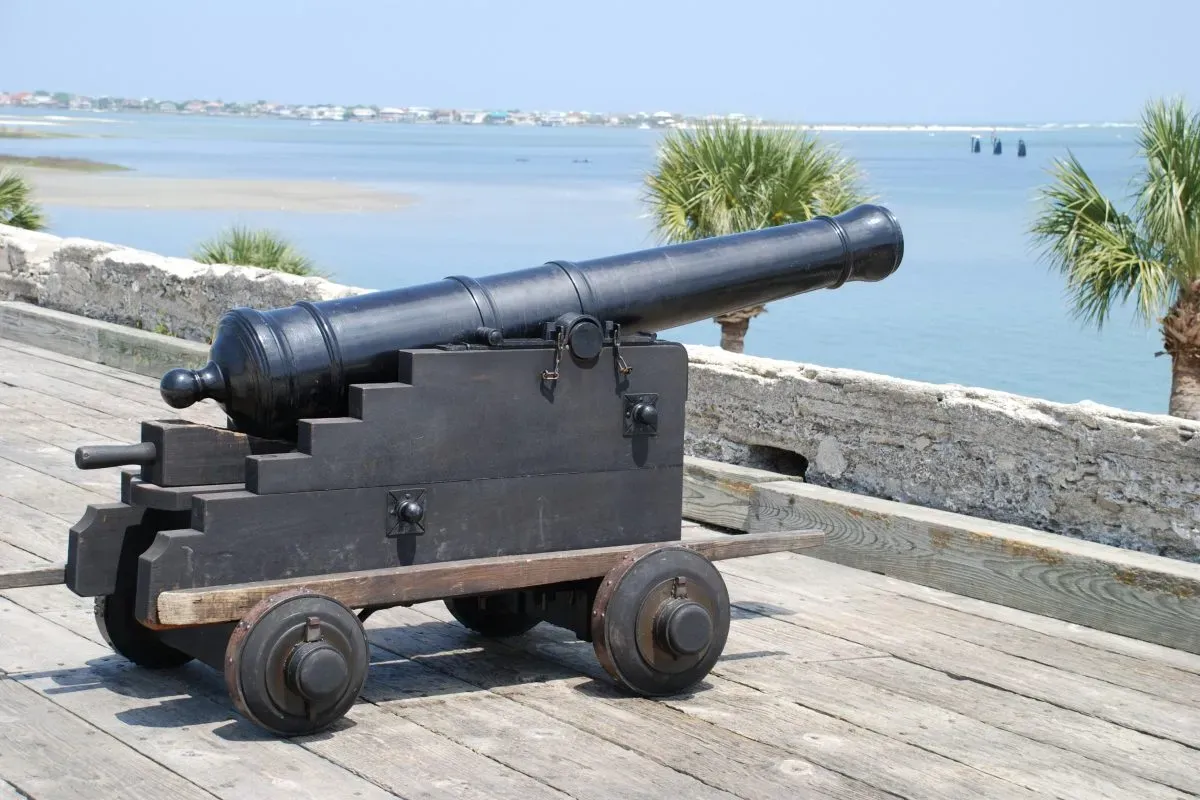
Workers on Panama’s Taboga Island have recovered two historic artillery pieces from the Second World War. The cannons, part of the island’s forgotten military past, will become a new cultural attraction. The project aims to highlight Taboga’s strategic role in defending the Panama Canal.
Samuel Pérez Flores, a biologist with the firm Thelmar leading the recovery, confirmed the operation’s success this week. His team, guided by local residents, located and extracted two of five known cannons from a remote western area of the island. The challenging terrain prevented the recovery of the remaining three pieces.
The recovered weapons are 155-millimeter GPF (Grande Puissance Filloux) model 1917 cannons. Each weighs approximately two tons. They were originally part of a mobile coastal defense network established by the United States. Pérez and his team are now preparing the artifacts for public display as a centerpiece of a broader initiative to blend history with ecotourism.
“We are rescuing these pieces from oblivion to turn them into a tourist attraction,” said Samuel Pérez Flores. “This helps people understand the historical and strategic importance of this island in defending the Panama Canal during the world wars of the last century.” [Translated from Spanish]
The project is spearheaded by the Panama Tourism Authority. Officials plan to integrate the cannons into a renovated trail system, creating a historical circuit. This effort seeks to diversify the cultural offerings of Taboga, often called the “Island of Flowers,” beyond its beaches.
A Strategic Bastion in Global Conflict
Taboga’s new tourist attraction stems from a deep and largely overlooked military history. The opening of the Panama Canal in 1914 coincided with the outbreak of the First World War. That event immediately forced authorities to prioritize the waterway’s military security. Forts were constructed at both Atlantic and Pacific entrances, heavily outfitted with artillery.
The strategic imperative intensified dramatically during World War II. The canal became one of the most critical points in the Western Hemisphere. Its ability to connect oceans made it a vital commercial artery and a potential target for the Axis powers. In this context, Taboga and the neighboring islet of Taboguilla emerged as key components within the canal’s defensive system.
The United States, acutely aware that a disruption to the canal would be a devastating logistical blow, perfected a defense-in-depth strategy. This system included coastal artillery, anti-aircraft batteries, and mobile units deployed at strategic points. Taboga was integrated into the defensive complex of Fort Amador on the mainland. The island hosted observation posts on strategic high ground and artillery positions like the newly recovered cannons.
Panamanian researcher Álvaro Visuetti has extensively studied the isthmus’s defense. He emphasizes the significance of these mobile batteries.
“The 155 mm mobile batteries installed in areas like Taboga represented a flexible response to changing threats,” Visuetti noted. “They integrated into a defensive system that prioritized constant surveillance of the Pacific.” [Translated from Spanish]
Visuetti also highlights that the canal’s defense did not rely solely on large fortifications. It depended on a coordinated network of observation, communication, and artillery. These installations were all linked to command centers in the former Canal Zone, forming part of the Caribbean Defense Command. Despite serious fears and concrete enemy plans, the canal was never directly attacked. The substantial military infrastructure, however, stands as a testament to the perceived threat.
From Forgotten Relics to Cultural Heritage
The two recovered cannons are tangible reminders of this global conflict’s local footprint. Abandoned for decades, they were found mounted on their original “Panama mounts.” These circular concrete platforms allowed the guns a 360-degree field of fire to counter potential naval incursions. Their recovery was a logistical challenge, requiring careful planning to navigate the island’s difficult topography.
The Tourism Authority’s project extends beyond the cannons. It includes rehabilitating the El Vigía lookout point, a key former observation post, and creating a new beach access for the El Morro trail. This work transforms scattered historical remnants into a coherent narrative for visitors. The goal is to offer an experience that combines natural beauty with a profound historical lesson.
For Panama, revisiting this past enriches the national historiography. It invites a reevaluation of the country’s role in a global conflict often narrated from distant theaters. The project on Taboga provides a physical anchor for that story. It turns overgrown concrete bunkers and rusting metal into open-air museum pieces.
Tourism officials expect the historical circuit to strengthen Taboga’s appeal. It offers a unique selling point distinct from other island destinations in Panama Bay. Visitors can now hike trails that once served military purposes, ending at viewpoints that scanned for enemy ships. They will encounter the massive cannons, preserved and interpreted for public education.
Future phases of the island’s development may look to other historical infrastructure projects for inspiration, such as regional ones historic rail corridor. The immediate focus remains on preparing the cannon site for its inauguration. Samuel Pérez Flores and his team are currently cleaning and stabilizing the artifacts. They are determining the final placement for optimal visitor access and preservation.
Taboga Island is rewriting its tourist map. By rescuing two cannons, it has unlocked a chapter of history that explains why this peaceful island was once a vigilant sentinel. The project proves that preservation and tourism can work together. It turns forgotten defense into a modern attraction.