


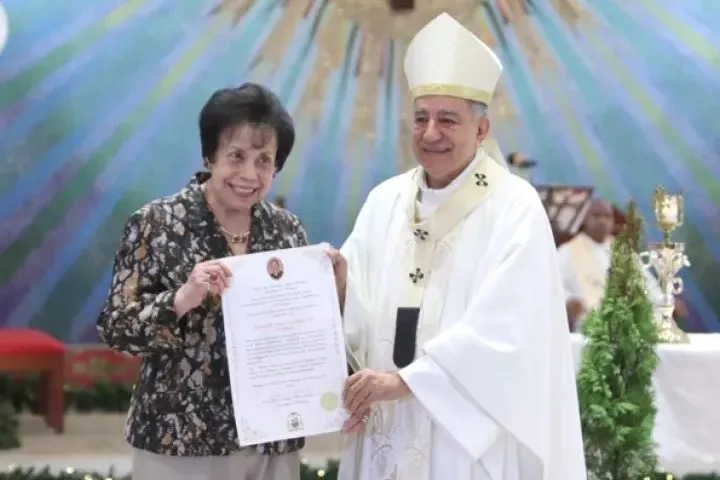
The Archdiocese of Panama presented its Santa María La Antigua medal to veteran journalist Luz María Noli Rodríguez during a special mass on Sunday, January 4. The ceremony recognized Noli’s decades of ethical leadership in Panamanian journalism, particularly during the nation’s most turbulent political periods. Archbishop José Domingo Ulloa led the tribute at the Metropolitan Cathedral as part of the archdiocese’s centennial jubilee year celebrations.
Noli, the first woman to serve as news director for the national broadcaster Televisora Nacional (TVN), was praised for her unwavering commitment to truth. The event deliberately coincided with the Epiphany (holiday), drawing a parallel between the Biblical Magi’s quest and a journalist’s duty.
A Career Forged in International Study and National Crisis
Archbishop Ulloa detailed Noli’s early career foundations during his homily. She pursued academic training in France and Spain, absorbing European journalistic principles that emphasized interpretation and context over mere repetition of facts. She brought that rigorous standard back to Panama, Ulloa said, elevating the quality of television news reporting.
“She prepared academically in France and Spain, learning from the best European journalism schools that reporting is not repeating, but interpreting with rigor, contextualizing, explaining with clarity,” Ulloa stated. [Translated from Spanish]
Her leadership was most critically tested when she assumed the news director role. Noli guided the newsroom through the final years of military dictatorship and the chaotic transition to democracy that followed. The archbishop specifically highlighted her work during the national broadcast of Pope John Paul II’s 1983 visit, an event that unified the country.
Steering Public Trust Through Political Upheaval
The homily painted a vivid picture of Noli’s role in the anxious period after the December 1989 U.S. invasion of Panama. Public institutions were fragile and credible information was scarce. Ulloa credited her with helping to rebuild the nation’s “informational shipwreck” during that time of profound disorientation and pain.
Her Sunday interview program, “Diálogo,” became a cornerstone of civic education for 25 years. Presidents, ministers, and social leaders sat across from her, facing prepared and incisive questioning. The program was known for its clarity and its respect for the audience’s intelligence, avoiding spectacle.
“Many remember that phrase which disarmed ambiguous speeches. ‘What you are trying to tell me is that…’ This revealed a prepared interviewer, incisive and deeply respectful of the public’s intelligence,” Ulloa recalled. [Translated from Spanish]
That approach, the archbishop argued, helped sustain public trust during repeated political, social, and moral crises. Noli’s career demonstrated that communicating with truth and hope is an essential service for democracy.
Jubilee Calls for Bridge-Building Communication
Sunday’s mass opened the archdiocese’s “Jubilee for the World of Communications.” The Church framed this as a period of grace and reflection for a society grappling with social tension and divisive rhetoric. The jubilee’s theme is “Communicate to build bridges and ignite hope.”
Archbishop Ulloa issued a direct challenge to modern media professionals. He urged them to follow the example of the Magi by offering their own symbolic gifts. These include the gold of honest professionalism, the incense of words faithful to truth, and the myrrh of courage when reporting requires personal sacrifice.
“The Church recognizes the urgency of a communication that does not feed fear or confrontation, but serves truth, encounter, and reconciliation,” Ulloa expressed. [Translated from Spanish] The honoring of Luz María Noli, he concluded, provided a concrete model of that ideal for current and future generations of Panamanian journalists.