


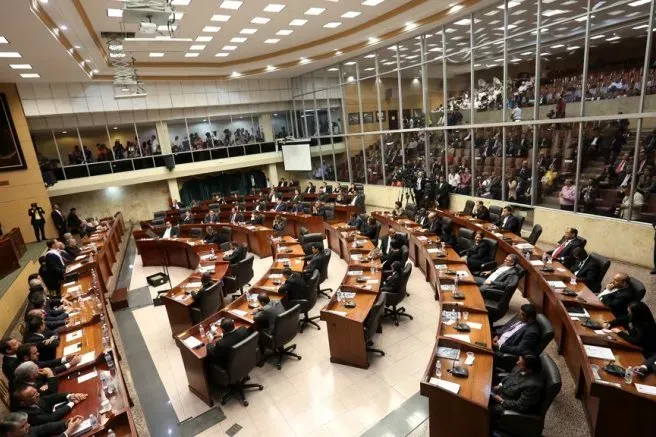
Panama’s National Assembly spent at least $59,000 on international flights and per diems for its legislators last year. Official travel records from 2025 show a pattern of trips to global forums, ideological conferences, and multilateral summits funded by taxpayers. While the total number of journeys was not extensive, several were notably expensive and concentrated among a small group of deputies.
The Directorate General of Finance for the legislature provided the documentation. It details travel for parliamentary events, “experience exchanges,” and specific diplomatic missions. Several lawmakers repeated international destinations, and one individual undertook two intercontinental trips within eight months.
“The pattern reflects selective missions, concentrated in few names,” wrote political editor Eliana Morales Gil, who reviewed the records. [Translated from Spanish]
The expenditures come amid ongoing public scrutiny of government spending. They highlight how the National Assembly allocates resources for its members’ international engagement.
Intercontinental Travel for Parliamentary Roles
Deputy Didiano Pinilla Ríos of the Democratic Change (CD) party logged two major trips. In February, he traveled to Morocco for a meeting of the Board of Directors of the Latin American and Caribbean Parliament (Parlatino). His seven-day journey featured a $3,600 airline ticket.
Pinilla flew again in September, this time to the People’s Republic of China. He attended the 2025 Friendly Exchange Forum for Legislators as a Parlatino representative. That ten-day trip cost $2,700 for airfare alone. His dual roles demonstrate how regional parliamentary appointments can facilitate extensive travel.
Focused Training and Ideological Conferences
Other trips had more specialized agendas. Roberto Archibold Chuito of the Panameñista Party spent five days in Medellín, Colombia. His mission focused on training in sustainable urban development and mass transit systems. The assembly covered his $372 airfare and $800 in per diems.
A clear ideological focus marked a June journey to Uruguay. Three deputies attended the Ibero-American Congress for Life and Family in Montevideo. The group included Jairo “Bolota” Salazar Ramírez of the PRD, along with Lilia Batista Rodríguez and Yuzaida Marín from the Realizing Goals (RM) party.
Their stays lasted five to six days. Combined costs for airfare and per diems for the trio exceeded $10,000. Marín defended the trip’s purpose at the time.
“Topics of great relevance for our societies were discussed, including strengthening public policies that promote the value of human life and the protection of the family as the fundamental nucleus of society,” Deputy Yuzaida Marín stated. [Translated from Spanish]
A Busy Autumn of Diplomatic Engagements
October proved a particularly active month for overseas travel. CD deputy Julio de la Guardia Arrocha attended an investment forum in Madrid. His five-day trip required a $4,787 airfare and $3,000 in expenses.
During the same period, his party colleague Manuel Cohen flew to Rio de Janeiro, Brazil. Cohen participated in the Fifth Latin American Forum against Antisemitism. His four-day mission cost $2,500 for the flight.
Alaín Cedeño Herrera of RM had a shorter trip to Ecuador shortly after. He engaged in a consultation mechanism meeting over two days, with costs totaling nearly $1,500.
Record Cost and Year-End Travel
The most expensive single ticket of the year was purchased in December. Carlos Agustín Afú Decerega, a CD deputy, traveled to New Delhi, India. He participated in a UNESCO Intergovernmental Committee meeting on intangible cultural heritage for eight days. The airfare alone reached $9,786.
Also in December, Edwin Vergara Castillo of the Panameñista Party went to Madrid for a preparatory meeting of the Ibero-American Parliamentary Forum. His ticket cost $4,134. Two other deputies, Manuel Cohen Salerno and José Luis Varela Rodríguez, traveled to Washington, D.C., for a conference of presidents.
The final tally of $59,000 does not represent an overwhelming sum for a national legislature’s annual operations. Critics might argue the figure seems modest. The concentration of trips among certain individuals and to specific types of events, however, raises questions about selection criteria and the tangible benefits for Panama’s National Assembly (Panama).
Administrative staff also undertook international travel on the assembly’s budget. An assistant traveled to Brussels for a parliamentary alliance summit on China in November, with a $4,500 flight. Another attended a political communication summit in Cartagena, Colombia, in September.
These records offer a transparent, if limited, snapshot of publicly funded international engagement. They show a legislature connected to global networks. The ongoing debate concerns how such connections are forged, who gets to represent the country, and what value these specific journeys ultimately bring back to Panamanian citizens funding them.