


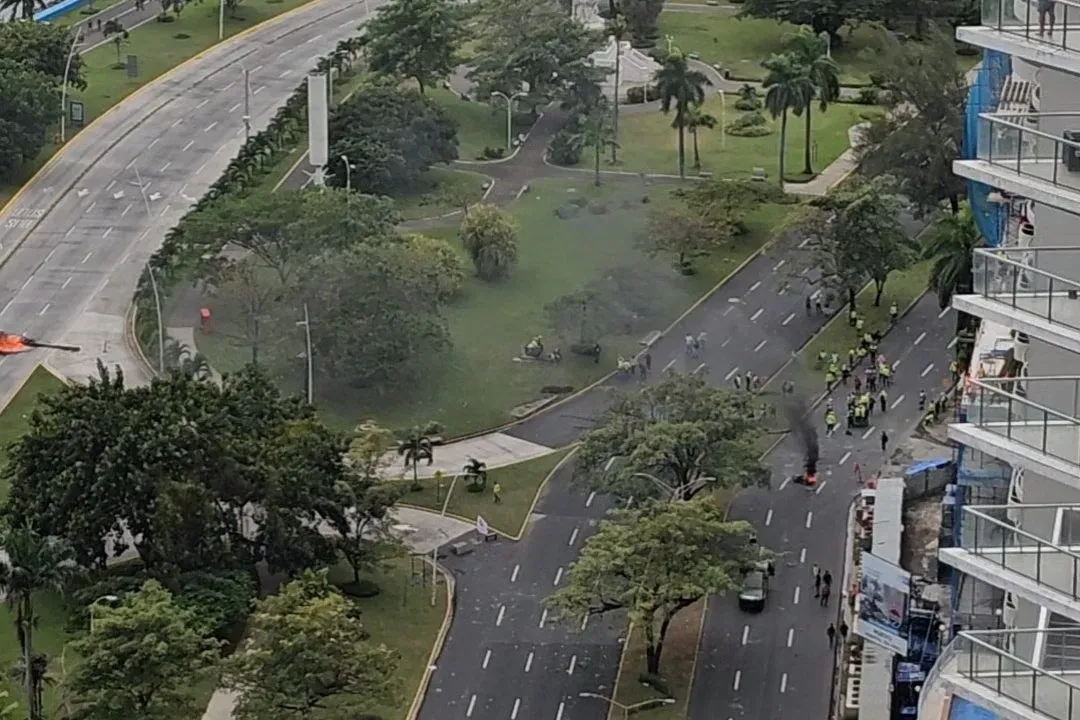
Panamanian President José Raúl Mulino issued a stark warning this week against a return to disruptive national protests. He promised his administration would not allow protestors to paralyze the country with road closures again. The president made these remarks during a public event in Chiriquí Province on Thursday.
Mulino spoke at the inauguration of the Remigio Rojas Irrigation System, a public works project representing an investment of 6.5 million dollars. His comments were directed at agricultural producers and business leaders gathered for the event. The president specifically referenced the widespread road blockades that brought significant parts of Panama to a standstill in 2023.
A Firm Stance on Economic Disruption
Addressing the crowd, Mulino recalled the severe economic and logistical consequences of the past protests. He described seeing trucks loaded with export goods stranded at Enrique Malek Airport while citizens struggled to find domestic gas. The president framed those events as a direct attack on the agricultural sector’s hard work.
“You know those endless road cuts and blockades are over, the ones they used to hinder the economic rhythm, to block tons of food and production that is the fruit of your effort,” Mulino told the audience. [Translated from Spanish]
He connected the past unrest to political actors, using strong language to condemn their methods. Mulino insisted the scenario would not be repeated under his watch. His pledge forms part of a broader emphasis on law, order, and economic stability for his government.
“It was painful to see the airport full of trailers with products for export, while people fought over a tank of gas. All for what? Because these communist scoundrels had this country blocked in five or six points, and that is not going to happen again,” the president stated. [Translated from Spanish]
The government’s position comes alongside concrete legislative action. Earlier this week, the Cabinet Council authorized Minister of Government Dinoska Montalvo to present a bill criminalizing the use of masks or hoods during demonstrations. That proposed law could impose prison sentences of up to six years, a move critics argue may infringe on the right to protest.
Commitment to Agricultural Projects
Beyond his warnings, President Mulino used the Chiriquí event to reaffirm his commitment to Panama’s agricultural development. He shifted his focus to another stalled irrigation initiative, defending its original purpose. The Tonosí Irrigation project in Los Santos Province was designed to provide water to producers during the dry season.
That project was halted following a Public Ministry investigation into the alleged disappearance of 39 million dollars. Mulino argued the project itself was unfairly maligned due to the corruption scandal surrounding it. He called it a “very good” project for a key agricultural and livestock region and vowed to see it through.
“My commitment is to leave the province of Los Santos working,” Mulino said, pledging to revive the essential infrastructure. [Translated from Spanish]
His dual message of security and agricultural support targets a core constituency. The administration appears to be balancing a hardline stance on public order with promises of tangible economic investment in rural areas. This approach aims to reassure farmers and business owners still recovering from past disruptions.
Observers note the president’s rhetoric signals a low tolerance for the protest tactics that defined previous years. The upcoming anti-mask legislation, coupled with these public declarations, establishes a clear policy direction. The government’s strategy is now facing scrutiny from human rights groups concerned about civil liberties.
For now, the agricultural sector in regions like Chiriquí appears to be a primary beneficiary of the current focus. The inaugurated irrigation system and promised revival of the Tonosí project represent direct investments. How the administration navigates the balance between security and freedom of assembly remains a developing story.