


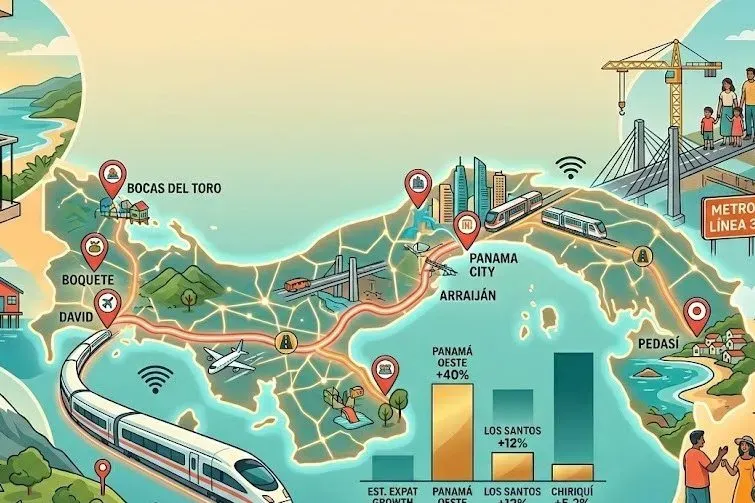
Major new infrastructure projects are actively reshaping where international migrants choose to live in Panama. Government data from 2025 reveals a pronounced shift away from traditional hubs, with expats and investors now targeting emerging regions connected by new railways, bridges, and highways. This movement is directly tied to the execution of the nation’s government strategic plan for national development and decentralization.
Foreign residency registrations in Panama Oeste, the region west of the capital, jumped 40 percent last year. This surge correlates with the ongoing construction of Metro Line 3 and the monumental Fourth Bridge over the Panama Canal. Once considered merely a commuter belt, the area is transforming into a primary destination. Master-planned communities like Panama Pacifico offer integrated living with special economic zones, attracting those seeking alternatives to the dense urban core.
Where Expats Are Moving According to Government Statisics
| Province | Foreign Resident % (Est. 2025/26) | Growth Driver |
| Panamá (City) | 55% | Business, Luxury, Connectivity |
| Panamá Oeste | 18% | Metro Line 3, Affordability |
| Chiriquí | 12% | Lifestyle, Retirement, New Rail |
| Los Santos | 7% | Digital Nomads, Eco-Tourism |
| Coclé (Coronado/Farallón) | 5% | Established Beach Communities |
| Others | 3% | Emerging Frontiers |
Source: Compiled from SNM Annual Reports and INEC Geographic Distribution Data
Connectivity Unlocks Previously Remote Regions
The trend extends far beyond the capital’s suburbs. Improved roads on the Azuero Peninsula have cut travel times, fueling a 12 percent rise in foreign-owned property titles in Los Santos province over two years. Locations like Pedasí and Playa Venao now combine reliable high-speed internet with eco-luxury appeals, drawing remote professionals and retirees alike. Meanwhile, the city of David in Chiriquí is solidifying its role as a secondary metropolitan center.
“The state’s priority is to develop the entire national territory with efficient, modern infrastructure that improves quality of life for all,” said Minister of Public Works Rafael Sabonge. [Translated from Spanish]
An expanded international airport and a proposed multi-billion dollar high-speed rail line to the region are key catalysts. Expatriates are settling in the foothill towns between David and the established hotspot of Boquete, seeking a balance of climate, amenities, and accessibility. Residential construction permits in Chiriquí are now growing faster than the national average.
Even Panama’s Caribbean coast is experiencing a renaissance through strategic public works. New water treatment plants and hospital facilities in areas like Bocas del Toro have addressed historical concerns about utilities and healthcare. These investments are making island and coastal living a more practical long-term proposition for foreign residents.
Public-Private Partnerships Accelerate Development
This nationwide build-out is largely powered by Panama’s framework for Public-Private Partnerships (PPPs). The model allows the government to leverage private capital and expertise for large-scale projects. It has become the engine for delivering the transport and utility corridors that are redrawing the country’s livability map. For migrants, this means reliability and modern services are reaching new frontiers.
The data underscores a clear geographic redistribution. While Panama City province still holds an estimated 55 percent of foreign residents, the share living in Panama Oeste has grown to 18 percent. Chiriquí and Los Santos now account for another 19 percent combined, a figure that continues to climb. Established beach communities in Coclé remain stable, while entirely new areas begin to register on the radar.
“We are not just building bridges, we are building connectivity and opportunities in every province. This is integrated development that creates new poles of economic growth,” stated Finance Minister Felipe Chapman. [Translated from Spanish]
The practical impact for current and prospective expats is significant. Daily life is becoming less centralized. The ability to work remotely from a beach town or a mountain valley no longer requires a major compromise on medical care or a difficult journey to an international airport. This infrastructure-led shift is creating a more diversified portfolio of lifestyle and investment options across the country.
This transformation also aligns with national goals to attract specific migrant profiles. The development of tech-ready communities with modern amenities is designed to appeal to digital nomads and skilled professionals. Simultaneously, improved healthcare and services support the retirement market. Panama’s attracting high-net-worth individuals with investments in luxury real estate within these new growth corridors.
Challenges persist, of course. Managing growth sustainably and ensuring local communities benefit are ongoing concerns. The success of these new hubs will depend on consistent maintenance and the continued expansion of social infrastructure like schools and clinics. Yet the direction is unmistakable. Panama’s interior and coastal regions are opening up in a profound way, fundamentally altering the classic expatriate playbook for the nation.