


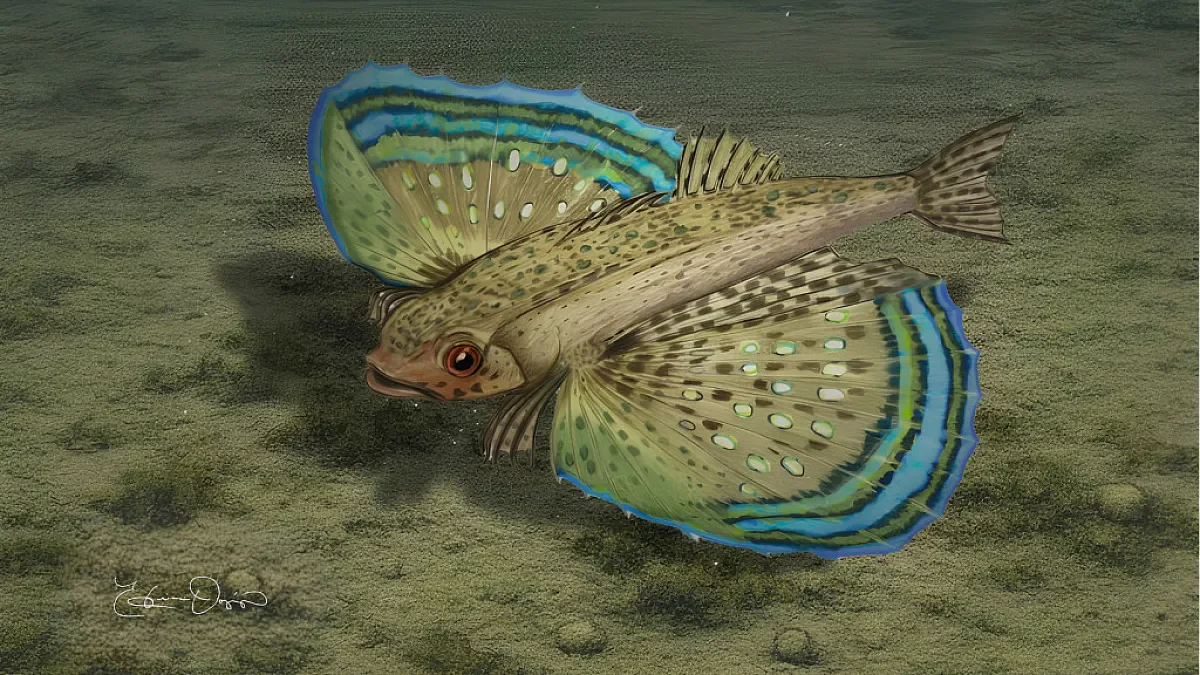
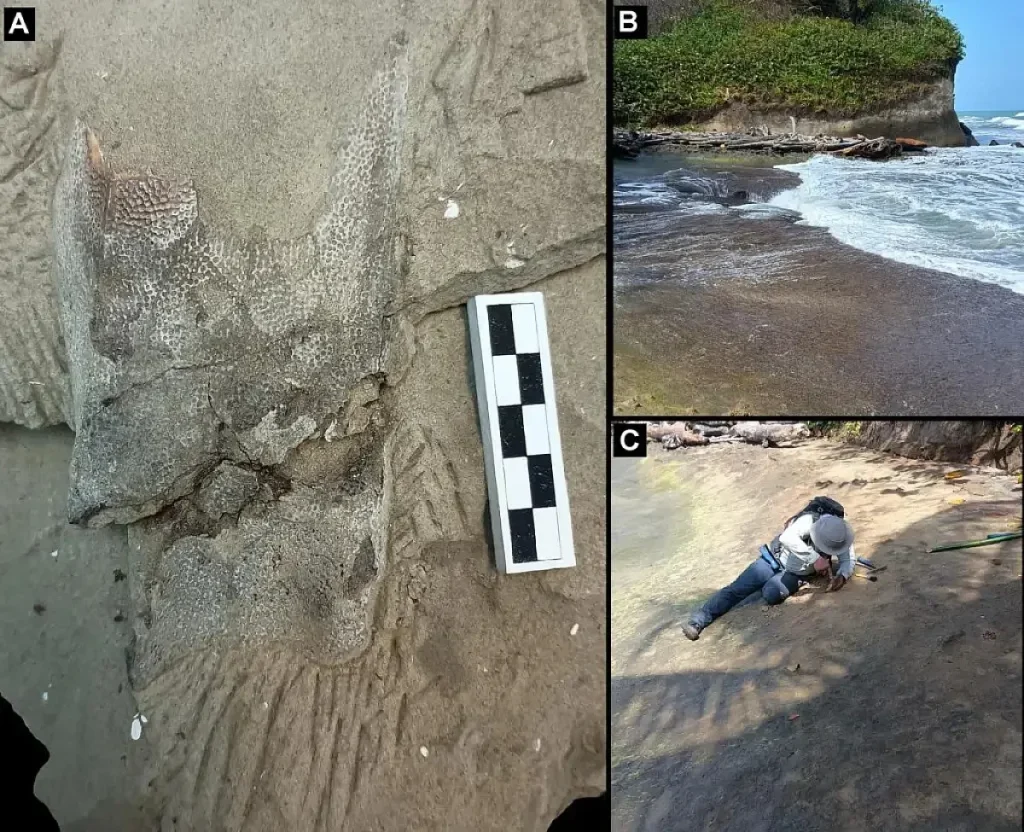
A fossilized fish head recovered from Panama’s Chagres Formation has turned out to be much more than just another specimen in a collection. Scientists from the University of Panama have identified the exceptionally preserved flying fish fossil as a completely new species, and the discovery is delivering fresh evidence about how the rise of the Central American isthmus reshaped marine evolution roughly 10 million years ago.
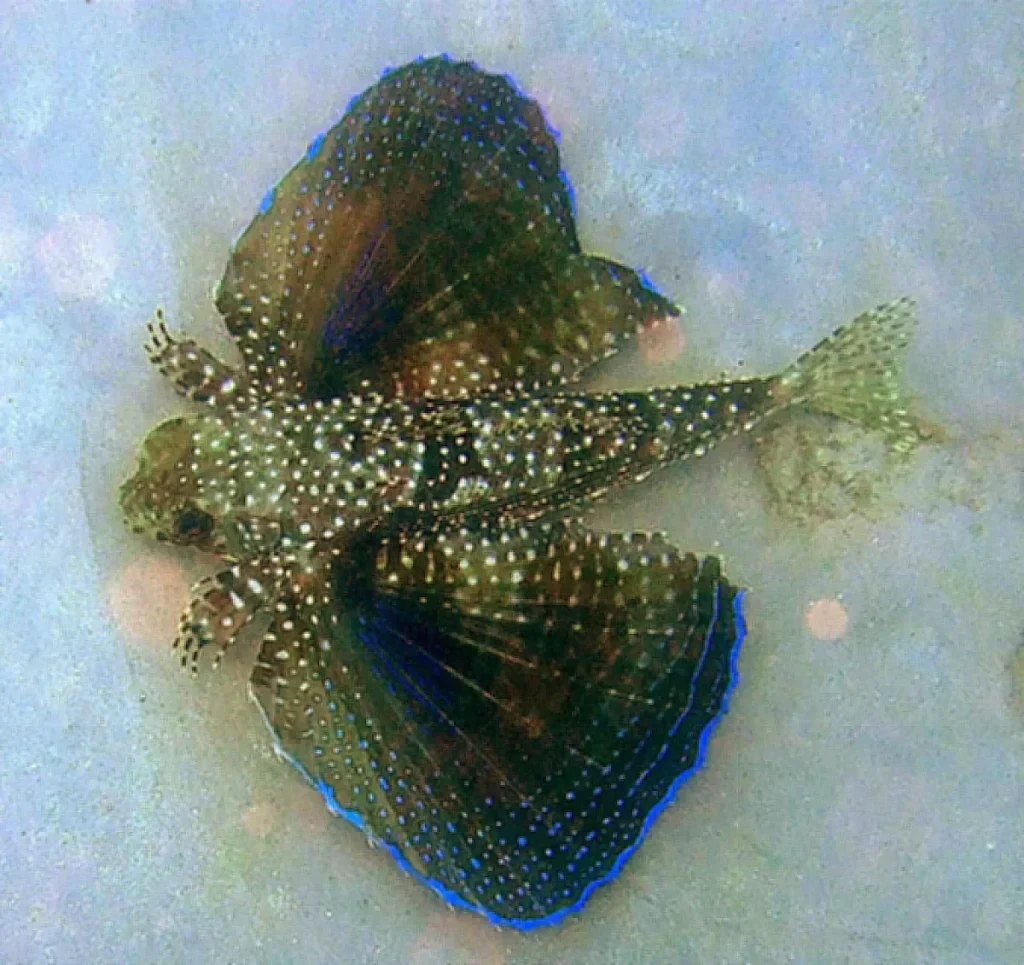
The new species, formally named Dactylopterus decrozi, belongs to the Dactylopteridae family, a group commonly known as flying gurnards or bat flying fish. These unusual fish possess enlarged pectoral fins that give them a wing-like appearance, though they glide through water rather than air. The formal description appeared in Scientific Reports, an international peer-reviewed journal, and the research team says the fossil represents the first direct evidence linking the closure of the Central American Seaway to speciation events in ocean fauna.
A Name That Honors Panama’s Marine Science Legacy
The scientific name Dactylopterus decrozi carries deep local significance. It pays posthumous tribute to Luis D’Croz, a marine biologist who served as a professor in the Department of Marine Biology at the University of Panama and as president of the Panamanian Association for the Advancement of Science. D’Croz helped shape several generations of Panamanian marine biologists during his career, and the researchers chose his name to recognize that lasting contribution to the scientific community.
Yostin Añino, from the university‘s Department of Zoology, participated in the study alongside Carlos De Gracia, who served as corresponding author and research coordinator. Their collaborative effort brought together paleontological expertise and advanced analytical methods to confirm that the fossilized head represented a species previously unknown to science.
How the Flying Fish Fossil Explains Isthmus Evolution
The presence of Dactylopterus in the Chagres Formation, combined with molecular clock analysis, points to a compelling evolutionary narrative. Researchers concluded that the divergence between Pacific and Atlantic lineages of this group happened approximately 10 million years ago, a timeline that aligns with the gradual closure of the Central American Seaway.
Before the isthmus fully emerged, a deep water passage known as the Central American Seaway connected the Pacific and Atlantic oceans. According to the study, the ancestral lineage of these fish migrated from the Pacific toward the Atlantic through those deep water passages while the isthmus was still forming. Once the deep connections closed, populations on either side became isolated from one another. That isolation opened the door for the Dactylopterus genus to evolve independently in the Atlantic. Scientists describe this process as vicariance, where a geological change creates a barrier that separates populations of the same lineage, setting the stage for differentiation and eventually the emergence of new species.
This fossil So stands for something bigger than a single specimen. It provides the first evidence that the Central American Seaway directly influenced speciation events in marine fauna during a pivotal window of Earth’s history. The timing matters because it places the evolutionary split squarely within the period when Central America was taking its modern shape, transforming ocean circulation and biological connectivity across the tropics.
Imaging and Rock Analysis Confirm Deep Marine Origins
To determine the specimen’s characteristics, the researchers turned to computed tomography at the Nuclear Instrumentation Laboratory of the Federal University of Rio de Janeiro in Brazil. Those scans gave the team a detailed look at internal structures without damaging the fossil and helped confirm that the fossilized head did not match any known species, clearing the way for its formal designation as a new taxon.
The investigation didn’t stop with the bones. Researchers also examined the rock that encased the fossil using spectroscopy and X-ray diffractometry at Fluminense Federal University, also in Brazil. The presence of minerals like andesine and pyrite indicated that the fish was buried close to where it died, in a deep marine setting with very low oxygen levels. Those conditions, hostile to scavengers and bacteria, likely contributed to the exceptional preservation of this flying fish fossil.
A Window into Panama’s Prehistoric Oceans
The Chagres Formation continues to yield remarkable paleontological treasures, and this new flying fish fossil adds an important chapter to the story of Panama’s deep past. Before the isthmus fully emerged, the waters that are now part of Central America served as a biological corridor. Species moved freely between what would become separate oceans. The closure of that corridor set off a cascade of evolutionary changes, affecting marine life across the region and beyond.
For paleontologists and marine biologists alike, the identification of Dactylopterus decrozi underscores how much remains to be discovered in Panama’s fossil-rich formations. It also demonstrates the value of international collaboration, with Panamanian researchers working alongside Brazilian institutions to apply cutting-edge analytical tools to locally collected specimens. Such partnerships expand what individual teams can achieve and bring sophisticated equipment within reach of researchers across Latin America.
Ultimately, this fossil tells a story of transformation, both geological and biological. The same forces that raised the Isthmus of Panama also split ancient populations, pushed marine life into new evolutionary directions, and left behind a record that scientists are only beginning to read. The newly named species stands as a tribute to that deep history and to the dedication of researchers like Luis D’Croz who devoted their lives to understanding Panama’s marine world.