


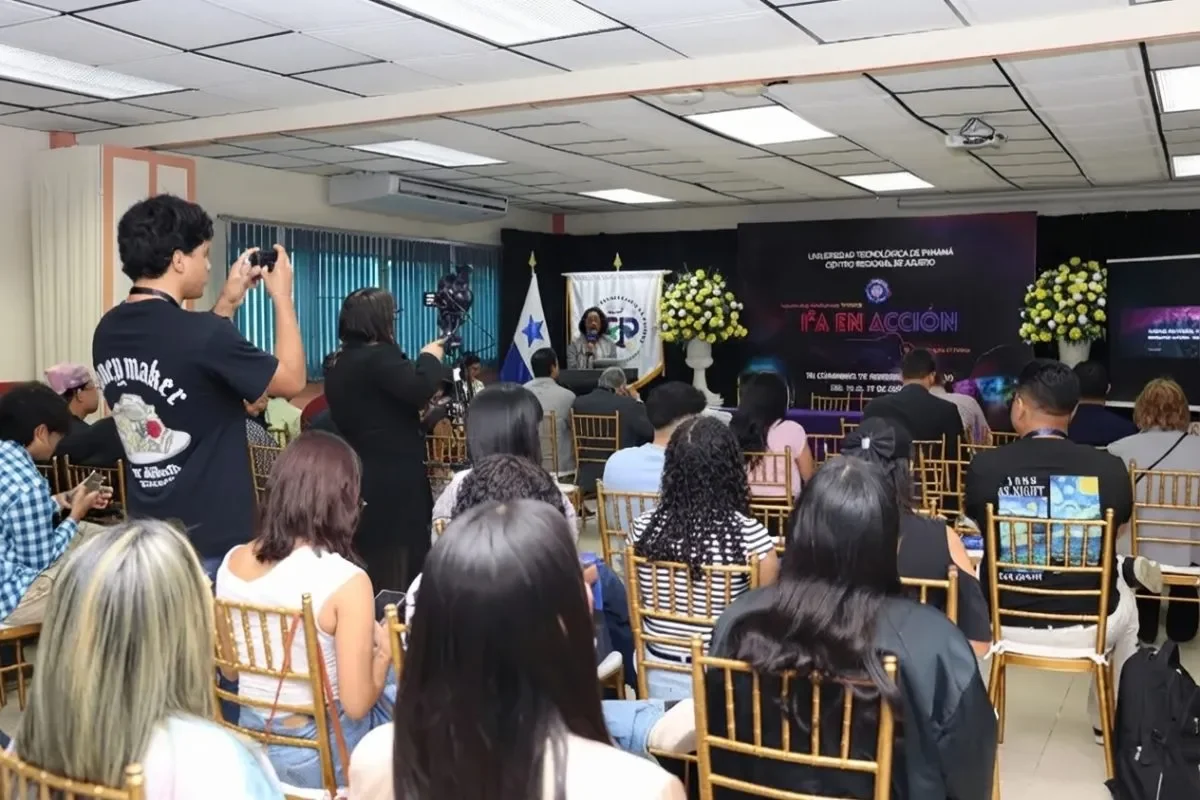
The Universidad Tecnológica de Panamá (UTP) hosted two regional technology congresses in September, advancing the national Azuero Chiriqui development strategy through discussions on artificial intelligence, semiconductors, and smart logistics. Specialists from seven countries gathered at UTP’s regional centers in Azuero and Chiriquí between September 15 and 18, 2026.
The Azuero event ran from September 15 to 17 as the XII Congress of Engineering, while Chiriquí hosted the V International Congress of Sciences and Technologies for Sustainable Development (CITDES 2026) from September 16 to 18. Participants came from Panama, Argentina, Colombia, the United States, Uruguay, Mexico, and Costa Rica.
National AI Strategy Presented at Azuero Engineering Congress
The Azuero congress operated under the theme “Engineering and Artificial Intelligence in Action: Designing the Future.” Organizers structured the event around six core areas, including sustainable civil engineering, energy and electrification, mechanical design and manufacturing, Industry 4.0 and logistics, digital technologies and AI, and applied science for sustainable development.
Ing. Elvira De León from Senacyt’s Office of Critical and Emerging Technologies presented Panama’s National Artificial Intelligence Strategy during the opening session. Alejandro Carbonell from Ciudad del Saber followed with an analysis of Panama’s innovation ecosystem and the transformations AI brings to the country.
Dr. Edwin Collado, a researcher at the Azuero Regional Center and congress president, emphasized the importance of knowledge exchange.
“Today more than ever, we need spaces that allow us to share knowledge, discover new ideas, build connections, and bring our students closer to the scientific and technological advances transforming our society” [Translated from Spanish]
Dr. Lilia Muñoz, UTP’s Vice Rector for Research, Graduate Studies, and Extension, represented Rector Dr. Ángela Laguna Caicedo. She stated that technology must serve humanity and sustainable development. The event also featured workshops, a science and business fair, an innovation forum, and cultural and sports activities.

Semiconductors and Smart Ports Dominate Chiriquí Agenda
The CITDES 2026 congress in Chiriquí focused on smart ports and logistics, sustainable mobility, hardware and semiconductors, transformation and innovation, intelligent systems, and educational innovation. Forums addressed four priority topics for Panama and the region: semiconductors, logistics, coffee, and English language instruction.
Joshua Hammerschlag from Mexico’s Tecnológico de Monterrey delivered a keynote on “Entrepreneurship with Impact.” Other master conferences covered engineering, digital transformation, infrastructure, logistics, and entrepreneurship. Researchers from Panama presented scientific articles in poster format after passing evaluation and originality verification processes.

Innovation Pitch Competitions Connect Labs to Markets
For the first time, the congress introduced two project presentation spaces before juries. The Transfer Pitch Lab and Pitch Tank UTP allowed participants to present innovation projects, business ideas, and technological solutions. Beyond receiving feedback, participants gained access to mentorship options, incubation programs, and knowledge transfer opportunities.
The closing sessions in Azuero featured Dr. Iván Villalón from ITESO, the Jesuit University of Guadalajara in Mexico, who presented “Artificial Intelligence: The Power to Create the Future.” Ing. Yazmín Mirones from Liberty Latin America delivered a conference titled “Designing Inside the Box.”
The dual congress format reflects UTP’s broader effort to decentralize technological capacity building beyond Panama City. By convening international specialists at regional centers, the university aims to strengthen local research networks and connect students with emerging industry demands in AI, semiconductor development, and intelligent infrastructure. The events underscore how regional academic institutions are positioning themselves as drivers of the national technology agenda.