


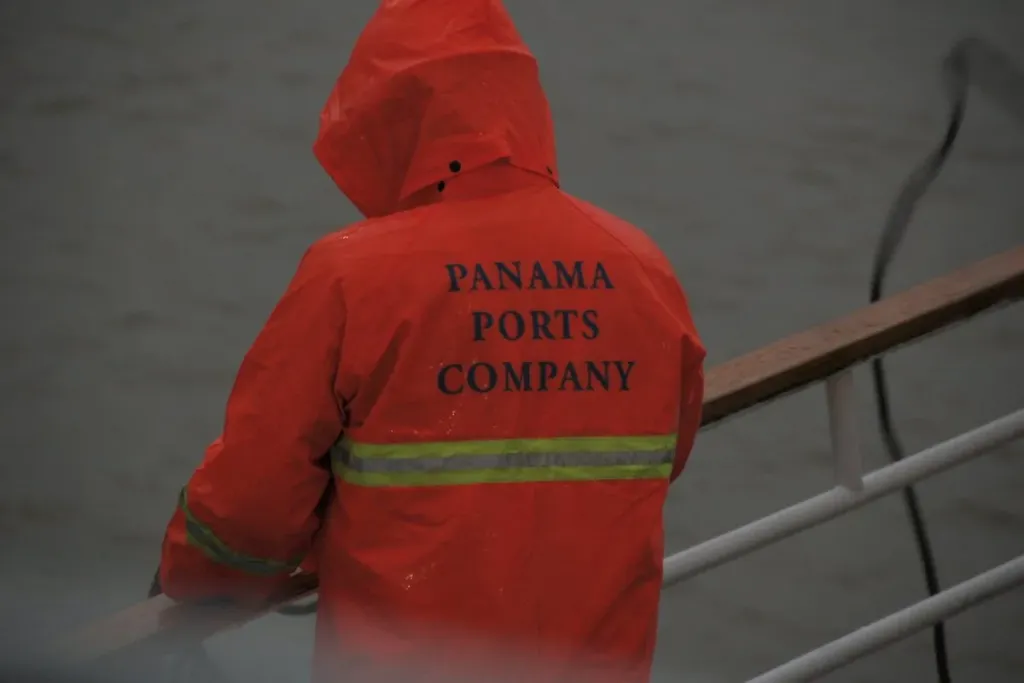
Panama Ports Company (PPC) has accused Panamanian authorities of conducting a surprise raid on its private storage facilities in Albrook. The company, a subsidiary of Hong Kong’s CK Hutchison Holdings, claims the February 26 operation targeted legally privileged documents related to ongoing court cases. This escalation follows the government’s takeover of the key Balboa and Cristobal ports just days earlier.
In a strongly worded statement released Friday, PPC labeled the state’s actions a breach of legal protocol. The company insists authorities entered a private storage center without prior notification. This facility, according to PPC, held proprietary information and material protected under attorney-client privilege, gathered for its judicial defense.
“This action demonstrates that the State has undermined due process as part of the state takeover,” the company stated. [Translated from Spanish]
The raid represents a sharp deterioration in the protracted dispute over port concessions. PPC asserts it had previously requested clear coordination mechanisms with the state to safeguard its confidential data. Instead of cooperation, the company says it faced what it calls “even more serious measures.”
Government Defends Port Takeover and Raid
The Public Ministry (Panama) provided a different account. Officials clarified the Albrook operation was an “exceptional search.” Superior Prosecutor Azael Samaniego, however, avoided confirming the targeted offices belonged to PPC specifically. The government’s position is that its actions are lawful and necessary.
This conflict stems from a definitive court ruling that found PPC’s contract with the state unconstitutional. That ruling paved the way for the Panama Maritime Authority (AMP) to assume control of the Balboa and Cristobal port terminals on February 23. The government then quickly approved interim 18-month contracts with new operators, APMT Panama S.A. and TIL Panama S.A., to run the critical logistics hubs.
“They were mistaken about the president and the government because here we do what must be done,” President José Raúl Mulino said during his weekly press conference, referencing PPC’s parent company. [Translated from Spanish]
President Mulino revealed that nearly all of last year was spent in negotiations with CK Hutchison executives in New York and Washington. He characterized those talks as unproductive, stating the only thing encountered was “arrogance.” The president firmly declared that no entity would forcibly remove Panama from its own ports.
International Arbitration Threat Looms
PPC’s statement warns of taking the case to international forums, signaling a likely move toward investor-state arbitration. The company argues the state has disregarded the rule of law, creating an environment where foreign investors cannot trust Panama’s legal and contractual framework. This claim strikes at the heart of Panama’s reputation as an investment destination.
The company also alleges a “daily campaign of disinformation” by the state. This campaign, PPC says, aims to distract public attention from what it terms the “forced taking” of the ports and the occupation of company assets. The panama ports company asserts the transition has been poorly coordinated and lacking transparency, leading to operational failures.
Financial details of the interim port contracts are now public. Resolution No. 4 approves a $26.1 million contract for APMT Panama to operate the Balboa port. Resolution No. 5 approves a $15.8 million contract for TIL Panama to run the Cristobal port. Both agreements are valid for 18 months, giving the state time to arrange a permanent solution for the strategic assets.
Legal experts note the raid on PPC’s offices adds a complex new layer to the dispute. The core issue involves the balance between state authority following a court order and the protection of private property rights, including intellectual property and legally privileged information. The company’s assertion that its due process rights were violated will likely form a key part of any international legal challenge.
The outcome of this high-stakes clash will resonate beyond the port terminals. It tests Panama’s institutional stability and its commitment to contractual sanctity for foreign investors. The operations of the panama ports are crucial for regional trade, meaning any prolonged instability could affect maritime logistics. For now, the Panama Ports Company and the Panamanian government remain on a direct collision course with no clear path to de-escalation in sight.