


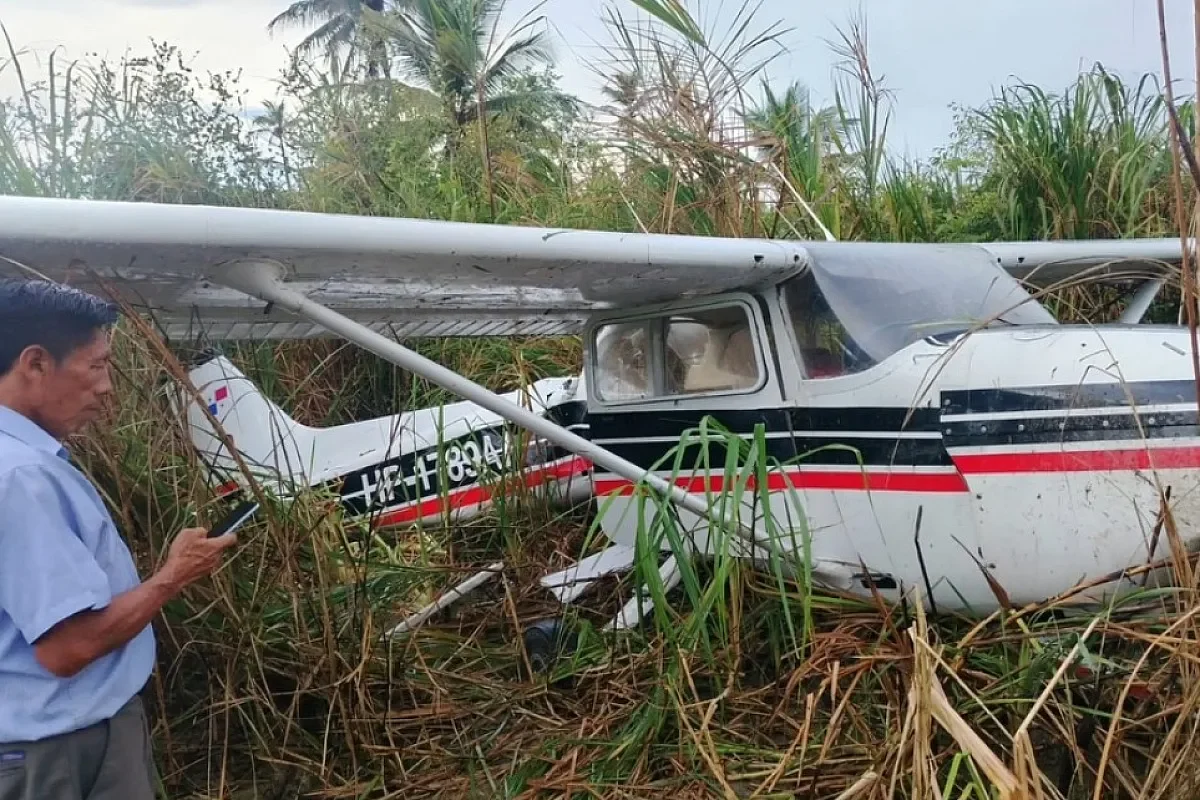
A pilot walked away completely unharmed Tuesday morning after a Panama aircraft accident sent his single‑engine plane swerving off the runway in Wanugandi, a remote airstrip in Panama’s Guna Yala indigenous region. The aviator was the only person on board when strong crosswinds grabbed the Cessna 172 during an attempted departure, leaving the aircraft damaged but sparing its occupant any physical injuries.
Adverse Weather Forces Precautionary Landing
The chain of events began earlier that morning. The aircraft, registration HP‑1789, had lifted off from Panama City’s Marcos A. Gelabert airport and was en route to the small coastal settlement of Achutupu. Around 10:00 a.m., deteriorating weather conditions made it impossible to continue safely. The pilot made an unscheduled but controlled landing on the Wanugandi strip, a move aviation officials later described as a standard precaution.
When the weather appeared to ease, he attempted to resume the flight. But as the Cessna accelerated down the runway, gusting winds struck with enough force to overwhelm the plane’s steering. The craft veered sharply to the right and left the prepared surface before coming to a stop. The Civil Aviation Authority (AAC) confirmed the pilot suffered no injuries and that nobody else was involved in the mishap.
Emergency Teams Deploy After Panama Aircraft Accident
Within hours of the incident, Panamanian authorities activated search‑and‑rescue protocols. A helicopter, call sign HP‑02A, ferried personnel from the AAC’s rescue service directly to the scene. Coordinating with airport security and operations crews already on the ground, the team secured the site and began initial assessments.
The AAC’s Accident Investigation Unit immediately launched a technical inquiry to piece together the exact causes. Investigators are examining the Cessna’s flight path, the local wind shear data, and the pilot’s handling of the emergency. In a statement, the AAC underscored its role as a safety watchdog.
“We reiterate our commitment to operational safety and will continue to ensure compliance with established protocols for air operations” [Translated from Spanish]
Aviation Lifelines in Panama’s Coastal Wilderness
The Panama aircraft accident highlights a broader reality of domestic air travel in regions like Guna Yala. With hundreds of small islands and a coastline perforated by dense jungle, fixed‑wing aircraft often serve as the only practical link between villages. Airstrips such as Wanugandi and Achutupu are short, sometimes unpaved, and frequently exposed to fast‑changing Caribbean weather.
Pilots flying these routes routinely contend with sudden squalls and tricky crosswinds, especially during the rainy season that peaks mid‑year. The Cessna 172, a high‑wing workhorse known for its forgiving handling and short‑field capabilities, has long been a staple for such operations. Still, even a veteran pilot can struggle when wind gusts overpower the rudder authority of a light aircraft during the critical takeoff roll.
What the Investigation Could Uncover
While the pilot’s quick decision to divert and his subsequent handling of the aborted takeoff likely prevented a far worse outcome, investigators will leave no detail unchecked. Their focus will include whether the gust was a sudden, isolated microburst, and if the runway surface itself played a role. They’ll also look at the aircraft’s maintenance records and the pilot’s recent experience in similar conditions.
Panama’s aviation safety framework requires that all such events, even those without casualties, undergo rigorous review. The findings could lead to updated operational bulletins for regional air carriers or revised training scenarios for short‑field takeoffs in high‑wind environments. For now, the priority remains gathering data from the incident site and the aircraft’s instruments.
Ultimately, the swift emergency response and the aviator’s survival underscore the resilience built into Panama’s regional air network. As the investigation continues, authorities maintain that protecting passengers and crews on every flight, no matter how remote the destination, stays central to their mission. The Wanugandi mishap serves as another real‑world test of a system designed to learn from close calls and keep the country’s small aircraft safely in the sky.