


Panamanian drivers will absorb one of the steepest fuel hikes of 2026 starting Friday at 6:00 a.m., when the Panama fuel increase takes effect across all gasoline grades and diesel. The National Energy Secretariat authorized price ceilings that push 95-octane gasoline up 10.5 cents per liter, 91-octane up 9.3 cents, and diesel up 13 cents, according to official figures released Wednesday.
For motorists in Panama City and Colón, that translates to $1.384 per liter for 95-octane, or roughly $5.24 per gallon. Diesel will reach $1.530 per liter, equivalent to $5.79 per gallon. The adjustments mark the largest single revision for gasoline since March and the second-largest diesel increase this year, trailing only July’s 18.3-cent surge.
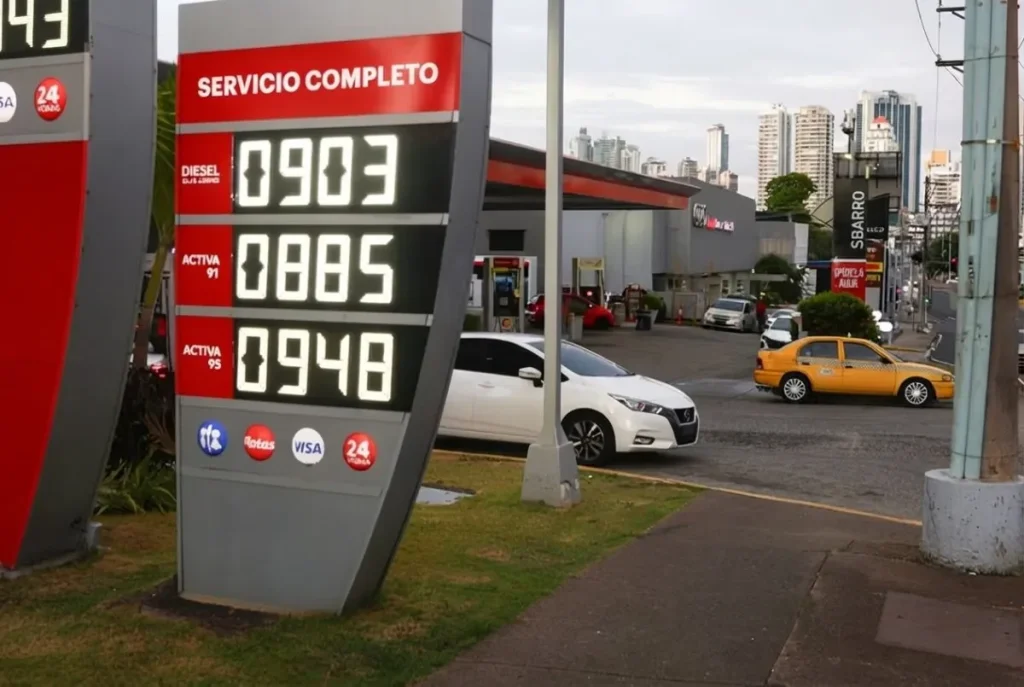
Panama Fuel Increase Breakdown by Region
The new maximum prices vary significantly outside the capital corridor due to transportation costs. In Changuinola, near the Costa Rican border, 95-octane gasoline will hit $1.434 per liter ($5.43 per gallon), while diesel climbs to $1.580 per liter ($5.98 per gallon). These rural prices reflect the added logistics expense of moving fuel to distant distribution points.
Percentage-wise, diesel users face the heaviest burden with a 9.3% biweekly jump, adding approximately 49 cents per gallon. Gasoline buyers aren’t spared either. The 95-octane grade rises 8.2%, costing drivers about 40 cents more per gallon, while 91-octane increases 7.8% or 35 cents per gallon.
Crude Oil Surge Drives Price Pressure
Behind the Panama fuel increase sits a dramatic run-up in international crude benchmarks. West Texas Intermediate jumped from $92.15 per barrel on September 2 to $107.02 by September 15, a 16.1% climb in just two weeks, according to U.S. Energy Information Administration data tracked through the St. Louis Federal Reserve.
The trajectory wasn’t linear. WTI peaked at $103.57 on September 10, dipped to $101.27 the following day, then resumed climbing. By September 15, futures settled at $105.83 after a 4.4% single-day gain driven by renewed supply concerns. Tensions in the Middle East and disruptions along strategic oil shipping routes fueled the volatility, traders said.

Economic Ripple Effects and Consumer Impact
The diesel increase carries outsized implications for Panama’s economy. Trucking companies, agricultural producers, and public transportation operators rely heavily on diesel, and their higher fuel costs typically filter through to consumer prices for food, goods, and services within weeks. Industry analysts noted that cargo transport rates could adjust upward before the end of September.
Reference price data for the September 2-15 period shows sustained pressure across all refined products. The 95-octane benchmark accumulated a 10.71% increase during those two weeks, while 91-octane rose 9.87% and diesel gained 10.54%. Comparing only the period’s start and end points, 91-octane actually outpaced the others at 6.65%, followed by 95-octane at 5.51% and diesel at 2.02%.
The National Energy Secretariat reviews fuel prices every two weeks, adjusting maximum ceilings based on international refined product references, crude oil movements, and exchange rates. Panama’s dollarized economy and open fuel market make local prices particularly sensitive to global oil swings, leaving consumers exposed to rapid adjustments like the one taking effect Friday.