


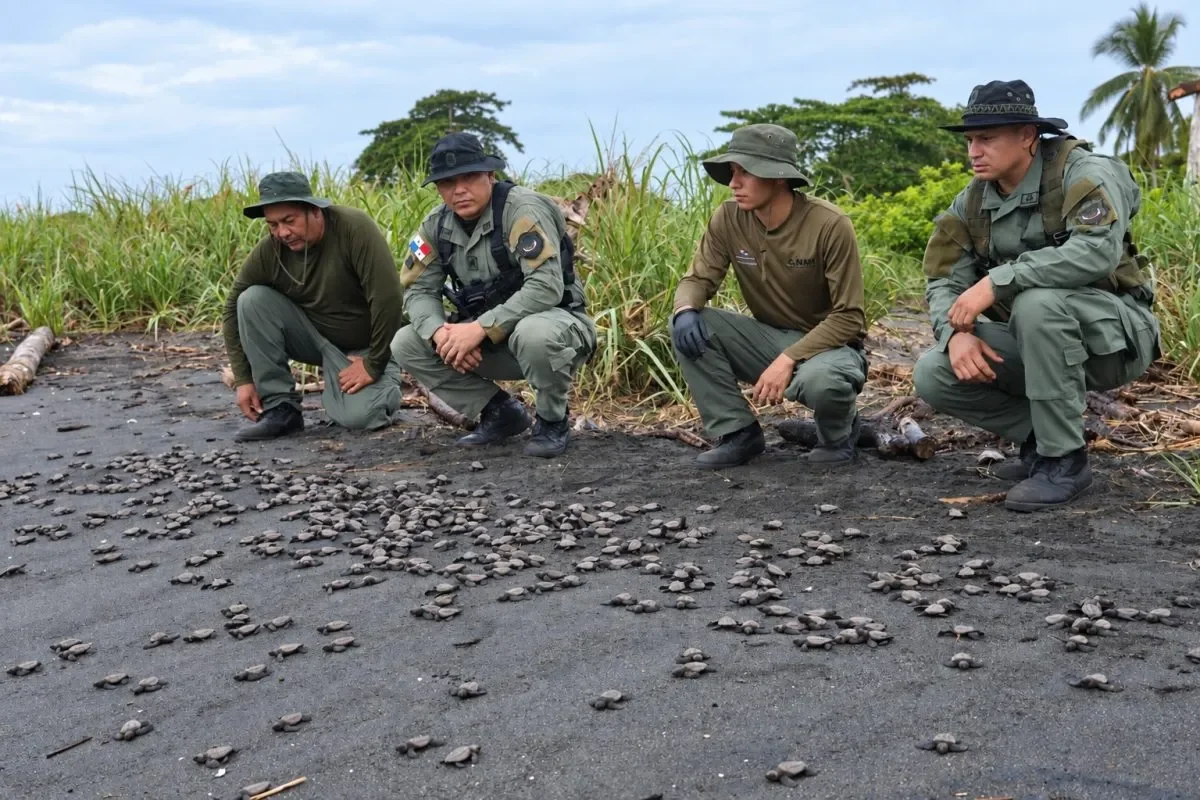
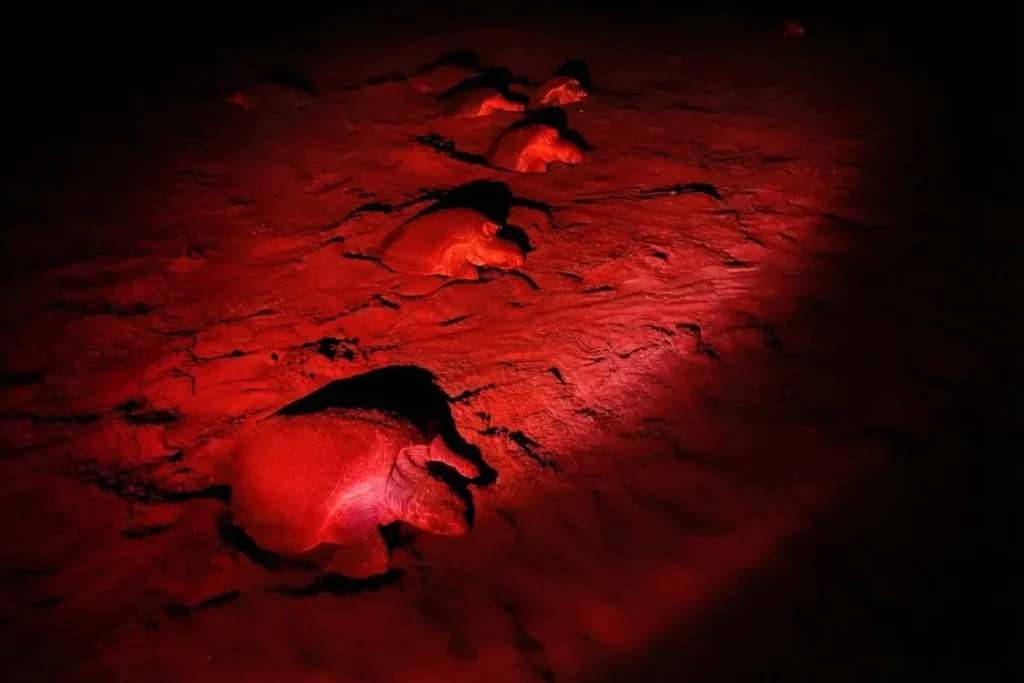
Under the cover of darkness along Panama’s southern coastline, an ancient ritual unfolds with remarkable intensity this September. More than 10,000 sea turtle nests now dot the volcanic sands of Tonosí in Los Santos province, each one representing a fragile promise of survival for species that have navigated Earth’s oceans for over 100 million years. The sheer density of nesting activity across Isla Cañas Wildlife Refuge and La Marinera Reserve has transformed these remote beaches into one of the hemisphere’s most critical conservation frontlines, where biologists and park rangers work through the night to ensure that what begins as a buried clutch of eggs ends as a scramble toward the surf.
📑 Table of Contents
The numbers tell a story of both urgency and hope. At Isla Cañas alone, conservation teams currently safeguard 419 nests holding 41,982 olive ridley turtle eggs, the highest count anywhere in Panama. Each nest averages roughly 100 eggs, and with incubation success rates exceeding 80 percent, thousands of hatchlings are already making their way into Pacific waters. At La Marinera, where nests remain undisturbed along the natural beach rather than being relocated to hatcheries, the scale of protection defies precise measurement. Marine biologist Maylin Rivera, a researcher with the National System of Protected Areas, suggests the figure likely surpasses 800,000 eggs spread across the shoreline.
The Night Watch Protecting Sea Turtle Nests From Silent Threats
Between six in the evening and six in the morning, the beaches of Tonosí become a coordinated operation of patience and precision. Teams of biologists, park rangers, and environmental police patrol continuously, scanning the dark shoreline for the telltale tracks of a female turtle emerging from the Pacific. Each encounter triggers a careful protocol, measuring the turtle, checking for identification tags, and evaluating any anomalies that might affect her nesting success. The work never pauses because the stakes never diminish.
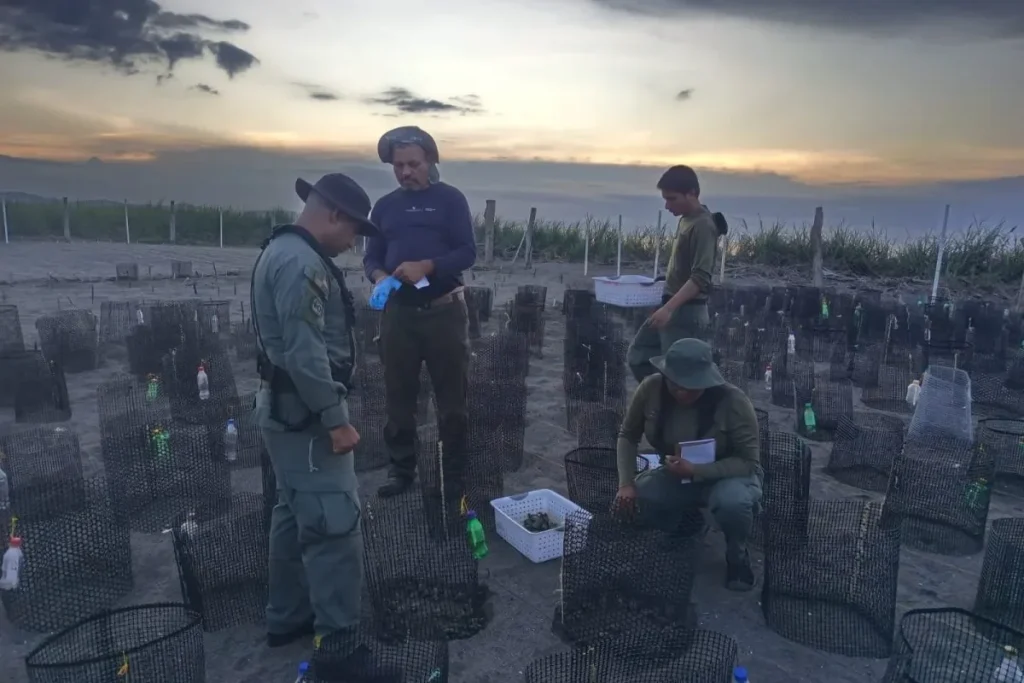
“From six in the evening until six in the morning, monitoring intensifies. At nightfall, the technical team and park rangers continuously patrol the entire beach, recording every female that arrives to nest. During this process, measurements are taken, we verify if she is tagged, and we evaluate the presence of anomalies or other relevant characteristics for identification and tracking. These actions are permanent, because 85% of rescued eggs reaching their final phase, which is hatching, depends on this,” Rivera explained [Translated from Spanish].
That 85 percent hatch rate represents the difference between extinction and recovery for species like the olive ridley and green turtle. The work extends beyond simply counting nests. Teams must decide which clutches can remain in situ, protected by their natural camouflage and beach positioning, and which require relocation to artificial hatcheries due to erosion threats, flooding risks, or predation pressure. At Isla Cañas, three hatcheries now operate at full capacity, with plans underway to open a fourth as the nesting season continues through its peak months.
Temperature, Magnetic Fields, and the Science Behind Nest Survival
What happens inside those buried nests over 45 to 60 days determines not just how many turtles hatch, but what sex they will be. Sea turtles employ temperature-dependent sex determination, a biological mechanism that makes nest temperature a decisive factor in population dynamics. Warmer nests produce more females, while cooler conditions favor males. This reality places climate considerations at the center of conservation strategy, as shifting sand temperatures could skew future generations in ways scientists are still working to fully understand.
Rivera detailed how the team monitors temperature and humidity within protected nests, achieving birth success rates above 80 percent through careful environmental management. But the science extends beyond the nest itself. Hatchlings emerge equipped with geomagnetic imprinting, an internal navigation system that records the magnetic signature of their birthplace. This biological compass allows them to return to the same beaches years later when they reach reproductive age. The slope of the beach, natural light on the horizon, and wave movement all guide their first critical journey to the ocean.
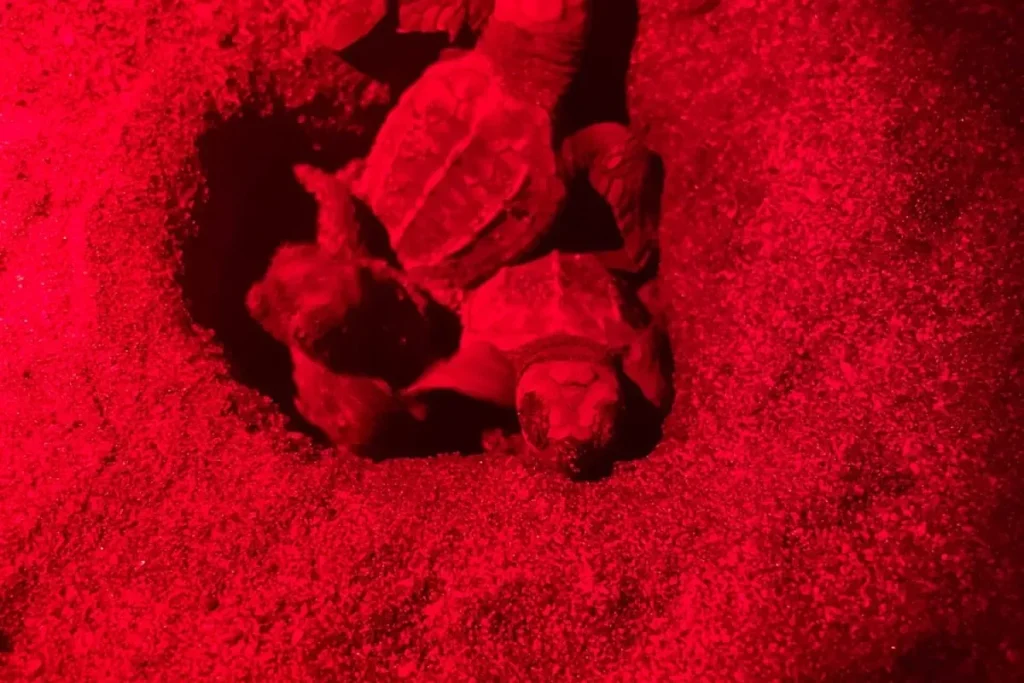
For conservationists, this means protecting sea turtle nests today is an investment in future nesting seasons. Every female that survives to adulthood carries the potential to return to these same sands, continuing a cycle that predates human civilization. The work at Tonosí recognizes that hatchling survival is only the first chapter in a decades-long story of migration, maturation, and eventual return.
La Marinera’s Pristine Advantage and Isla Cañas’ Community Challenge
La Marinera Reserve represents something increasingly rare on Central America’s Pacific coast, a beach without permanent human settlement, artificial lighting, or constant noise. Here, nests remain where turtles place them, scattered along the shoreline in patterns dictated by instinct rather than human intervention. The absence of disturbance creates conditions where arribadas, the mass synchronized nesting events that make olive ridley turtles famous, can unfold naturally. Some nests still require relocation to the artificial hatchery when erosion or flooding threatens, but the fundamental approach prioritizes maintaining natural ecological processes.
Isla Cañas presents a different reality, one where conservation must coexist with human presence. The refuge includes populated areas with residences, artificial lighting, noise pollution, and domestic animals, all factors that complicate turtle nesting success. Rivera emphasized how the team has invested heavily in environmental education and community awareness, working to build respect for conservation regulations among local residents. The three full hatcheries at Isla Cañas demonstrate the intensive management required when natural nesting faces human pressures.
“In this place, the dynamics are different. Here there is population, residences, light pollution, noise, domestic animals, with which we have been doing environmental education work, awareness, and respect for the conservation and protection regulations that exist to safeguard sea turtles,” Rivera stated [Translated from Spanish].
From Hatchery to Horizon and the Long Road Home
The moment a hatchling breaks free from its egg marks the beginning of a journey measured in decades and thousands of nautical miles. After emergence, the tiny turtles navigate toward the ocean using environmental cues that have guided their species through epochs of planetary change. The slope of the beach directs them downward, the natural light of the horizon pulls them seaward, and wave movement provides the final signal that they have reached their destination. What follows is a period of dispersal and growth that remains largely mysterious to science.
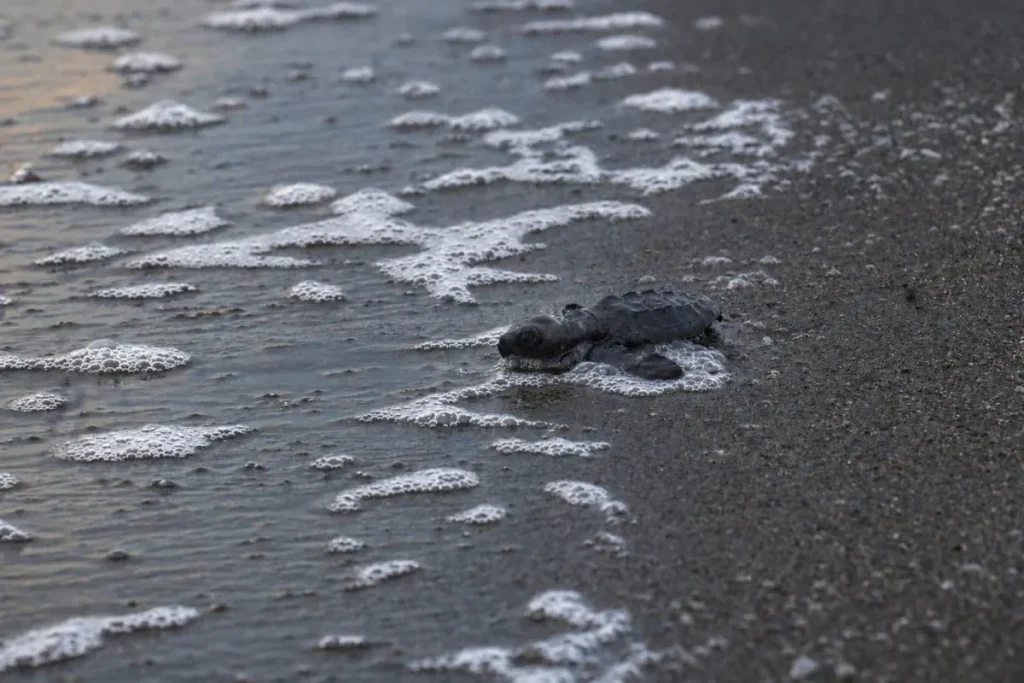
For the teams at Tonosí, the release of 27,910 neonates from La Marinera and 8,735 from Isla Cañas this season represents measurable success in a field where outcomes often remain uncertain. Each released hatchling carries the genetic legacy of its species and the accumulated knowledge of countless generations. Whether they survive to adulthood depends on ocean conditions, predation, fishing pressures, and luck. But the foundation built during those first critical hours on the beach, protected from predators and human disturbance, gives them a fighting chance.
The work of protecting sea turtle nests extends far beyond counting eggs and patrolling beaches. It encompasses temperature monitoring, community engagement, scientific research, and the patient accumulation of data that informs future conservation decisions. The 24-hour dedication of MiAMBIENTE personnel, park rangers, and environmental police reflects an understanding that these beaches represent irreplaceable habitat for species whose continued existence depends entirely on human willingness to share the shoreline.
A Shared Responsibility for Panama’s Marine Heritage
As the 2026 nesting season continues, the message from MiAMBIENTE remains consistent and urgent. Anyone encountering a nesting turtle should maintain distance, avoid artificial lights, and respect the fragile process unfolding before them. The agency’s call for shared responsibility recognizes that conservation cannot succeed through enforcement alone. It requires a cultural shift, one where coastal communities see themselves as stewards rather than spectators of marine life.
The beaches of Tonosí hold more than eggs and hatchlings. They hold the accumulated wisdom of species that survived the extinction of dinosaurs and adapted to changing oceans across geological time. That such ancient creatures still return to these shores, seeking the same sands their ancestors chose, speaks to the remarkable continuity of life on Earth. Protecting sea turtle nests here means preserving that continuity for generations yet to come.
Each September brings new arribadas, new nests, and new opportunities to get conservation right. The 10,000 nests currently under protection in Los Santos represent not just a seasonal milestone but a testament to what dedicated teams can achieve when science, community engagement, and political will align. In the darkness of these Pacific beaches, the future of sea turtle populations is being written one nest at a time, one hatchling at a time, one night patrol at a time.