
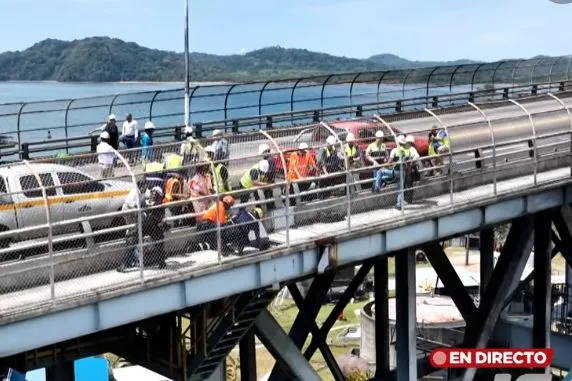
Panama’s Ministry of Public Works has begun installing a network of 28 high-pressure sensors on the iconic Bridge of the Americas. This real time structural monitoring initiative is a direct response to a serious fire and explosion on the bridge last month. The project aims to ensure the safety of a critical artery used by over 65,000 vehicles daily.
Crews are placing the devices at various points along the bridge’s span. Officials say the sensors will continuously measure movements and vibrations, providing instant data on the structure’s behavior. This system is part of a broader maintenance and rehabilitation program following the April 6 incident, which resulted in one fatality.

Authorities Emphasize Bridge Safety and Ongoing Evaluation
The Ministry of Public Works (Panama) stressed that the new monitoring is a precautionary enhancement. A full technical evaluation of the bridge had already been underway since November of last year, independent of the recent event. Government assessments so far have not identified any damage compromising the bridge’s fundamental stability or safety.
“These devices will be placed at different points on the bridge with the objective of measuring movements and vibrations, as well as detecting any situation that could compromise its operation,” [Translated from Spanish] the MOP stated in its announcement.
Rehabilitation work on areas affected by the fire is proceeding concurrently with the sensor installation. The United States government has provided technical support for the evaluations of this key piece of Panamanian infrastructure. Maintaining the structural integrity of the Bridge of the Americas is crucial for national mobility and commerce.
Heavy Vehicle Restrictions Remain in Force
While the new structural health monitoring system is implemented, existing traffic restrictions will stay in effect. A weight limit of 10 tons for heavy vehicles has been enforced on the bridge since 2009. Authorities are reiterating the importance of compliance with this rule for the long term preservation of the structure.
The bridge serves as the primary connection between Panama City and the western provinces. Any prolonged closure or significant damage would cause major disruptions to the national economy and thousands of daily commuters. The sensor network represents a significant technological upgrade for the aging bridge’s maintenance regime.
Real time data from the sensors will give engineers an unprecedented look at how the bridge responds to traffic loads, weather, and other stresses. This proactive approach to infrastructure management is becoming standard for critical spans worldwide. Panama’s investment in this technology signals a commitment to modernizing its key transport links.
Project managers have not provided a specific completion date for the sensor installation. They confirm the work is advancing as a priority. The ministry plans to integrate the sensor data into its central monitoring systems for continuous analysis by structural engineers.