


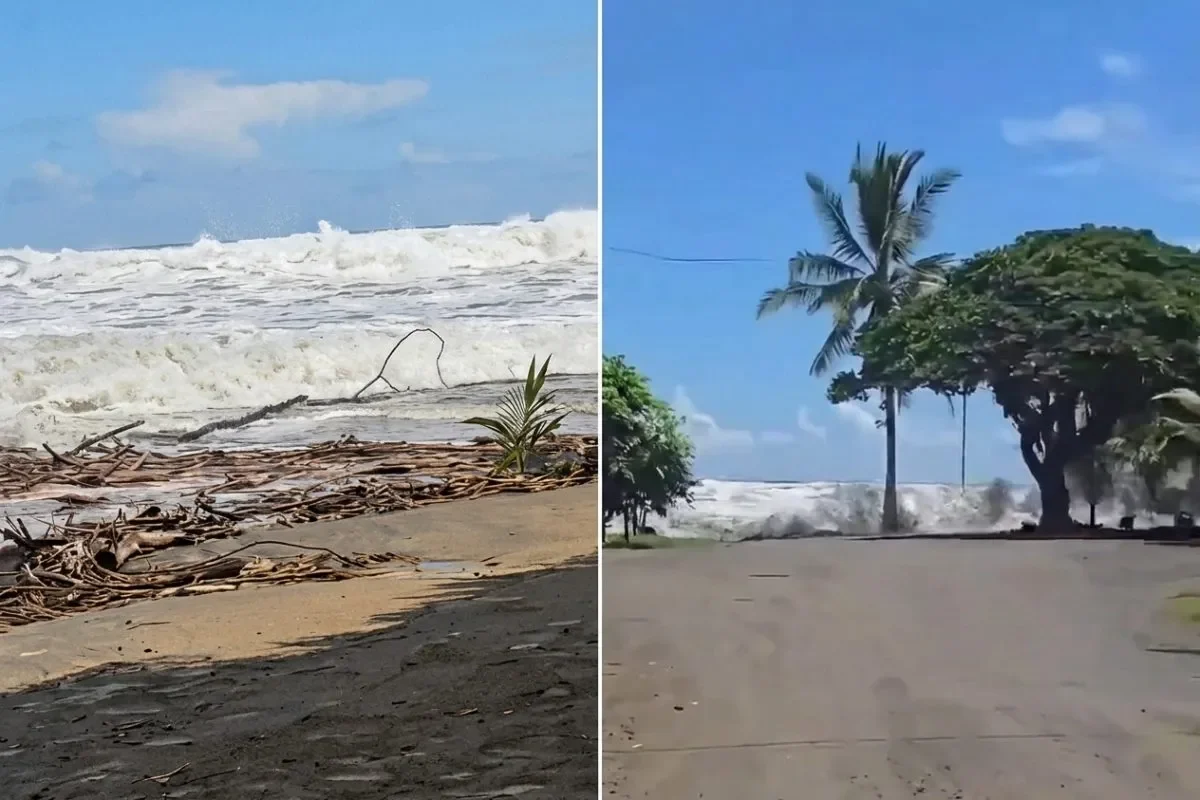
Seawater pushed into coastal residences in Isla Cañas, Los Santos province, on Friday after a powerful earthquake generated anomalous waves along Panama’s Azuero Peninsula. The U.S. National Oceanic and Atmospheric Administration (NOAA) ruled out any tsunami threat despite the coastal flooding Panama residents experienced near the epicenter.
Isla Cañas en Tonosí, necesitan ayuda. @Sinaproc_Panama @presidenciapma @JoseRaulMulino @mulinomaricel https://t.co/06LkVnjjs5
— Mélida 🌺🐾💐 (@edithfirst22) October 9, 2026
Néstor Duque, director of the University of Panama’s Geosciences Institute, confirmed the flooding stemmed from wave activity triggered by the seismic event. No fatalities have been reported, though more than 100 aftershocks continued throughout the day.
Tras el terremoto de magnitud 7.2 en Panamá, el Instituto de Geociencias advirtió que las olas anómalas podrían repetirse durante varias horas en Isla Cañas y el sur de Los Santos, mientras otras zonas del país tendrían un impacto menor https://t.co/it1n5YLUjy https://t.co/Dh9eMGuxT9
— LA CRÓNICA (@lacronicacom) October 10, 2026
Wave Heights and Coastal Flooding Panama Impact
Duque explained that waves reached between one and three meters in sectors closest to the earthquake’s epicenter on the Azuero Peninsula. The inundation affected homes situated near the shoreline in Isla Cañas, a coastal community in Los Santos.
The specialist noted that wave heights diminish significantly as they travel farther from the source. Distant points could see swells between 30 centimeters and one meter, while areas farther up the Central American coast would experience even smaller wave activity. NOAA’s assessment ruled out tsunami conditions despite the localized flooding.
Evacuations and Humanitarian Response
Residents affected by the water intrusion in Isla Cañas were relocated to El Cigua, a nearby community. Panamanian authorities planned to dispatch humanitarian aid to the area on Saturday morning. The evacuation focused on families whose homes sustained water damage from the anomalous waves.
Emergency officials maintained monitoring operations as aftershocks continued. The seismic sequence produced more than 100 tremors following the main earthquake, keeping coastal communities on alert through the evening hours.
Structural Damage and Regional Assessments
Beyond the coastal flooding, the earthquake caused material damage to buildings across Panama’s interior provinces. Churches and cathedrals sustained notable structural impacts, according to official reports. At least 15 people suffered minor injuries during the event.
El Instituto de Geociencias de la Universidad de Panamá informó que el ingreso de agua a viviendas cercanas a la costa de Isla Cañas, en la provincia de Los Santos, se produjo por olas anómalas registradas tras el fuerte sismo que sacudió al país este viernes. Video: Fuente Externa Más información en nuestro periódico: https://t.co/S3dCiis3j9 #debate.do #elperiodicodelasmayorias
— debate.do (@midebate) October 10, 2026
Fire stations and roadways also recorded damage as emergency crews worked to assess the full scope of destruction. The combination of seismic shaking and subsequent wave activity created a dual hazard scenario for communities along the Azuero coastline.
Geosciences experts continue tracking aftershock patterns while local authorities coordinate damage assessments. The absence of casualties marks a critical outcome for a seismic event of this magnitude, though recovery efforts for displaced families remain ongoing.