


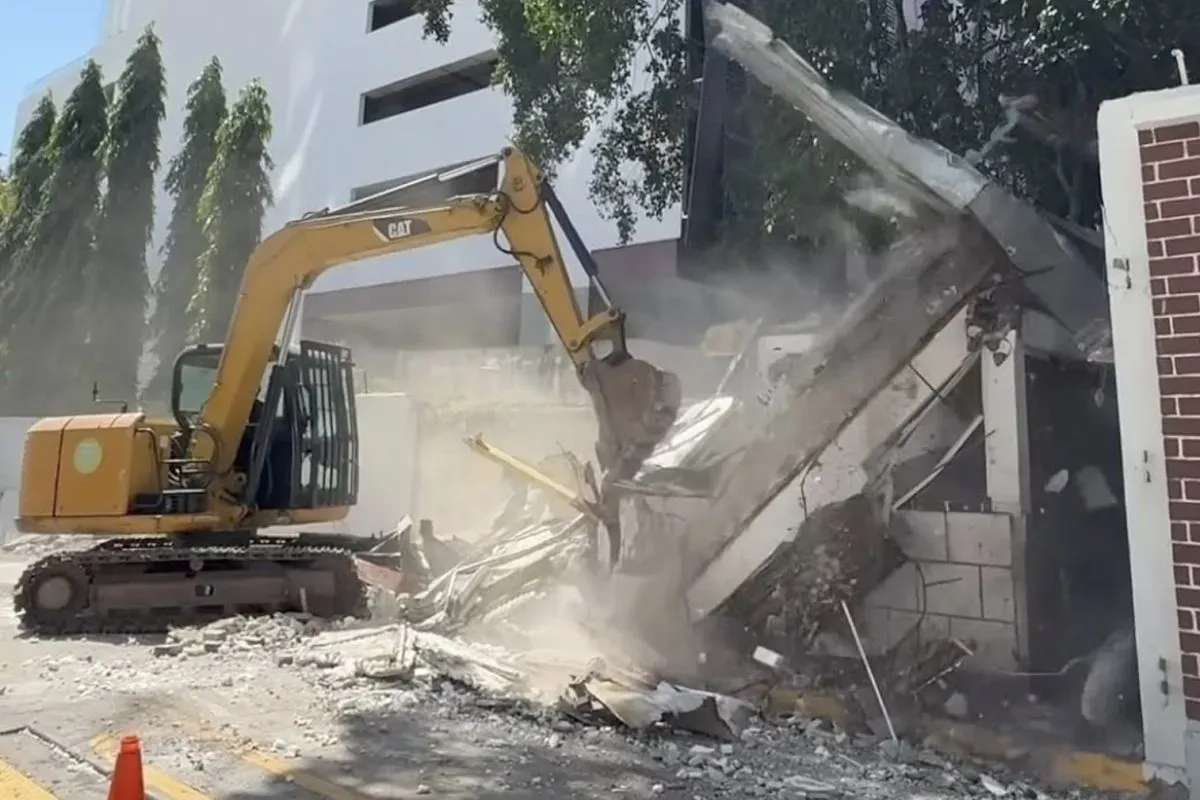
Work crews in Panama City began demolishing a security structure on Monday that had blocked public access to a coastal park for over two decades. The action, taken in the Coco del Mar sector of San Francisco, follows a formal resolution by Mayor Mayer Mizrachi and aims to reclaim a community green space.
📑 Table of Contents
Local officials described the demolition as a critical step in resolving a protracted urban dispute. The structure, a guardhouse for the Belvedere Park residential building, was built directly on a public easement (servidumbre) leading to the 1.3-hectare Coco Parque. The building’s concession for that portion of public land expired in 2023.
San Francisco representative Serena Vamvas oversaw the initial operations. She stated the move was firmly grounded in technical and legal reviews conducted by city and national authorities.
“What is happening today is based on a provision signed by the mayor,” Vamvas said. [Translated from Spanish] “We have a report from the Mayor’s Office and from Anati, which documents all the topography and the easement that has been surveyed. Today we have begun the entry to Coco Park.”
The demolition unlocks the immediate next phase: restoring permanent pedestrian access. For years, residents could see the public waterfront land but could not legally reach it, sparking continuous neighborhood complaints and administrative battles.
From Shipyard to Community Park Vision
The site of Coco Parque originally functioned as a shipyard. The state recovered the land after a prior concession ended, and community groups have since pushed to transform it into an open urban park. A public consultation in July last year saw nearly 400 residents approve the access project.
Advocates argue the park is desperately needed in a district with a documented shortage of adequate green spaces, sidewalks, and recreational areas. Once open, it would serve residents from Coco del Mar, Viña del Mar, and wider San Francisco.
The effort to reclaim the land involved multiple government tiers. The local junta comunal/community board requested intervention from the Mayor’s Office, which then engaged the National Land Administration Authority (Anati) and the Ministry of Housing and Land Management (Miviot) for official reviews and surveys.
A Participatory Path Forward
With the physical barrier now being removed, the project shifts to planning the park’s design and future management. Authorities had previously evaluated an alternative ecological boardwalk along a nearby mangrove, but recovering the original easement allows for a more direct connection.
Community involvement is slated as a cornerstone of the upcoming phase. Plans include participatory design workshops to shape the park with trails, urban furniture, lighting, and security measures. The formation of a community board or patronato to assist with long-term maintenance has also been proposed.
Vamvas framed the demolition as a commitment to returning essential public assets to the citizens. Her message underscored a resolve to prevent future obstructions.
“The community deserves its park; they must support us. Coco Park is moving forward and we will not let anyone stand in the way,” Vamvas expressed. [Translated from Spanish]
For long-time residents and activists, the sound of demolition equipment represents a hard-won victory. It concludes a chapter of persistent advocacy for a parcel of land that existed on official maps as public domain yet remained inaccessible in practice. The work aligns with broader municipal efforts, under Mayor Mayer Mizrachi, to streamline governance and address legacy urban issues.
The clearing of the access way opens a literal and figurative path. It transforms Coco Parque from a point of contention into a tangible project, moving the community’s vision for a shared coastal park closer to reality after more than twenty years of waiting.