


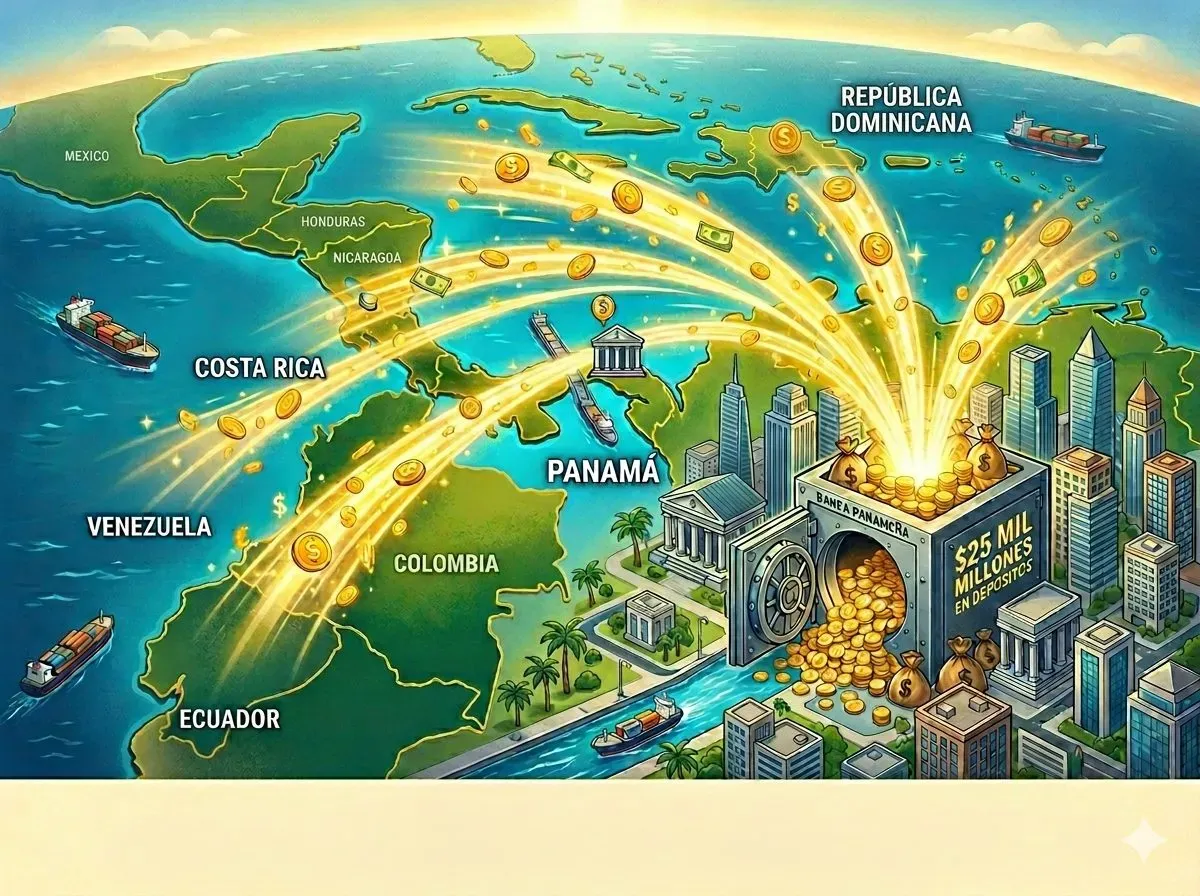
Panama’s international banking center now relies on five Latin American nations for more than half of its external deposits. Colombia, Costa Rica, Venezuela, Ecuador and the Dominican Republic together contribute roughly $25.4 billion to the country’s banking system. The Superintendency of Banks of Panama released the data this week.
Total deposits reached $120.7 billion by April 2026. External deposits alone hit $49.86 billion. That represents 41.3 percent of all money held in Panamanian banks. A year ago, external deposits accounted for 39.1 percent of the total. The shift shows Panama deepening its role as a regional financial hub.
Individual foreign depositors drive most of this growth. Their holdings reached $39.16 billion, or 78.5 percent of all external deposits. Term deposits dominate this category at $26.74 billion. But demand deposits grew fastest, surging 28.3 percent over the past year. Savings deposits rose 14.9 percent.
These numbers confirm Panama’s position as a critical financial intermediary for Latin America. The concentration of deposits from specific countries means we must closely monitor economic and political developments across the region. [Translated from Spanish]

Colombia Leads as Top Source of External Deposits
Colombia remains the largest source of external funds. Colombian depositors hold $11.45 billion in Panamanian banks. That equals 23 percent of all external deposits. Nearly one of every four dollars from abroad comes from Colombia.
Costa Rica follows with $4.6 billion. Venezuela contributes $3.35 billion. Ecuador adds $3.23 billion. The Dominican Republic rounds out the top five with $2.77 billion. Together these five countries now account for 50.9 percent of all external deposits.
The concentration has increased. Colombia, Costa Rica and Venezuela raised their combined share from 36 percent to 38.9 percent between April 2025 and April 2026.
Panama’s banking system now holds more than $49 billion from foreign sources. More than half of that money comes from just five economies. Any major shift in those markets could directly affect capital flows into Panama.

Regional Instability Creates Both Risks and Opportunities
Economic slowdowns in Colombia could reduce deposit inflows. Regulatory changes in Costa Rica might alter banking patterns. Political tensions in Venezuela could drive either capital flight toward Panama or capital repatriation. Similar dynamics apply to Ecuador and the Dominican Republic.
Many regional companies use Panama as a platform for international operations. They manage liquidity here. They hold dollar reserves here. The International Banking Center of Panama benefits directly from this corporate activity. But it also means economic trends in those countries show up quickly in Panama’s bank balance sheets.
Presidential elections change government policies. Tax reforms alter investment calculations. Fiscal crises trigger capital movements. Social protests create uncertainty. Institutional instability pushes depositors to seek safer havens. In some cases, all this uncertainty drives more deposits into Panama. Investors want dollar protection. They want risk diversification away from their home countries.
In other cases, improving conditions at home encourage capital to return. That can slow or reverse deposit growth. The key variable is Panama’s ability to maintain its appeal as a regional financial center. Latin America’s cycles of political, fiscal and economic uncertainty show no signs of ending. Neither does the flow of external deposits into Panama’s banking system.
The data through April 2026 makes one thing clear. Panama’s financial stability is increasingly tied to the health of its Latin American neighbors. When they prosper, deposits grow. When they struggle, deposits can still grow as capital seeks safety. But the relationship remains constant. Panama watches what happens in Bogota, San Jose, Caracas, Quito and Santo Domingo. The numbers on its bank balance sheets depend on it.