


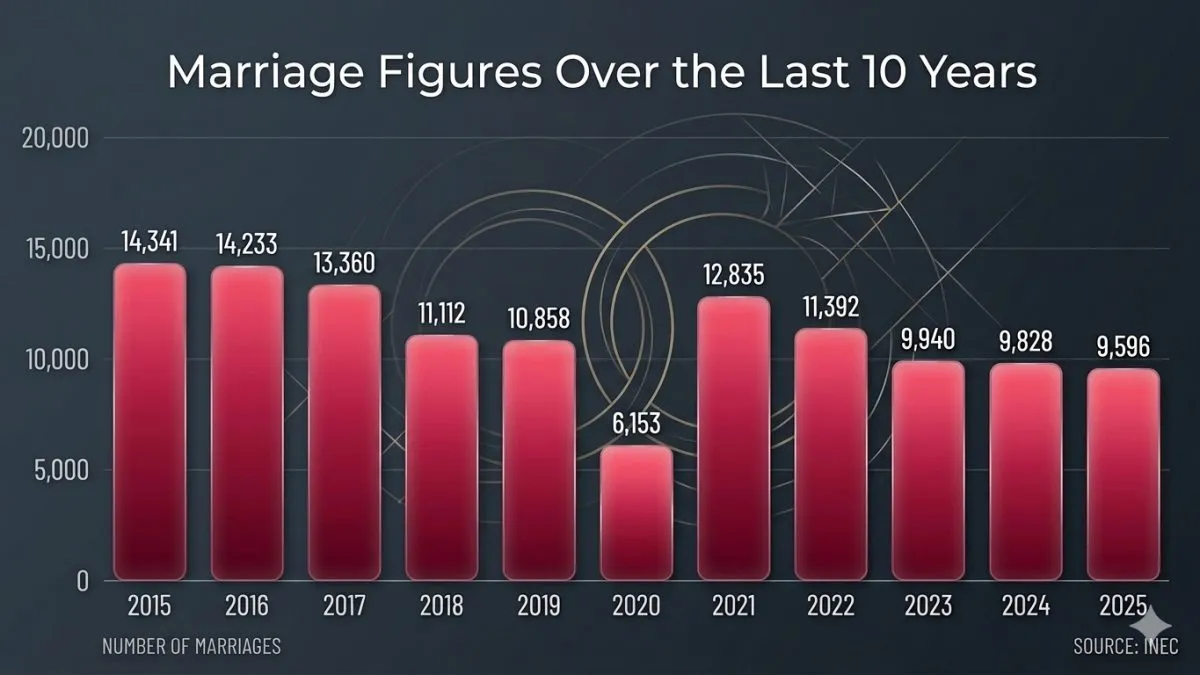
The number of couples getting married in Panama has dropped dramatically over the last ten years. New data from the National Institute of Statistics and Census Panama shows that civil unions fell from 14,341 in 2015 to just 9,596 in 2025. This represents a staggering 33 percent decline in only one decade.
📑 Table of Contents
Experts point to a combination of economic hardship and shifting social values. The fallen from 14341 marriages in 2015 to under 10,000 today suggests a fundamental change in how Panamanians view the institution. High living costs and job insecurity are now major factors in the decision to marry.
“In 2015, 14,341 couples formalized their union before a judge,” said Alis Fernández Aguilar, who analyzed the data. “Ten years later in 2025, the figures reveal barely 9,596 marriages.” [Translated from Spanish]
Economic Uncertainty Drives the Trend
Economist Elián Carrillo explained the phenomenon in purely financial terms. Getting married involves serious economic commitments. These include housing, shared expenses, potential children, debt obligations, and long-term financial stability. But unlike previous decades, a huge portion of Panama’s workforce operates outside the formal economy.
The country’s informal economy Panama sector now employs roughly 47.1 percent of workers. For young people the situation is even worse, with unemployment rates exceeding 20 percent. Nearly 700,000 Panamanians work for themselves or run small businesses.
“A person can have a partner, but they may not necessarily feel able to formalize a legal union if they don’t have a stable contract, social security, savings capacity, or access to credit,” Carrillo said. [Translated from Spanish]
Dayana, a university professional with stable employment, described the reality many face. “I think we are all prioritizing economic stability and independence first. Everything is very expensive, everything is harder to buy. A car, a house, even going to the supermarket for three small things already costs 60 dollars. I think we are all focused on surviving.” [Translated from Spanish]
Changing Values and Generational Shifts
Clinical psychologist and therapist Román Emiliani noted a growing search for economic and emotional independence. Many people now prioritize their individual stability before building a shared project with someone else.
“There has been a kind of individualization,” Emiliani said. “Me with my children, you with your children, and if it doesn’t work out, each person goes their own way.” [Translated from Spanish]
The psychologist also pointed to the pandemic’s lasting impact. Many individuals realized they could generate income independently through entrepreneurship. This behavioral shift has been especially noticeable among women.
“Many women realized they could make their own decisions and create their own budgets without being economically dependent on another person,” Emiliani emphasized. [Translated from Spanish]
The Panama marriage rate decline correlates strongly with rising female education and workforce participation. In 2015, 94,707 women enrolled in Panamanian universities. By 2024 that number had jumped to 116,357, an increase of nearly 23 percent.
Economist Carrillo addressed this directly. He said when women have more professional aspirations, education, and labor participation, marriage becomes a much more selective decision. The traditional path of apartment, stability, job security, and feeling “ready” has become harder to achieve.
Luis and Lourdes, both in their 30s with university degrees and stable jobs, illustrate this new reality. They have clear priorities and marriage is not one of them.
“I don’t want to,” Luis answered without hesitation. “I think it is an emotional, economic, and time responsibility that is affected by many factors you cannot control. It could mean a change in my lifestyle that I am not willing to make. I prefer my professional and economic independence 100 percent.” [Translated from Spanish]
Lourdes agreed completely. “Honestly I am not opposed to the big wedding, but my profession is my priority,” she said. [Translated from Spanish]
As, a 28-year-old woman engaged to a same-sex partner, offered a different perspective. “I value my professional development and my economic stability,” she said. “But I also consider it important to have the right to share a life with the person I love and for that union to be recognized under equal conditions.” [Translated from Spanish]
Emiliani also explained that previous negative relationship experiences affect partner selection. The combination of economic pressure, individual aspirations, and personal history creates a complex environment. Marriage has lost its status as the default step into adulthood. It now depends heavily on what each person considers their top priority.
The data shows a sustained decline that not even the temporary pandemic rebound in 2021 managed to reverse. For many Panamanians, the question is no longer about finding love. It is about whether they can afford the life that marriage traditionally demands.