


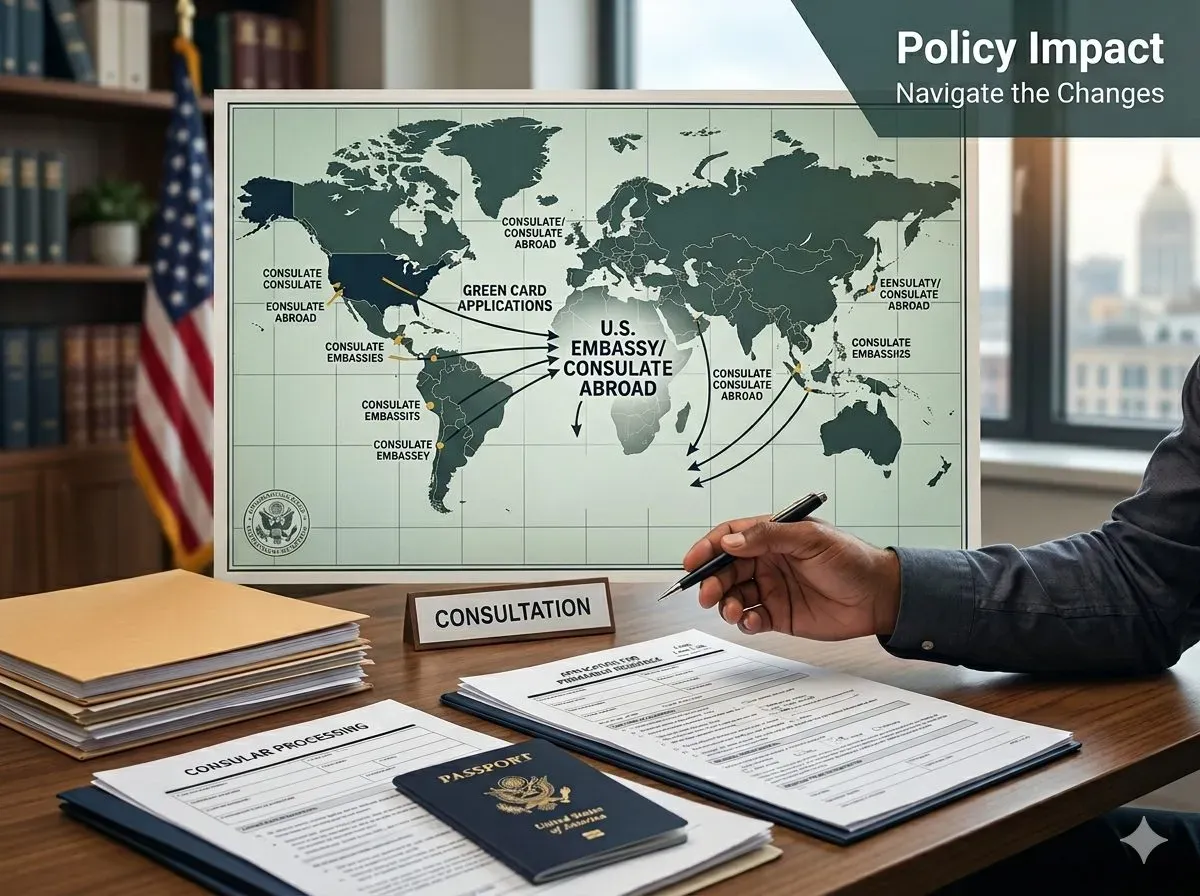
The Trump administration announced Friday that temporary visa holders seeking green cards must now return to their home countries to complete the application process. This marks a dramatic shift from current immigration practice. U.S. Citizenship and Immigration Services issued the directive, ending the option for most people to change their status while living in the United States.
Under previous rules, roughly half of all green card applicants filed from inside the country through adjustment of status. That option is now gone for most non-immigrant visa holders. The agency cited enforcement concerns and resource allocation as primary reasons for the change.

Official Statement Confirms Policy Reversal
USCIS spokesperson Zach Kahler released a statement Friday evening outlining the new requirements. “From now on, an alien who is in the U.S. temporarily and wants a Green Card must return to their home country to apply, except in extraordinary circumstances,” Kahler said.
“When aliens apply from their home country, it reduces the need to find and remove those who decide to slip into the shadows and remain in the U.S. illegally after being denied residency.” — Zach Kahler, USCIS spokesperson [Translated from Spanish]
The policy directly impacts people who entered the United States on a non-immigrant visa. These categories include students, temporary workers, and tourists. The government expects these visitors to leave when their authorized stay expires.
“Our system is designed for them to leave when their visit is over,” Kahler said. “Their visit should not function as the first step in the Green Card process.”
Massive Impact on Annual Immigration Numbers
Former USCIS official Doug Rand provided context on the scale of this change. In a typical year, roughly 1 million people apply for green cards. Half of those applicants file from within the United States to change their status while already living here, Rand explained.
“The purpose of this policy is exclusion,” Rand said in a statement. “Remember that Trump has banned people from over 100 countries from returning to the U.S., so forcing them to go abroad for consular processing is no pathway at all.”
The administration argues the change will streamline operations. USCIS will redirect resources toward other priorities. These include processing visas for victims of violent crime and human trafficking. Naturalization applications will also receive more attention under the new framework.
Kahler said the process would “make our system fairer and more efficient.” He emphasized that following the law allows the State Department to handle most of these cases at U.S. consular offices abroad.
PM-602-0199-AdjustmentOfStatusAndDiscretion-20260521
Immediate Consequences for Current Applicants
Thousands of people currently in the United States on temporary visas now face an uncertain path to permanent residency. Those who began the adjustment of status process before the announcement may face delays or denials. Immigration attorneys expect a flood of questions from confused clients.
The policy does include an exception for extraordinary circumstances. USCIS did not define that term in Friday’s announcement. Legal experts anticipate litigation over the scope of that exception.
Critics argue the policy effectively blocks green card access for many qualified applicants. Travel bans currently prevent citizens from more than 100 countries from reentering the United States after departure. For those individuals, returning home for consular processing means leaving permanently.
The change represents one of the most significant immigration policy shifts in recent years. It reverses decades of administrative practice that allowed status adjustments from within the country. Implementation details remain unclear as agencies work to coordinate the transition.