


Panama’s legislative committee on governance unanimously approved a bill targeting public sector “no show jobs” in its first debate this week. The proposed law, known as the Anti Botella Law, would impose stiff prison sentences for officials who accept salaries for work they do not perform.
Deputy Janine Prado from the Vamos bloc confirmed the progress of Bill 408. The legislation seeks to amend Article 349 of Panama’s Criminal Code. It would establish non-commutable prison terms of six to eight years for public servants who accept appointments without providing the corresponding service.
An aggravated penalty of eight to ten years in prison would apply when the financial injury to the state exceeds fifty thousand dollars annually. Prado explained the law does not create a new criminal offense but instead toughens sanctions currently limited to community service or small fines.
“Ironically, you could pay ten fines with the very money you are receiving from the no show job,” Deputy Janine Prado said. [Translated from Spanish]
The deputy also stated her bloc aims to add an article sanctioning the officials who make the irregular appointments. This would create accountability on both sides of the corrupt transaction. The bill now moves toward consideration by the full Panama National Assembly.
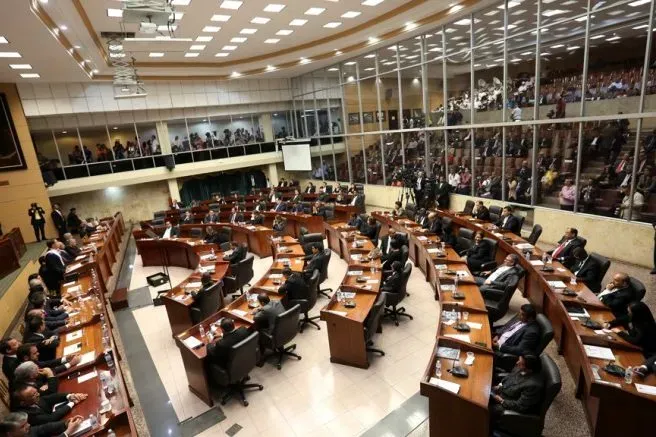
Transparency Demands and Budget Concerns
Beyond the new legislation, Prado raised serious concerns about budget transparency within the legislative body itself. She reported that her bloc has unsuccessfully requested copies of resolutions justifying budget transfers for over eight months.
According to the deputy, the National Assembly’s final budget exceeded one hundred sixty million dollars. That figure stands in stark contrast to the initial projection of ninety seven million dollars established by law. The nearly sixty million dollar difference, Prado argues, lacks accessible documentary support.
“We are understanding that a completely irregular procedure exists, and I would even dare to say it is illegal,” Prado affirmed. [Translated from Spanish]
Faced with this lack of response, the Vamos bloc filed two habeas data actions before the Supreme Court of Justice. These legal petitions demand the release of the budgetary information. The move highlights ongoing tensions regarding oversight within the asamblea nacional/national assembly itself.
Legislative Agenda and Economic Priorities
Looking ahead to the new legislative period starting July 1, Prado said her bloc will continue pushing initiatives to strengthen anti corruption efforts. She mentioned a stalled anti corruption project in the same Government Committee and a proposed reform to the ACODECO consumer protection law.
That reform would grant the agency greater tools, particularly within the real estate sector. Prado also called on whoever assumes the presidency of the Assembly to prioritize accountability. She urged a reduction in the size and budget of the legislative branch.
Commenting on the recent repeal of Decree 10 regulating platform based transportation, the deputy called the executive’s move a “serious error.” She did, however, value the opening of a dialogue table to address the issue. Prado warned the debate must center on citizens and users, actors she believes lack proper representation in the current discussions.
The deputy emphasized the need for a national vision prioritizing economic reactivation and job generation. Key sectors like construction still show no clear signs of recovery, especially in Panama’s interior provinces. The push for the Anti Botella Law forms part of a broader demand for fiscal responsibility and transparent governance as the country addresses these economic challenges.