


The Panama rent surge in Panama City’s rental circles usually points a finger at newcomers from the United States and Europe, but the numbers tell a different tale. A Panama rent surge is squeezing some of the capital’s most sought-after neighborhoods, even as immigration data reveals Latin American arrivals vastly outnumbering North Americans. The real forces behind rising rents are more nuanced than a simple story of expat demand, and the neighborhoods foreign residents have historically loved are now becoming battlegrounds for a much broader pool of renters.
Why the Panama Rent Surge Defies Easy Explanations
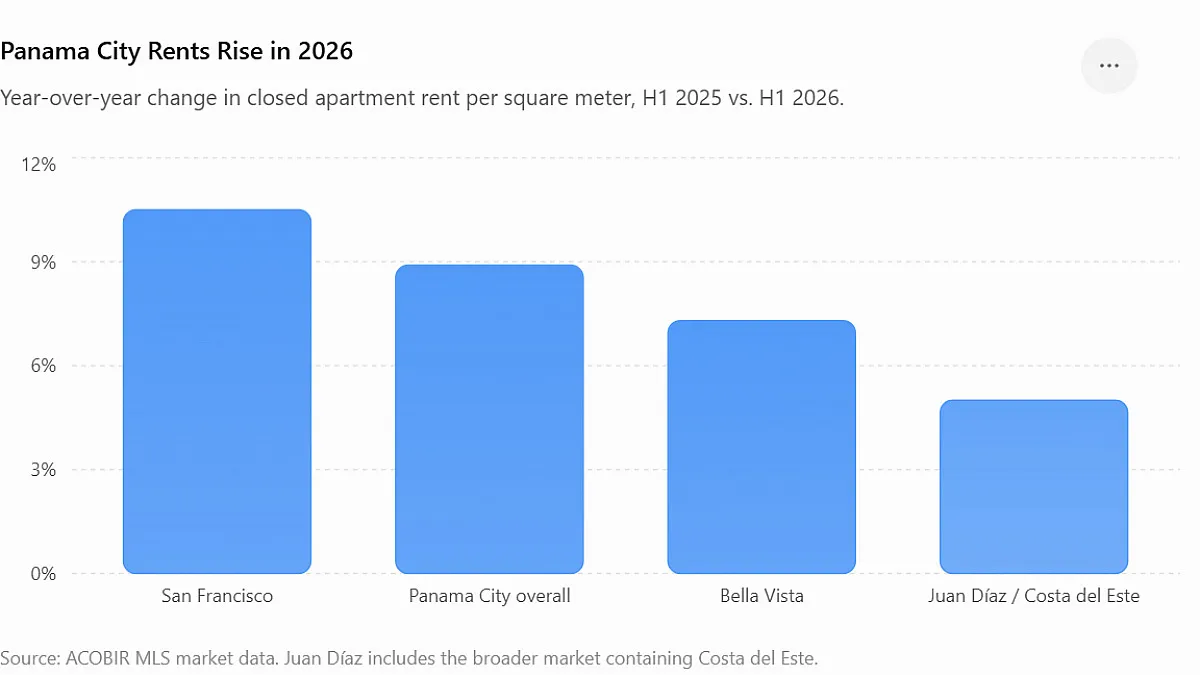
Anyone hunting for an apartment in Panama City during the first half of 2026 has likely felt the sting. Completed leases through ACOBIR’s MLS platform averaged $12.57 per square meter, up from $11.54 during the same stretch in 2025. That works out to an 8.9 percent jump in just twelve months, a dramatic acceleration from the 3.6 percent increase recorded the previous year.
But the immigration data complicates the narrative that foreigners are flooding the market. Through April 2026, Panama’s National Migration Service had approved 10,864 residency permits. The largest groups came from Colombia with 3,406 approvals, Venezuela with 1,956, and Nicaragua with 1,097. By comparison, Americans accounted for only 785 permits. Canada contributed 168, Spain 188, Italy 160, France 105, Germany 62, and the United Kingdom just 42. So while international migration certainly adds pressure, the idea that a sudden wave of North Americans and Europeans sparked an 8.9 percent citywide rent hike doesn’t hold up.
Something else is happening in Panama City’s rental economy. The old mental map of “expat neighborhoods” no longer matches the reality of who actually lives in places like San Francisco, Bella Vista, and El Cangrejo. These areas have evolved into mixed markets where Panamanian professionals, Latin American executives, and multinational employees compete alongside foreign residents for the same apartments.
Expat Neighborhoods Face a Shrinking Pool of Desirable Units
The neighborhoods most popular with foreign renters are precisely where the squeeze feels tightest. San Francisco, long a magnet for expats drawn by its central location, restaurants, supermarkets, Parque Omar, medical services, and easy access to business districts, posted the steepest increase among tracked submarkets. Closed rents there climbed from $11.52 to $12.73 per square meter, a 10.5 percent jump. Bella Vista followed with a 7.3 percent rise, moving from $11.35 to $12.18. The broader Juan Díaz market, which encompasses Costa del Este, rose about 5 percent from $13.49 to $14.17 per square meter.
What’s less visible in those percentages is the frustration brewing among renters who scroll through hundreds of online listings and still can’t find what they want. Panama City has no shortage of apartments in the aggregate. The INEC quarterly Construction Census continues to track new residential projects across Panama and San Miguelito, and cranes still dot the skyline. Yet the inventory that matters to a specific kind of renter is thin.
Picture someone looking for a modern, well-maintained two-bedroom in San Francisco, El Cangrejo, or Obarrio with decent furnishings, reliable air conditioning, parking, and competent building management, all priced between $1,200 and $1,600 monthly. That renter isn’t competing for the entire city’s housing stock. They’re fighting over a narrow slice of inventory that everyone else seems to want too. The result is a market where listings appear plentiful online while truly desirable units vanish within days.
Areas like Punta Pacífica and Avenida Balboa face a similar dynamic. These waterfront and near-waterfront zones have historically attracted foreign professionals and retirees, but their appeal now extends far beyond that demographic. A Panamanian executive, a Colombian professional on assignment, or a family choosing to rent rather than buy all target the same buildings. The expat renter isn’t just competing with another American anymore.
The Financial Toll of Rising Rents in Panama City
Percentage changes sound abstract until they hit a monthly budget. At the citywide ACOBIR average, a 100-square-meter apartment cost roughly $1,154 per month in the first half of 2025. By 2026, that same space demanded approximately $1,257. That’s an extra $103 every month, or more than $1,200 per year, just to stay in the same place.
San Francisco renters absorbed an even sharper hit. A 100-square-meter unit at the H1 2025 average of $11.52 per square meter translated to about $1,152 monthly. At the 2026 average of $12.73, the bill rose to roughly $1,273. The difference amounts to $121 more per month, or $1,452 annually. These figures reflect completed MLS leases rather than asking prices, which means landlords actually secured these amounts rather than simply advertising them.

Online asking prices suggest landlords are pushing even harder. An analysis of Encuentra24 listings placed Panama City’s average asking rent at approximately $14.70 per square meter in June 2026, about 13.5 percent higher than the same month a year earlier. The gap between asking and closed rents hints at a market where landlords test aggressive numbers, and enough renters reluctantly accept them to validate the trend.
What Comes Next for Renters and Landlords
The rental market’s trajectory depends on several forces pulling in different directions. On one side, new construction continues to add units to Panama City’s housing stock. On the other, the specific demand for well-located, well-managed apartments in established neighborhoods shows no sign of cooling. The influx of Latin American professionals, who often arrive with corporate housing stipends or stable employment, keeps pressure on the exact segments of inventory that expats also prefer.
For landlords, the numbers validate what many already suspected. ACOBIR’s secondary-market statistics, drawn from rental and resale activity recorded through MLS ACOBIR, demonstrate that completed rents are rising steadily across the city. The acceleration from 3.6 percent growth in 2025 to 8.9 percent in 2026 suggests the market hasn’t yet found its ceiling.
For renters, the practical lesson is clear. Waiting for prices to drop in neighborhoods like San Francisco, Bella Vista, or Costa del Este may not be a winning strategy in the short term. The competition comes from too many directions, and the inventory of truly desirable units at mid-range prices keeps shrinking. Panama City isn’t running out of apartments, but it might be running out of the kind of apartments that people actually want to live in at a price they can stomach.
Ultimately, the Panama rent surge reflects a city in transition. The old labels of expat neighborhoods and local neighborhoods have blurred. A housing market that once seemed predictable now responds to a complex mix of Latin American migration, domestic professional demand, and the universal desire for well-located homes with modern amenities. Understanding that shift matters more than blaming any single group of newcomers, because the pressure on rents is coming from everywhere at once.