


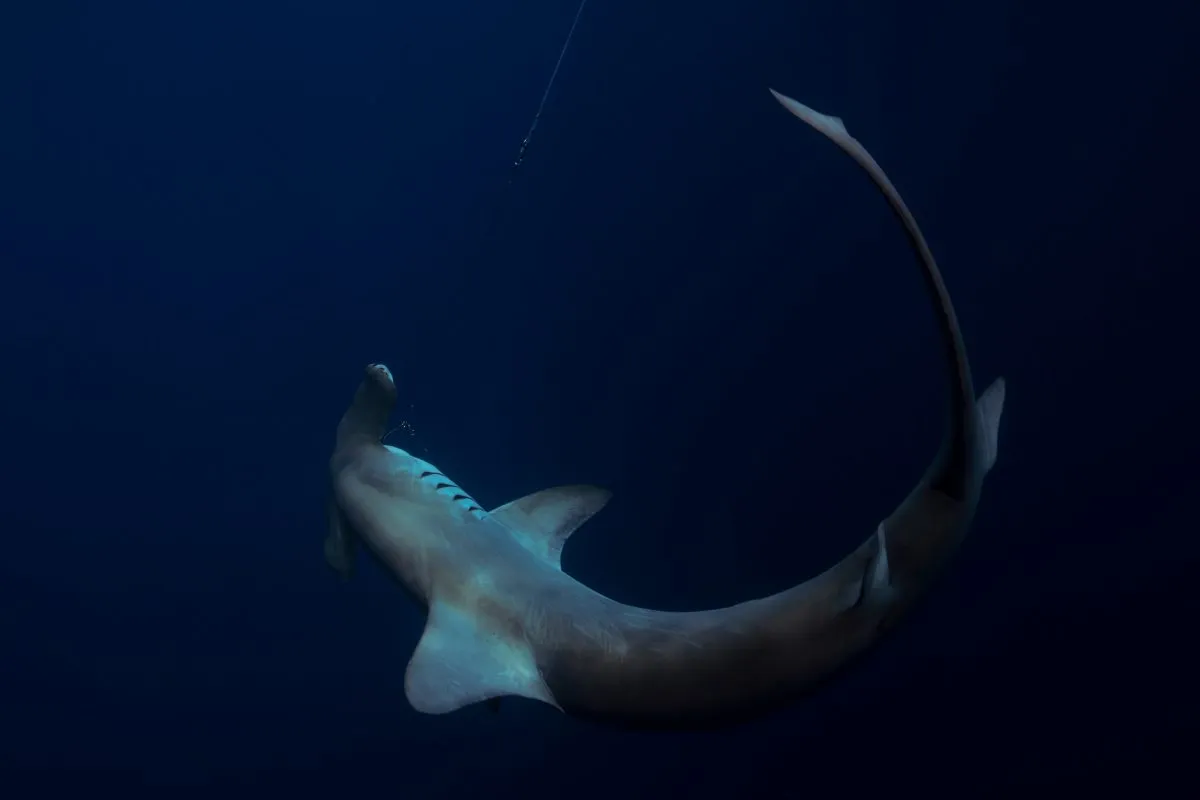
Long before industrial fishing reshaped marine ecosystems, Panama shark populations along the Pacific coast were about 20 times more abundant than those on the Caribbean side, according to new research from the Smithsonian Tropical Research Institute. The two coasts sit barely 100 kilometers apart and share several shark species, yet their prehistoric baselines were dramatically different. Scientists reconstructed this lost world not from bones or fishery records, but from tiny scales known as dermal denticles that sharks shed and that settle into reef sediments for thousands of years.
Dermal Denticles Unlock a Lost Shark World
The technique relies on dermal denticles, tiny hard structures that cover shark skin and shed continuously as the animals swim. Researchers collected sediment cores from reef zones on both coasts of Panama, focusing on deposits that formed between 7,000 and 3,000 years ago. Because the denticles preserve well in marine sediments, they function like a fossil archive of shark presence, similar to how pollen records reveal ancient plant communities.
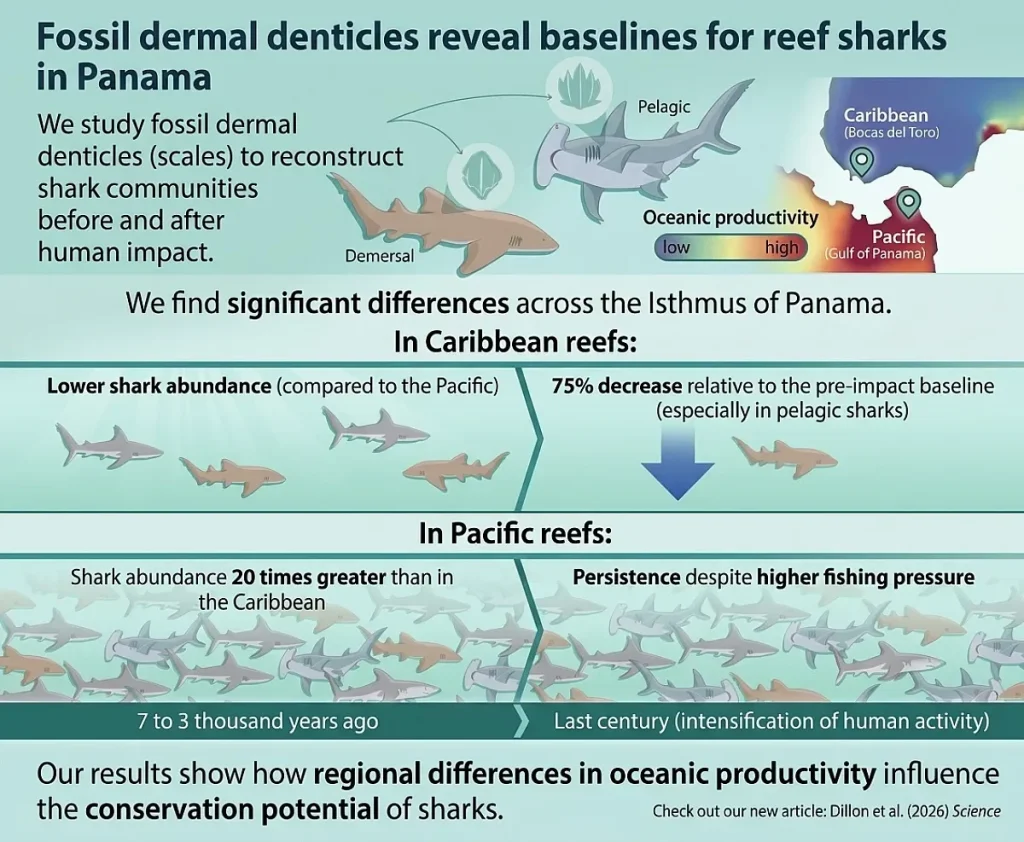
The team found that prehistoric Pacific reefs in the Gulf of Panama were packed with far more shark traces than Caribbean reefs of the same age. Specifically, denticle abundance on the Pacific side ran 20 times higher. The two coasts are close geographically and share several shark species, but their natural shark densities were already very different before industrial fishing began.
Modern sediment records tell another part of the story. Caribbean denticle accumulation has dropped about 75 percent from its prehistoric baseline. In the Pacific, recent averages remain statistically similar to the ancient baseline. Yet researchers say those modern averages might obscure more recent losses.
Why Panama Shark Populations Differ So Sharply
The main factor appears to be ocean productivity. Along Panama’s Pacific coast, seasonal upwelling draws cold water loaded with nutrients from the deep to the surface. That burst of productivity feeds plankton, fish, and ultimately large predators. The Caribbean side lacks this consistent nutrient supply. Its clear, warm waters favor coral reef growth, but the ecosystem stores much of its energy in reef structure rather than in the pelagic food web that sustains shark abundance.
Fishing history adds a counterintuitive twist. More than 98 percent of Panama’s reported fishing happens on the Pacific coast. Despite that, Pacific shark denticle records have not fallen below the prehistoric range, according to the research. Caribbean reefs, which face far less direct fishing pressure, have experienced a sharper relative drop in shark traces. Current Pacific reefs generate about 100 times more shark denticles than Caribbean reefs.
Still, the researchers caution against reading the Pacific results as a clean bill of health. The 100-year average may conceal steep declines after the 1980s, when targeted shark fishing grew in the Gulf of Panama. Changes to the upwelling system itself, possibly linked to shifting ocean conditions, could also reduce how many predators the region can support.
Rethinking Conservation Targets Across Two Coasts
The study argues that restoration goals should account for each coast’s natural productivity and history. A healthy Pacific reef is not a fair template for a Caribbean reef. If conservationists applied Pacific baselines to the Caribbean, recovery targets could be wrong by an order of magnitude or more. That mismatch could waste resources or set expectations that local ecosystems never met historically.
This finding highlights the value of conservation paleoecology, which uses sediment cores, fossils, and other ancient evidence to reconstruct ecosystems before human impacts. Shark denticles are especially useful because they are abundant, durable, and directly linked to predator abundance. For Panama shark populations, these tiny clues provide a way to separate natural differences from human-caused declines.
The research also has broader implications for tropical marine conservation. Where nutrient-rich upwelling zones create natural shark hotspots, managers may need different indicators of health than in coral-dominated, nutrient-poor settings. Baseline-setting that ignores oceanography could lead to misleading conclusions about which reefs are degraded and which are simply less productive by nature.
Ultimately, the Smithsonian research turns a small biological particle into a powerful conservation tool. It shows that Panama’s two coastlines were never ecological twins, even before fishing reshaped their waters. A successful shark recovery strategy in the region will likely need separate benchmarks, built around the Pacific’s productive upwelling and the Caribbean’s structurally rich reefs, if it hopes to reflect the true history of Panama shark populations.