


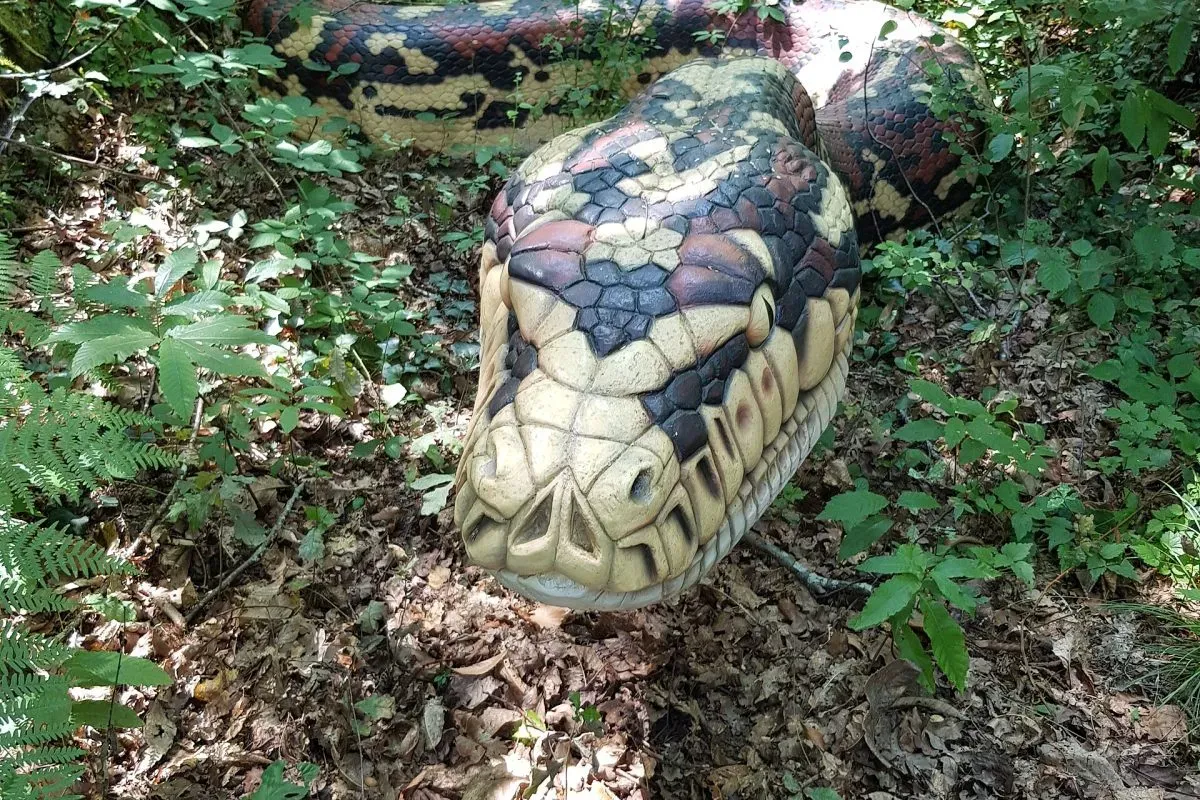
Visitors to Panama City this July can come face to face with a creature that dwarfed everything in its path. The Punta Culebra Nature Center is hosting a special exhibition centered on the Titanoboa, the largest snake ever to slither across the Earth. The event coincides with global celebrations for World Snake Day, giving families a chance to learn about these often misunderstood reptiles.
Scientists estimate the Titanoboa measured more than 13 meters long. That is longer than a city bus. It lived roughly 60 million years ago in what is now South America. The snake weighed over a ton and could crush a crocodile with ease. For comparison, today’s largest snakes, like the green anaconda, rarely exceed 6 meters. The Titanoboa was truly a monster of its time.
Real Fossils and Expert Talks at Exhibition
The exhibition takes place inside the Qrioso space at Punta Culebra. This is not a simple photo display. Organizers have brought in actual fossilized vertebrae from the Titanoboa. Visitors can touch history. They can see the bone structure that supported such an enormous body. Experts will be on hand to explain how this predator hunted and why it grew so large.
One of the most striking parts of the exhibit allows guests to compare the Titanoboa with modern snakes. A replica of the prehistoric giant sits alongside a current boa constrictor. The size difference is staggering. Children and adults alike can grasp just how dominant this creature was in its ancient ecosystem.
The event runs on July 16 from 1:30 p.m. to 3:30 p.m. But the center itself opens on a wider schedule. From Wednesday through Friday, doors open at 1:00 p.m. and close at 5:00 p.m. On weekends, the center welcomes visitors from 9:00 a.m. to 5:00 p.m. The ticket booth stops selling entry at 4:00 p.m. each day.
Affordable Entry for Residents and Tourists
Punta Culebra has kept prices reasonable for this special event. Panamanian citizens and legal residents pay only $6.00. Non-residents pay $10.00. Senior citizens with a pension card get in for $3.00. Children under 13 also pay just $3.00. No advance reservation is required. However, the center will limit entry if it reaches maximum capacity. Visitors should plan accordingly, especially on weekends when crowds tend to be larger.
The center does not allow pets on the premises. For those interested in guided tours or school programs, staff can be reached by email at puntaculebra@si.edu. Phone inquiries go to 212-8793. The center also accepts WhatsApp messages at 6362-4219.
Why World Snake Day Matters in Panama
Panama sits at a crossroads of biodiversity. Its jungles and coastlines host dozens of snake species, from tiny coral snakes to massive boas. Yet many people fear snakes without understanding them. World Snake Day aims to change that perception. Events like the Titanoboa exhibition help bridge the gap between fear and fascination.
Snakes play a critical role in controlling rodent populations. They are predators, yes, but they are also prey for larger animals. Without snakes, ecosystems would fall out of balance. The Titanoboa exhibition reminds us that these reptiles have been part of the planet’s story for millions of years. They deserve respect, not blind terror.
The Smithsonian Tropical Research Institute manages the Punta Culebra Nature Center. The institute has long been a leader in tropical science and public education. This exhibition fits their mission perfectly. It combines hard science with hands-on learning. It sparks curiosity in young minds and satisfies the curiosity of adults.
Plan Your Visit to See the Giant Snake
Families should consider arriving early to avoid the afternoon heat and potential crowds. The center is located on the Amador Causeway, a popular area with stunning views of the Panama City skyline and the Bridge of the Americas. After the exhibition, visitors can walk along the causeway or grab a bite at nearby restaurants.
The Titanoboa display runs only on July 16, but the rest of the Punta Culebra Nature Center remains open year-round. The center features marine exhibits, nature trails, and touch tanks where kids can interact with starfish and sea cucumbers. It is a full day of learning for anyone interested in natural history.
For those who cannot attend, the center offers resources online. Teachers can request educational materials. Researchers can access data on local marine life. But nothing beats seeing those fossilized vertebrae in person. The Titanoboa may be extinct, but its legacy lives on in museums and science centers around the world.
This July, Panama joins that global conversation. The Titanoboa exhibition at Punta Culebra is a reminder that our planet has hosted life forms far stranger and larger than anything alive today. It is a chance to marvel at evolution’s experiments. It is also a chance to celebrate World Snake Day with experts who can answer every question you have ever had about these incredible animals.