


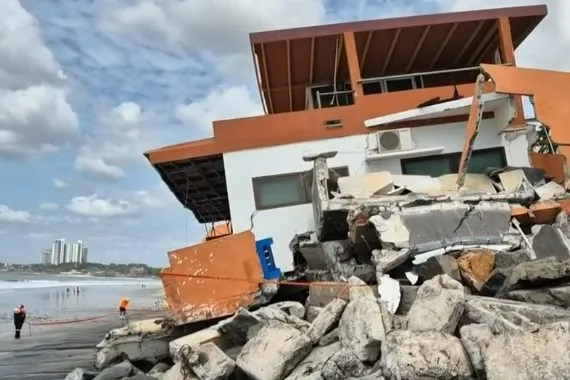
The Pacific Ocean is slowly swallowing parts of Panama’s coastline. In the remote communities of Rio Veraguas and Calovébora, families watch helplessly as the sea inches closer to their front doors. At least five homes have already been damaged by recent high tides and rough weather, with another 40 properties now sitting in precarious positions along the shoreline.
Yackzabeth Jiménez, operations chief for Sinaproc in Veraguas, described the scene as increasingly dire.
“We are seeing coastal erosion that is undermining the ground and especially affecting homes that are very close to the water,” Jiménez said. “Five homes are the most vulnerable because they are built with short-duration materials, which has caused them to collapse and put these people at risk.” [Translated from Spanish]
The crisis in this part of western Panama did not appear overnight. Sinaproc conducted technical inspections back in February and filed reports urging the relocation of families living in danger zones. Those warnings went unheeded, and now the situation has worsened dramatically after a weekend of extreme tidal activity and powerful waves.
Homes Built Too Close to the Water
The affected communities sit within the Veraguas province, a region known for its rugged coastline and rich biodiversity. But that beauty comes with a price. Many homes here were constructed using materials that cannot withstand the constant assault of saltwater and wind. Wooden walls rot. Foundations crumble. The ocean does not retreat.
Jiménez noted that the structural weakness of these buildings makes them especially vulnerable. When high tides hit, the water does not just lap at the doorsteps. It carves away the earth beneath the houses. The ground literally disappears. Families have lost bedrooms, kitchens, and in some cases entire homes to this slow-motion disaster.
The National Civil Protection System has been coordinating with other government agencies to find solutions. Relocation is the preferred option. Building new homes further inland would remove families from immediate danger. But these processes move slowly, especially in remote areas where infrastructure is limited and land ownership can be complicated.
A Pattern of Neglect Along the Coast
This is not an isolated incident. Coastal communities across Panama face similar threats, though few have received the attention they deserve. The combination of rising sea levels, increasingly violent storms, and poor construction practices has created a perfect storm of vulnerability.
Sinaproc issued a prevention notice for maximum tides along the Pacific coast, warning residents to stay alert. The agency has also urged people to avoid remaining in areas identified as high-risk zones. But for families who have lived on the coast for generations, the choice is not simple. Their livelihoods, their social networks, and their history are tied to these shores.
Government officials acknowledge the complexity of the situation. Relocation requires land, funding, and logistical support. Temporary shelters are not a long-term solution. And with climate change accelerating the pace of erosion, time is running out for many of these communities.
What Comes Next for Veraguas Families
The immediate priority is ensuring no lives are lost. Sinaproc has increased monitoring of the affected areas and stands ready to respond if conditions deteriorate further. But the broader question remains unanswered. How many more homes will be lost before meaningful action is taken?
Environmental experts point to the need for better coastal management policies. Mangrove restoration, seawall construction, and stricter building codes could help mitigate the damage. But these measures require political will and financial investment that has been slow to materialize.
For now, the families of Rio Veraguas and Calovébora wait. They watch the tides. They hope for calm weather. And they wonder if their homes will still be standing when the next high tide arrives. The ocean does not negotiate. It simply rises.
Nearby, the Coiba National Park remains a symbol of Panama’s natural wealth, a protected area that draws tourists and researchers from around the world. But the contrast between the park’s pristine waters and the crumbling homes just down the coast tells a different story. Conservation and community protection must go hand in hand. One without the other is not a sustainable future.