


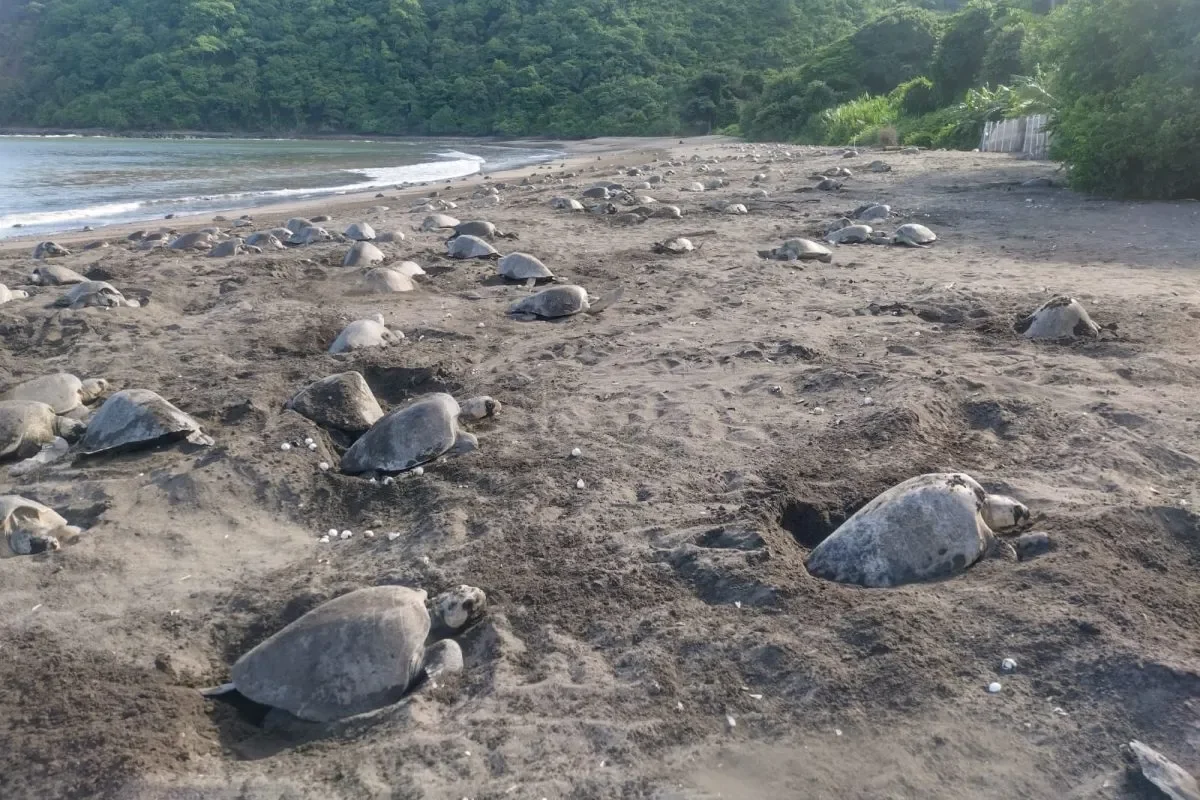
More than 11,322 olive ridley sea turtles have arrived at Playa La Marinera in Los Santos province during the 2026 turtle nesting season, marking a key significant arribadas recorded on Panama’s Pacific coast this year. The third mass nesting event of the season occurred during the first days of October, transforming the beach into a critical site for species survival.
Biologists, park rangers, and university thesis students from the International Maritime University of Panama coordinated monitoring efforts throughout the event. Their work documents nesting patterns, tracks population health, and safeguards vulnerable egg clutches from predators and human interference.

Why Protecting Turtle Nests During the 2026 Turtle Nesting Season Matters
Olive ridley turtles face constant threats from coastal development, plastic pollution, and illegal egg harvesting. Each nesting female deposits roughly 100 eggs per clutch, but only about one in 1,000 hatchlings survives to adulthood. Protecting nests during the turtle nesting season directly determines whether future generations of this species will return to Panama’s shores.
The arribada phenomenon, where thousands of turtles arrive simultaneously over several nights, concentrates vulnerable eggs in a small area. This makes coordinated protection essential. Local conservation teams patrol nesting zones, relocate at-risk clutches, and educate nearby communities about the ecological value of leaving nests undisturbed.

Olive Ridley Turtle Biology and Nesting Behavior
Olive ridley turtles reach sexual maturity between 10 and 15 years of age. Adult females typically measure 60 to 70 centimeters in shell length and weigh between 35 and 45 kilograms. They return to the same beaches where they hatched, guided by Earth’s magnetic field and chemical signatures in coastal waters.
Nesting occurs primarily at night, with females digging flask-shaped cavities in the sand using their hind flippers. Incubation lasts 45 to 60 days depending on sand temperature. Warmer sands produce more female hatchlings, while cooler temperatures yield more males, a dynamic that climate change increasingly disrupts.
Conservation Impact and Regional Significance
Playa La Marinera ranks among the most important olive ridley nesting sites in Central America. The 2026 season’s 11,322 recorded turtles represent a significant data point for researchers tracking population trends across the eastern Pacific. Comparable arribadas occur in Costa Rica’s Ostional Wildlife Refuge and Mexico’s La Escobilla beach, but Panama’s monitoring adds crucial regional data.
Each arribada draws international scientific attention and reinforces Panama’s role in transboundary marine conservation. The data collected by students and rangers feeds into broader efforts to protect migratory corridors used by sea turtles across multiple national jurisdictions.
Local authorities continue to enforce beach access restrictions during peak nesting periods. These measures reduce artificial light pollution that disorients hatchlings and prevent vehicle traffic from crushing nests buried beneath the sand.