


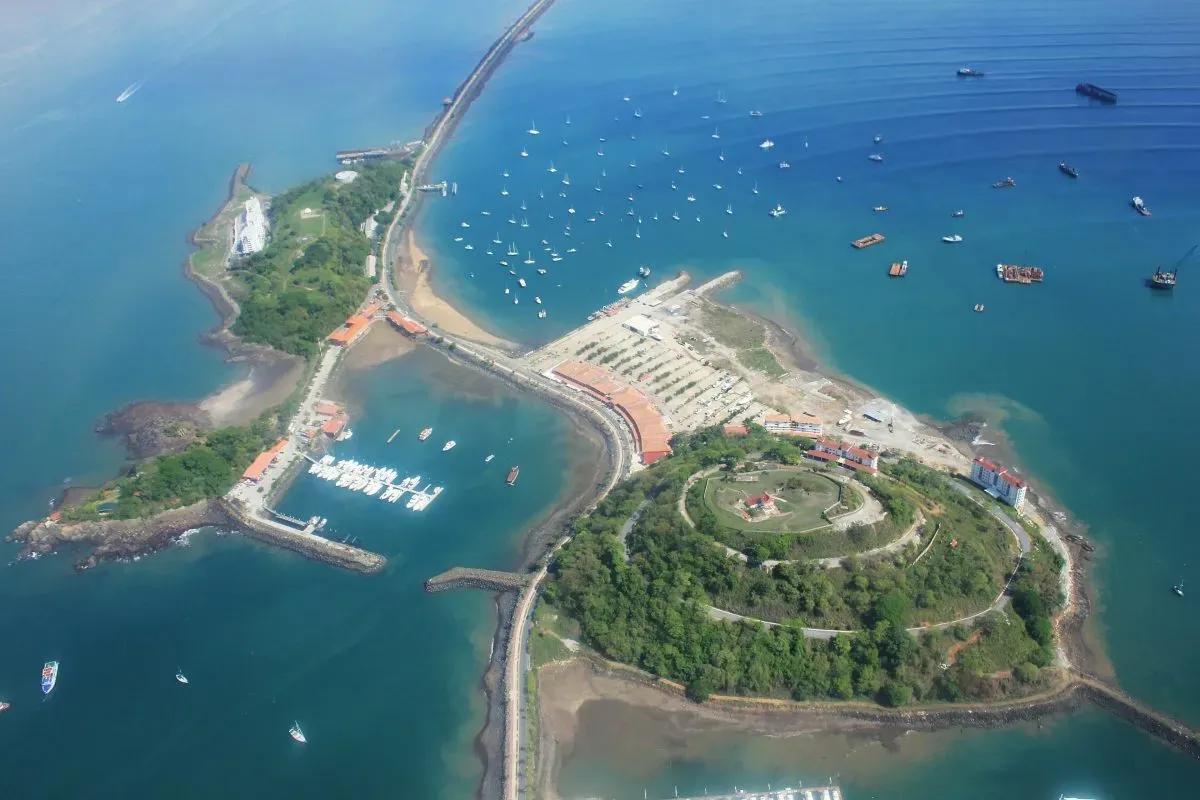
The chaos on Naos Island can no longer hide behind tourist renderings. Luxury promises made for a development at the Panama Canal entrance have given way to an abandoned airplane, court-ordered seizures and multimillion-dollar disputes.
Naos is not an airport. It has no runway, hangars or aircraft maintenance facilities. Yet a passenger plane sat parked on the island for nearly six years. The aircraft was supposedly destined for a themed restaurant. That project never materialized.
The plane became another symbol of the lawlessness that prevails along the Amador Causeway. Naos is the first island connected to the mainland via the causeway, adjacent to Punta Culebra. Its story mirrors those of Perico and Flamenco islands. The pattern is familiar: construction without permits, judicial disputes and unfinished projects.
But one thing sets Naos apart. Several apartments built here are now under state control.
A Concession Lost and a New Developer Takes Over
The original contract was awarded on March 8, 2002. It was ratified on July 4 of that year. The Naos Island development concession went to Naos Island Development Inc. The plan called for a five-star hotel, time-share apartments, a casino, nightclub, shopping center, convention halls and other recreational facilities spread across 5.2 hectares.
Naos Harbour Island is the only residential complex built facing the Pacific entrance of the Panama Canal within a state concession in Amador. The company’s directors included Jose Edmond Esses as president, Mike Btesh as treasurer and Ovadia Shrem as secretary.
That company lost the concession in 2004. Naos Harbour Island Inc. took over. Marco Shrem Gatena now serves as president, treasurer and secretary. Catherine Shrem Kotovieh and Lorena Hurtada de Castillo are directors.
In 2008, the Cabinet Council approved a second addendum to the 2002 contract. It extended construction deadlines, modified financial obligations and added elements like a breakwater. But differences emerged with the Panama Maritime Authority over the scope of those permits.
Construction of landfills, buildings and modifications to the original design moved forward anyway.
Controller Blocks Addendum Over Negative Advantages for the State
In 2009, then-Controller Carlos Vallarino denied the endorsement for the second addendum. He determined it granted “negative advantages” for the state. The Controller’s Office warned that Naos Harbour maintained arrears exceeding $1.4 million. The company had also failed to meet the agreed investment amount, calculated at more than $32 million.
“The addendum presented clear disadvantages for the State’s interests,” Vallarino said at the time. [Translated from Spanish]
The Money Trail Leads to a State Bank Loan
In March 2011, during the government of Ricardo Martinelli, Marco Shrem Gatena struck a deal. He worked with Gabriel “Gaby” Btesh to manage an interim line of credit for construction. They also arranged a short-term commercial loan with Caja de Ahorros, a state bank.
Just 18 days earlier, Ailedsabel Gonzalez had joined the company as treasurer. Gonzalez is a lawyer very close to Btesh and his businesses. She held that position until 2018.
When contacted, Shrem confirmed that Btesh participated in the project between 2011 and 2015. Shrem claimed he suffered “personal problems” and “political persecution” during the administration of Juan Carlos Varela from 2014 to 2019. He insists Btesh was not the intermediary to obtain the credit line with Caja de Ahorros, though he acknowledged Btesh “was a joint guarantor at one point for the bank loan.”
Shrem said the debt was “completely canceled.”
Court Orders Seizure of 79 Apartments
But documents and testimony obtained by this outlet tell a different story. The company accumulated a debt of approximately $25 million with Caja de Ahorros. That situation led to payment-in-kind agreements. The company delivered apartments built in Naos as part of the tourism project.
A seizure order was issued for 79 of the 136 properties. Those units remain under the control of the Administrative Unit of Reverted Assets, the entity that replaced the old Interoceanic Region Authority. Caja de Ahorros kept 17 apartments as part of financial agreements related to the project’s accumulated debts.
The third tower of the project remains unfinished. It shows cracks and deterioration after years of delays in executing the concession.
Shrem claims the original debt with Caja de Ahorros amounted to about $31 million. He says it was settled through payments, property deliveries and payment-in-kind agreements. He insists the seizure was lifted in 2024. But apartments remain under administration by the state bank.
The abandoned airplane, the seized properties and the unfinished tower all tell the same story. What was supposed to be a luxury development at the entrance to one of the world’s most important waterways has become a symbol of broken promises and regulatory failure.